
Building a new way

Chris Jimmerson
November 30, 2014

December first is World AIDS Day. As the world pauses each year to remember the losses and recommit to the struggle against HIV, it’s important to also remember what community responses to HIV can teach us about working for social change.


I have always been kind of a science and technology nerd. Knowing that, it may not surprise you to hear that many, many years ago, I found myself so excited to test out my new handheld digital organizer that you could plug this accessory into and turn it into a cell phone and wireless internet enabled device. It was sort of a prehistoric precursor to today’s smart phones. The whole thing assembled together was about the size of my head. I dutifully entered the contact information for my friends and coworkers from out of the paper address book I had previously been using.

In those days, I had been working for several years in HIV / AIDS research, treatment and advocacy. In those days, we only had a few approved treatments for the disease, and they didn’t work very well.

Fast-forward about five years, and thanks to the efforts of lots and lots of people, we were beginning to have drug combinations that were working and were keeping people alive.

I was synching my contacts onto a new device, by this point, an early actual smartphone, called a Treo, and I realized there were a bunch of them I needed to remove because the people they represented were no longer alive.

I deleted 37 names that day. Thirty-seven friends and coworkers for whom 5 years had been too long to wait – for whom the new drugs hadn’t come soon enough. Only one of them had been over 40 years old when he died.

In the years since, every so often I have looked back on that time and wondered how people in HIV -related work kept going. Amongst all the sickness and death, how did we sustain the fight and stay in the struggle, when at times it seemed it might never end, never get better?

Ultimately, I think it was because, even in the midst of all the dying, we chose life. We tried our best not to withdraw, not to look away from the suffering, not to sanitize the messiness or anesthetize the pain because to do so would not be living – not really, not fully.

We stayed in the struggle and let ourselves experience and remember the losses, even as they accumulated, because it was the only way to keep fully living; to keep the ability to love without limits; to wholly experience joy; to keep being able to see beauty.

Tomorrow is Word AIDS Day, a day when we are asked to stop and remember. We pause to recognize the real and often unspoken heroes who have stayed in the struggle and helped bring about vast improvements in our ability to prevent HIV infection and to offer treatment to those who are infected. We recommit to the ongoing, worldwide struggle against a disease that still affects far too many.

This morning I think, also, it is a moment to look back on those difficult earlier times of which I just spoke because they may contain lessons that can inform how we fulfill our mission, especially that part of it that compels us to do justice – to work for social change in so many different areas – certainly, given the events of the past week, to work against systemic racism and structural oppression.

Let us begin then by taking a moment now to pause and remember – a time of silent reflection – a time of meditation or prayer if you wish – or simply to focus on your breathing, as we join together in the silence.

___________________

Today, there are an estimated 35 million people living with HIV worldwide and 2.1 million new infections every year. And while we now have the ability to manage the disease and keep HIV -infected people healthy, there are still tens of millions of people worldwide without access to these life-saving treatments, and far too many we have not reached with HIV prevention education. Here in,Texas, the rate of new infections among young gay and bisexual men has more than doubled in recent years, due at least partially, I think, to a reduction in prevention messages resulting from our current political climate.

I think it is important always to remember though, that behind all of those statistics are actual, individual human lives. One of the lessons we learned in the early days of the struggle against HIV is the power of telling and remembering stories from those lives. Storytelling is an essential element of any social change effort. It is a powerful way to raise consciousness, especially in the face of ingrained prejudice and systemic oppression.

So I would like to share with you briefly part of the story of just a couple of those 37 folks I mentioned earlier.

Raul was a friend and co-worker who had moved to Houston from Puerto Rico as a young adult. He was a wiz at all things computer related; a relative rarity in the days when having a computer on every desk was still a fairly new part of office life.

I had hired Raul to work with me on maintaining the human ethics documentation the government required of us for the HIV -treatment studies we were conducting at a non-profit organization in Houston.

Raul was also a DJ, so in his off time, he was working with a vocal coach and English-language instructor because he wanted to be better understood when he got gigs as a DJ. A few blocks away from where Raul and I shared an office, we had a clinical space where our research nurses and volunteer physicians actually saw the people participating in the research studies. Our head research nurse’s name was James.

How shall I describe James for you?

James was in his early 30s. He somehow managed to get his hair to stand up to about here and then fold it back in a kind of semi tidal wave. He wore a ring on every finger of his right hand and had been known to show up for work in a full-length fur coat, even when it really wasn’t very cold out. James could be, oh, how can I say it nicely … flighty.

He was also the best research nurse we ever had, and our patients loved him.

One day, we had just gotten James a computer and printer for his office, and he was trying to get them set up. Raul and I were working on some particularly difficult and detailed ethics paperwork. Every few minutes, the phone would ring, and it would be James calling because he couldn’t get his printer to work. This went on for a good half of the day, until I finally asked Raul to go over and help James get the printer going.

A few minutes later, James called again, about something else this time, and as we were was talking, in the background, suddenly, I heard Raul say in perfect English, “You silly queen. You have to plug it in.”

This elicited a giggle from James who went on to acknowledge that indeed the printer did work much better when connected to a source of electricity.

Six months later, Raul started getting sick.

He fought until the very end. Even after he had been placed in a hospice, he never really accepted that he was dying. I guess very few 27 year olds would.

A couple of years later, James was gone too.

These are difficult and painful stories, and yet they are a part of much larger narrative – a story that while encompassing great loss and sorrow also reveals a defiant sense of hope among a growing community of people who refused to allow disease, discrimination and irrational fear to triumph – refused to accept the notion that it was somehow our own fault for being who we were – refused to accept that our lives didn’t matter. That people of color have had to raise their voices once again and proclaim very similar sentiments over the last weeks has seemed so eerily familiar.

Raul and James were a part of a community of folks who came together to struggle against what at the time seemed to be almost impossible odds. In those early days of the epidemic, it was primarily what we called the gay community – but it was broader than just the gay men being so devastated by the disease. I will always be go grateful to the gay women who joined in the fight and took care of their ailing brothers, even when they themselves were at relatively low risk for the disease. Likewise, I will always be grateful to the folks who were not gay but who joined in this community of hope and struggle out of compassion and a sense that we are all in this together, even though they risked being ostracized themselves when they did. In Houston, it was a bunch of folks from the Unitarian Universalist church who often volunteered with us at the research clinic. I remember one young woman was actually let go from her job because she did. It may seem hard to believe now, but then I just look at the hysteria and prejudice surrounding just a few Ebola cases in the U.S., and, again, it all seems so eerily familiar.

Recent scholarship on how successful social movements occur asserts that creating real social change requires us to do at least three things:

1. Provide services and support to help those harmed by social problems until the change can be made.

2. Raise our prophetic voices – speak truth to power and dismantle oppressive structures and institutions.

3. Realize that those first two things are necessary but not sufficient. That to bring about real and lasting change we have to build new institutions and social policies to replace those we have critiqued.

And we have to do all of this at all levels, from local community organizing to building powerful institutions at the national and worldwide level.

As we have seen in Ferguson, Missouri, and indeed across our nation in the past weeks, sometimes the very institutions meant to provide justice, to protect and serve, have themselves been permeated with racism and injustice, so we have to envision new institutional forms and policies. We have to build a new way.

That early community that joined together in the struggle against HIV disease did exactly that.

When the government was not providing adequate HIV prevention messages, they created them.

When there were far too few clinics for HIV testing, counseling and treatment, they built them. When the existing research institutions were too slow to test promising new therapies and get them to folks who had run out of treatment options, they created community-based research organizations.

When the disease spread to new populations, they were the first to adapt and to invite new people into leadership.

When there was no voice in the halls of power in Washington DC for those suffering from the disease, they stormed the barricades and built institutions with real political power. They built new ways, and I think that this idea of creating institutions, building new ways that may not yet exist, can inform how we do justice regarding a variety of social challenges, whether it is dismantling systemic racism or our struggle to save a severely threatened environment.

So let us now dwell for a moment in the spirit of this idea by rising in body or spirit and singing together hmn number 1017 in the teal hymnal, “Building a New Way”.

________________________

During the first Bush presidency, a group of us had gone to Washington DC to participate in a March on the Capital to demand greater support for HIV prevention, treatment and research. On the day before the march, we went to see a display of the AIDS Memorial Quilt, which had been laid out on the National Mall across from the capital. The quilt was built of rectangular panels sewn by the loved ones of persons who had died of AIDS. Often, they had sewn in photos and used fabric from something their loved one had worn to commemorate them.

The crowd that day was a patchwork of people much like the quilt itself – gay, straight; a variety of nationalities and ethnicities; men and women who had lost partners and spouses; parents who had lost children.

As we walked around the panels, above the noise of our murmured conversations, a group assembled on an outdoor stage that they had put up nearby, and one by one, they stood at a microphone and began reading names – the names of the dead represented by each of the panels of the quilt.

And after only a short moment, a quite fell over the crowd, we became very still, standing in silence and a sense of timelessness until only the sound of the names being read remained.

I did not consider myself religious at the time, but looking back on it now, I can sure understand where a concept like the Holy Spirit may have come from.

It was as if a spirit began moving among us during the reading of those names, and together we somehow all knew, each of us, that we had to keep going. We had to sustain the fight. We had to stay in the struggle until there were no more panels to be sewn – no more names to be read.

No more contacts to be deleted.

And even in our sorrow, maybe even because we were allowing ourselves to fully feel it, there was a beauty we could still see.

Looking back on it now, it was a moment of clarity that informs me even today. To do justice and to make community and nurture the spirit, far from being opposing dualities, these efforts, they need each other. Together, they form spiritual experience. They sustain us and help us stay fully engaged.

And though, as I outlined earlier, there is still much work to be done, people stayed in the struggle against HIV disease, many of them for 30 years now, and they have made huge differences throughout the world, even up against what at one time seemed impossible odds.

They built new ways, and so can we, whether we are doing justice in our world or facing the challenges of our daily lives. Even when the way forward seems long and difficult, as it has for many of us this past week, we must not give in to despair. In fact, these may be the times when it is most vital to:

Stay in the struggle. To live fully. To love without limits. To wholly experience joy. To keep finding ways to see beauty.

I think that is what religious community is for. We help each other live in these ways.

These are the ways that will move us toward creating institutions of compassion and justice. These are the ways through which we nurture our spirits. These are the foundations upon which we build.

Amen.

Benediction

Know that, as you go back out into the world now, there is a love that you carry with you beyond these church walls.

Know that the great mystery of our interconnectedness cultivates seeds of hope for justice and compassion.

Know that nearly boundless possibilities are still ours to create.

Go in peace. Go in love. Go knowing that this beloved community awaits you and holds you until we are together again.


Podcasts of this and other sermons are also available for free on iTunes. You can find them here.

Most sermons delivered at the First UU Church of Austin during the past 14 years are available online through this website. You will find links to them in the right sidebar menu labeled Sermons. The Indexes link leads to tables of all sermons for each year listed by date (newest to oldest) with topic and speaker. Click on the topic to go to a sermon.
 

Gratitude

Rev. Meg Barnhouse
November 23, 2014

The sermon is on gratitude as we recognize the one hundred year legacy of founding member and longtime music director Janet McGaughey.


Call to Worship

“Cultivate the habit of being grateful for every good thing that comes to you, and to give thanks continuously. And because all things have contributed to your advancement, you should include all things in your gratitude.” – Ralph Waldo Emerson

Centering

“And when you crush an apple with your teeth, say to it in your heart:
Your seeds shall live in my body,
And the buds of your tomorrow shall blossom in my heart, And your fragrance shall be my breath,
And together we shall rejoice through all the seasons.”
– Khalil Gibran

Sermon

It’s Thanksgiving and that means family. My family will be getting together this week in NC. Here is what it was like a couple of years ago.

Coming into the front room, I saw knives gleaming on bookcases and coffee tables. Uncle Lindsey had recently returned from Pakistan, where he and my mother had grown up as missionary kids, and he’d brought back a collection of Gurkha weapons. There were kukris of every length, dangerous curved blades whispering of battles long past. My cousin Rebecca’s twelve year old son Thatcher was running out the door to the screen porch brandishing a long Talwar sword, chasing his little sister Park into the back yard. No one seemed overly concerned. Since half the adults there were doctors and the other half were lawyers, I figured that if anything happened we could sort it out, so I set my casserole down on the side board and drifted over to where Lindsey was holding forth on his trip, on the bravery of the Gurkhas, and on the beauty of the Himalayas.

Listening to Uncle Lindsey is like surfing the web with no pop-up control. You will be talking along about the Himalayas, and suddenly he will start talking about Roger Bannister’s four minute mile, or he’ll say something like “Presbyterians are the only denomination that requires their ministers to be educated in Hebrew and Greek,” or “Santa Gertrudis bulls are too large to be pastured in North Carolina.” Still listening, but letting my eyes wander, I looked out the back windows into the yard and saw an enormous Brahma bull being led around the yard by a woman dressed like a rodeo cowgirl. Her blue vest with the silver stars sure was sparkly, but I could not be dazzled by sparkles when right behind her was this two thousand pound animal, speckled gray and white, with a hump on his shoulders and a dewlap flapping from side to side under his neck as he plodded behind her with the expression of a being praying for world peace. I was glad somebody was, with all the knives around. Most of us rode the bull that day, except the very elderly generation. They watched and clapped, though. Even cousin Pooh was tenderly coaxed out of her wheelchair and onto his broad and placid back.

Uncle Henry used to pray before dinner every year, a long prayer that reminded us about the Puritans and the Native Americans, a prayer that named one by one the blessings of this land and this family. Since we were at Rebecca’s house, I had been invited to say the prayer. No one else recognizes that I’m a minister, because they don’t approve of women ministers. My prayer was of gratitude for the land too, for the family, for the love that surrounded us. I invited those present to call the names of those we missed, those who weren’t able to be there or who had died. One person said “Margaret Annie, that was real nice.”

The food and the company were a great pleasure. We told stories of long-ago mischief and the planned some new mischief. One cousin and his wife told about entertaining the devout and extremely dull President of a southern Christian college. They had made the mistake of inviting a couple of the other cousins, and one of those had attempted to liven up the conversation by slipping Amaretto liqueur into his own wife’s after-dinner coffee. Through an unfortunate mix-up, the devout President’s wife was the one who was served the doctored coffee, and throughout the rest of the evening she pestered my cousin’s wife for her recipe. As the two who were in the know shook the sofa with their suppressed giggles, she said, “I finally turned to the woman and held her gaze.” Her hands were on either side of her face, like a horse’s blinders. “I held her gaze so she wouldn’t see them over there on the sofa laughing, and I told her, ‘Well, my secret is: I grind my own beans.'” They bet the lady ran right out to get a coffee grinder, but the taste of that coffee would continue to elude her.

After dinner we all lined up, as always, for flu shots. One of the doctor cousins brings a cooler full of medicine and doses everyone in a back bedroom with the help of his ten-year-old daughter. She’s an expert with the alcohol and cotton swabs. It’s good to get a chance to be brave together after dinner.

Thanksgiving for me is the family. I took my sons to this gathering every year since they were born. I am grateful for the tradition, the talent, the wildness, the faith, character and kindness of these people

Most families can be fun for a couple of hours. For many of us there are moments of being judged, moments of being misunderstood, pressured, evaluated. Maybe there are moments when we want to put out faces down into the sweet potato casserole and just give up. Maybe there are moments when we cross our fingers and pray that Aunt Elise won’t drink so many glasses of sherry that she ends up face down in our potatoes. We wish Uncle Haim would quit joking about our hair and that Aunt Nancy would leave our love life alone.

There are also moments of companionship, of feeling surrounded by love, moments when you share stories, take a nap, receive or give nurturing care, have good conversation. If it is just god-awful every year, then I question why you go. Usually it’s just a matter of building habits of attention that direct your receptors to the good things. Part of how you develop better habits of attention is through spiritual practice.

I am no good at spiritual practice. Even the one I use is easy for me to forget. I think I’m busy with important things, and I can’t be bothered with something so simple a child could do it. Even though studies show it’s good for your physical and mental health. Even though the Jewish scriptures say it will make your heart strong and merry. Even though mystics and psychologists alike praise it. What is my spiritual practice? Gratitude. It’s cheap too, and doesn’t take a lot of equipment or training.

A practice of gratitude starts with habits of attention, which shape your experience of your life. Gratitude begins with a habit of noticing the good things in your life and being grateful for them. You might say “thank you, God, or Higher Power, H.P. or Spirit, or Force, or Universe, or Soul Of All Things. Many of us have a sense of the Divine that is different from the traditional Judeo-Christian descriptions, and for some people, the name “God” is too much attached to the sense of the Divine they are trying to get away from. I read about one person who called her Higher Power “Donna.” It’s okay to explore different ways of thinking about the Higher Power you DO believe in. The Force has many names. Medieval mystic Meister Eckhart says if you only ever said “thank you” as a prayer, it would be a good prayer life.

Cicero, born about a century before Rabbi Jesus, wrote : “Gratitude is not only the greatest of virtues, but the parent of all others,” he said. By the 18th century, the free-market thinker Adam Smith, in his “Theory of Moral Sentiments,” supposed that people who did not feel gratitude were only cheating themselves out of happiness in life. And in the 19th century, Immanuel Kant described ingratitude with “the essence of vileness.”

Br. David Steindl-Rast, an author of many books and articles about gratitude says: “All gratitude expresses trust. Suspicion will not even recognize a gift as gift: who can prove that it isn’t a lure, a bribe, a trap? Gratefulness has the courage to trust and so overcomes fear. ” It takes trust in the bending arc of the Universe to be grateful. Unitarian minister Theodore Parker, in the mid-1800s, said “The arc of the universe bends toward justice.” Can we trust the universe? Is everything going to be okay in some way? Gratitude seems easier if you are willing to believe that. If we are just all headed to the slaughterhouse, gratitude seems stupid. All belief is a choice, and I choose to go with Parker on the arc of the Universe, and with Julian of Norwich, who said “All will be well, and all will be well, and all manner of things will be well.” Believing a thing just means choosing to act as if it is true. In an experimental way. To see what happens.

In the Jewish scriptures, in the book of Proverbs (17:22) it says “A merry heart does good like a medicine: but a broken spirit dries the bones.” Psychologists are beginning to take gratitude seriously as a field of research. Robert Emmons of the University of California at Davis, says: “Psychology has generally ignored the positive emotions. We tend to study the things that can go wrong in people’s minds but not the things that can go right. Gratitude research is beginning to suggest that feelings of thankfulness have tremendous positive value in helping people cope with daily problems, especially stress, and to achieve a positive sense of the self.” Studies are beginning to indicate that people who describe themselves as feeling grateful to others and either to God or to life in general tend to have higher vitality, more optimism, suffer less stress, and experience fewer episodes of clinical depression than the population as a whole. These results hold even when researchers factor out such things as age, health, and income, equalizing for the fact that the young, the well-to-do, or the hale and hearty might have “more to be grateful for.”

In an experiment with college students, those who kept a “gratitude journal,” a weekly record of things they should feel grateful for, achieved better physical health, were more optimistic, exercised more regularly, and described themselves as happier than a control group of students who kept no journals but had the same overall measures of health, optimism, and exercise when the experiment began. (Researchers use frequency of exercise as a barometer for general well-being because it is an objective measure that links to subjective qualities; people who exercise three or more times per week tend to have better indicators of well-being). Psychologist Dan McAdams of Northwestern University, whose specialty is well-being research, says he recently became interested in gratitude when he saw studies suggesting that increasing a person’s sense of thankfulness could lead to lower stress and better life “outcomes,” meaning success in career and relationships. Gratitude isn’t even listed in the 1999 addition of the presumably encyclopedic “Encyclopedia of Human Emotions,” a standard psychology text. “But if a sense of thankfulness can turn someone’s life from bitter to positive,” McAdams notes, “that makes gratitude an important aspect of psychology.”

Gratitude keeps you in the present moment — it clears your mind of the wishing, wanting, worrying, regretting and story telling about why we are this way or why someone else did what they did. You are freer to move, to change, to be guided as to what your next step might be. I do think that trying to change things you cannot change is a sure way to lose your mind. It’s a textbook way to stay exhausted. It is a textbook way to stay dissatisfied. Exhaustion and dissatisfaction are two indicators of soul sickness. Sometimes, around the Holidays, your soul just gets tired. You feel irritable and tense, nothing looks fun, you can’t think. When your soul is getting sick, it’s time to dust off your spiritual practice. Not that you dust it off only when you are sliding into a sink full of the dirty mop water of despair, but that’s as good a time as any.


Podcasts of this and other sermons are also available for free on iTunes. You can find them here.

Most sermons delivered at the First UU Church of Austin during the past 14 years are available online through this website. You will find links to them in the right sidebar menu labeled Sermons. The Indexes link leads to tables of all sermons for each year listed by date (newest to oldest) with topic and speaker. Click on the topic to go to a sermon.


December 14, 2014 Congregational Meeting

This is your official notice for our regularly scheduled Congregational Meeting on Sunday, December 14, 2014, 1:15pm – 2:30pm in the Sanctuary.

The agenda, proposed 2015 budget and other meeting materials are available in the copy room at the church and by clicking on the link below:

12-14-2014 Congregational Meeting Packet

We have also posted the voting list in the copy room at the church. Please check the list and let Chris Jimmerson know if you have any questions or believe you have incorrectly been omitted from the list. Chris may be reached at chris.jimmerson@austinuu.org and (512) 452-6168.

The church bylaws specify the following regarding voting eligibility: “Individuals who have been members of the church for 30 days or more and who have (as an individual or part of a family unit) made a recorded financial contribution during the last 12 months and at least 30 days prior to the meeting, have the right to vote at all official church meetings.”

We will be providing childcare during the meeting. Please RSVP to childcare@austinuu.org.

Also, Dec. 14 will be the only day that you can vote and rank order your ten favorite social justice nonprofits to receive MSO donations in 2015. Come to the congregational meeting, or to the gallery at the Social Action table after either worship service to make your vote.

We look forward to seeing you at the meeting!

November 23, 2014 Pre-Congregational Meeting

Please join us for the pre-congregational meeting on Sunday November 23 at 1:15 p.m in the sanctuary. Childcare will be available. We will discuss the proposed agenda and materials to be actually voted upon at the formal congregational meeting to be held on December 14, 2014 at 1 p.m, including the proposed 2015 church budget.

Materials for the meeting are available in the copy room at the church or by clicking on the link below:

Pre-Congregational Meeting Packet

In addition, the Monthly Service Offering nomination forms for 2015 will be available at this meeting.

The problem of evil

Rev. Meg Barnhouse
November 16, 2014

Why bad things happen to good people is a basic question for humanity, no matter what your view of the world.


My first angry questions about the bad things in the world were related to my parents’ marriage. I remember at 10 or 11 being angry at God because they were not getting along. I walked ahead of them down a sidewalk in Mexico City, my teeth gritted, crying, and asking “Why, WHY can’t they be happy together?”

The most recent sorrows have been the suffering of people in Syria, Israel Africa. Closer to home, there is cancer in a child, cancer in grown-ups, and car accidents, The question of why bad things happen has occupied my mind for about fifty years then, and I’m not even close to the answer. I hope you weren’t thinking we might have it.

We talked a lot in my family about war and starvation, we talked about the cruelty of people around the world. My father was in the news business; he heard it all. He says he used to stand by the AP ticker and cry.

I’m not alone in not having the answer. This question has been debated for at least 20,000 years. We know this from excavations in the Indus Valley which uncovered fragments of Hindu scriptures. The Hindus among us say that evil is a part of God. Shiva is the creator and the destroyer. Kali-Ma creates by destroying. There are demons, but they roar and devour on assignment from the gods. All destruction isn’t had, after all. Any gardener pulling up leggy, spent plants will tell you that. Destruction makes room for the new.

The Buddhists say evil is illusion. If you can see through the illusion, becoming enlightened, you will be free. Bad things happen because people are attached to their picture of how things should be, to the outcomes of certain actions. We desire security, health, good relationships, admiration, long and happy lives for ourselves and our children. Since we are attached to those things through desire, we make ourselves unhappy when they don’t happen the way we want them to. If we could let go of desire we would suffer no longer. If only we could just enjoy our health, our families, our eyesight, our money, our minds as long as they last and let them go with peace in our hearts we would be fine.

One of the oldest books in the Hebrew Scriptures is the book of Job, and the question of why bad things happen to people is what the whole book is about. In that story, Satan is at God’s side, and they are talking like colleagues. “I bet Job wouldn’t be such a fine upstanding servant of yours if he weren’t so healthy and wealthy,” Satan says.

“You go ahead and test that theory,” God says, and Job’s sufferings begin. After he has lost all of his children, all of his possessions and his health, and is sitting on top of an ash heap letting the dogs lick his sores, his three friends come to him and deliver their best religious opinions of why he is suffering.

“Man is born to trouble as the sparks fly upward,” one says.

“God corrects and disciplines his people ….. God wounds but he also bind up. You have to trust. You are not more righteous than God.”

The second friend is shocked at Job’s questioning God.

“God is always just. Your children must have sinned against God. Even now, if you become pure and upright, he will restore you. “

Job says “I have done nothing wrong … but how can a mortal be blameless before God? His is powerful and mighty. How can I argue with him? Then he goes on to argue some more …

The third friend reiterates the argument that Job must have done something wrong. Even if he didn’t before now, these rude questions and arguments are bad enough to deserve all the punishment in the world. “

Job still stubbornly says. “God is wise and powerful, and he is God. I want to talk to God himself about this.” So God comes down.

Jung says it’s because God knew that God had done wrong. (In fact Jung talks about the death of Christ as God’s answer to Job.)

Here is the answer God gives in the book of Job. I am God. Who are you? I don’t owe you anything. Then Job repents. God tells the friends that they have not spoken correctly about him as Job has, he makes them repent too. Then he restores all Jobs property and gives him more children. Seven sons and three daughters, to whom he grants and inheritance along with their brothers. We find beauty and sophistication in the arguments of this ancient text. But not an answer.

Is God responsible for evil? Did he create it? Those who say “yes” to that are the ones who believe, if God is Omnipotent, that He is in control of everything. He must therefore be “allowing” evil. The question, for those who want to believe that God is both all-loving and all powerful is best put by Archibald McLeish in his play about Job called “J.B.” He writes “If God is good, he is not God. If God is God, he is not good.”

There are those in the three religions of the Book, Judaism, Christianity, and Islam, who say evil is a result of the Fall, which is what they call the story of Eve and Adam in the Garden of Eden, choosing consciousness, choosing the knowledge of good and evil. All pain, all cruelty, all war and pestilence came into being after the Garden.

There are those who believe that all evil is a result of free will. We suffer because we decided to marry the wrong person or didn’t have the skills or the knowledge to work a relationship out, or we were too stubborn or too prideful, etc. People die in floods and earthquakes because greedy or lazy developers continue to build along fault lines or on flood plains. We get cancer because we eat food that’s processed with chemicals or have to breathe air that companies have polluted or because we live too stressful a life. Children are molested because their molesters were molested.

People make bad choices with their free will. Progressives are rooted in the Romantic Era’s philosophy that children are born a blank slate, and that if they have the right nurture they will grow into good people. People would make better choices if they had peace in their homes and neighborhoods, if they had good schools and consistent parenting. So we work to make those things better in order to decrease the suffering in the world. The UU thinking is that we are good in our nature, but capable of doing evil. The Humanist Manifesto of 1933, which was extremely influential in Unitarian thought, asserts that our living conditions and training have a big effect on our ability and tendency to choose good. If we can make these conditions better for people we will see more people choosing to do good.

There are those who say a lot of evil comes from “Natural Law.” Nature doesn’t take our hearts into account at all. If you are a living organism and you stay outside in sub-zero temperatures, you will freeze. Natural Law. If a woman decides to hit someone over the head with a two-by-four, it’s not the wood’s fault. It is, in fact, the wood’s job to be hard and unyielding. Natural law says if one hard unyielding object hits another one, the softer one will get a dent in it. We count on that law on a day to day basis, as we mash potatoes and cut paper. Our world would be chaos if wood were hard when you want to build with it and soft when you try to hit with it. If cars were strong when you load them down with your family and their luggage, but soft when they run into someone on a bicycle.

Nature makes a lot of organisms that are not viable. Other organisms break down and die. Nature doesn’t discriminate. Some of these organisms are microscopic. Others are us or our children. We use our free will to deal with what comes with as much grace, love, and compassion as we can muster. For some people this makes sense, but they feel the loss of a God who can protect and defend us and our children against the heartlessness of Nature.

The force that through the green fuse drives the flower drives my green age, that blasts the roots of trees is my destroyer. And I am dumb to tell the crooken rose, my youth is bent by that same wintry fever.
Dylan Thomas.

Is most of what we call evil simply an interaction between human free will used badly and natural law, or are there people (or dogs and cats, for that matter) who are just born bad?

Is there a force of evil that exists outside of us, beyond us? For people who believe in a personification of evil, in a devil, explanations are simpler, and the big picture has a drama and a story line that satisfy. Even if you just believe in some kind of an energy or force of evil, it helps explain a lot. As in most matters of belief, you end up choosing what you believe and acting as if it’s true. Those among us less comfortable with belief in the spiritual realms would say what choices made in the context of cultural and societal influences. Those among us comfortable with beliefs in spiritual unseen forces believe that there is an energy that wants to tear life down.

For us, the decision to be on the side of that which builds up, that which heals, to be on the side of love is our spiritual path. When terrible things happen, we lean on one another for strength and comfort. It is my belief that loving actions leave an energy behind that never fades. Loving actions since the beginning of life on earth are added to this stream of energy, and that is what I mean if I say the word “God,” By loving, by standing with one another in suffering, we actually build God. This is the Spirit of Love that flows in and through us if we allow it, urging us in good times and in terrible times, to choose love.


Podcasts of this and other sermons are also available for free on iTunes. You can find them here.

Most sermons delivered at the First UU Church of Austin during the past 14 years are available online through this website. You will find links to them in the right sidebar menu labeled Sermons. The Indexes link leads to tables of all sermons for each year listed by date (newest to oldest) with topic and speaker. Click on the topic to go to a sermon.


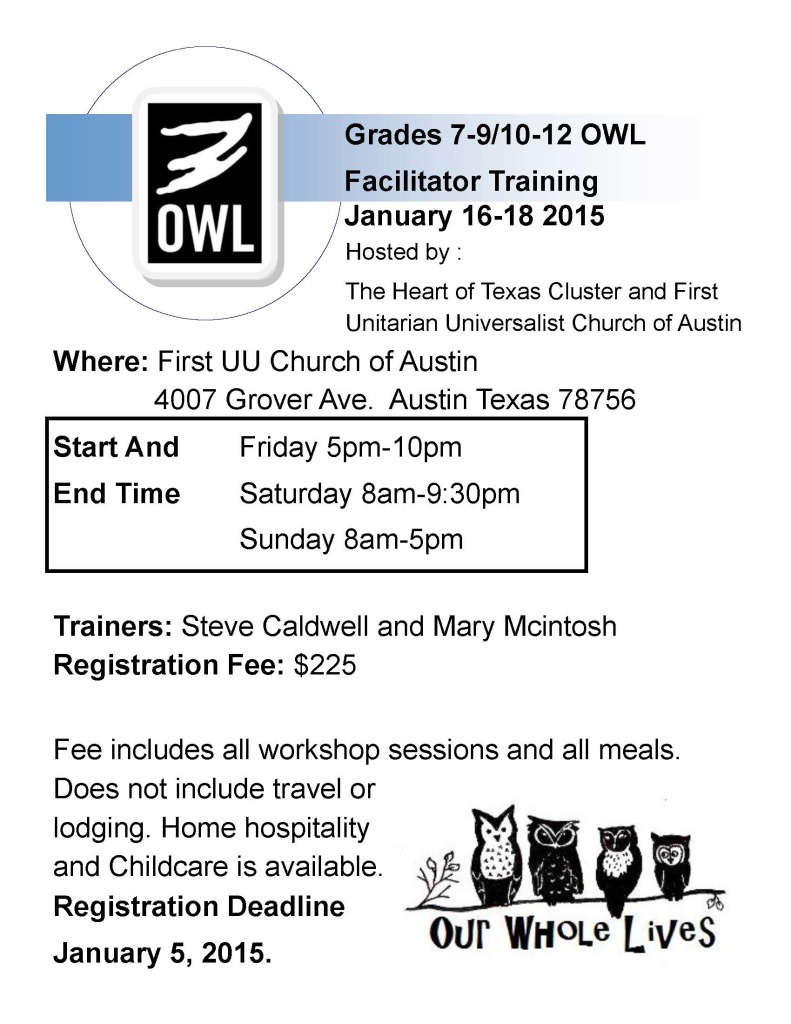
Southern Region “Our Whole Lives” training coming soon!

Our Whole Lives helps participants make informed and responsible decisions about their sexual health and behavior. It equips participants with accurate, age-appropriate information in six subject areas: human development, relationships, personal skills, sexual behavior, sexual health, and society and culture. Grounded in a holistic view of sexuality, Our Whole Lives not only provides facts about anatomy and human development, but also helps participants clarify their values, build interpersonal skills, and understand the spiritual, emotional, and social aspects of sexuality. Click here to register: http://fd8.formdesk.com/UUASR/austinowl

Click the image below for a PDF version of this flyer.

Owl Save the Date

Keep the home fires burning

Rev. Meg Barnhouse
November 9, 2014

This year marks the 100th anniversary of World War I. How did it change our world? How might we hold in our hearts some of its lessons?


In the early 1900’s, technology was changing the world in Europe and Russia. People became more ready to think about doing things other than what they’d been “born” to do. Electricity was more widespread. The automobile enabled more travel. The strictures began to lift.

One peasant was able to travel from the countryside to St. Petersburg to see the Tsar. He wrote about his disappointment after coming face to face with the man. The Tsar in my mind was the container of wisdom, the glory and the history of Russia. What I saw, he said, was an ordinary little fellow on ordinary legs. It was as if he suddenly realized that ordinary people were running things.

All of the heads of state were cousins, related to Queen Victoria. Nickolas, the Tsar of Russia was related, as was his wife Alexandra. Kaiser Wilhelm of Germany was her grandson. He used to visit her in the summers, admiring the ships that ruled the seas and vowing to himself to have a navy as grand as his grandmother’s when he grew up. He was ashamed of his left arm, which did not work, and which he was shamed for as a child. The German culture prized physical perfection, and he had been injured by the forceps at his birth.

Germany was newly a nation, wanting to be part of the colonizer group like France, Great Britain and Holland.

Germans were convinced of the superiority of their culture. Socialists wanted change. The Kaiser was riding around in cars. wearing a cavalry uniform. Everyone was reading Nietzsche. The cities were the great melting pot, and in order for revolution to come, they reasoned, the cities had to explode.

The people of Europe were doing better than they had been. It is not when the people are at their lowest that revolution happens. It is when things start to get a little better that revolution happens. The structures of class had seemed set in stone. The way things had always been were in a terrible tension with what was coming into being. Artists had visions of a looming storm. Something felt clogged that had to be freed. If that meant war, some said, so be it.

“A war with Austria would be a splendid little thing for the revolution.” Lenin

Anarchists were people who wanted change, but did not believe that working within the systems that existed would be possible. They had no power in those systems. When people feel powerless is when they start breaking things. Emma Goldman, in the US, was advocating civil disobedience and planning an assassination to send a message to the way things were. In the Austro-Hungarian Empire, in Serbia, a man named Gavrilo Principe had been rejected by the Serbian army for being to small.

“Wherever I go people think I’m a weakling. Even though I’m not.” In the Serbian Army some officers who believed they needed regime change. The old ruler was on his way out and the Archduke Ferdinand was going to take the throne. He had already had his portrait painted wearing the Emperor’s medals. These officers, who called themselves The black Hand, stirred up a few of the Anarchists. Told them the route the procession would take, supplied them with pistols. Security got wind of something threatening changed the route. The driver took a wrong turn and drove the Arch Duke and his wife to face the assassin.

“By far the cleverest thing I ever did in my life was to marry my Sophie. She is everything for me: my wife, my doctor, my advisor – in a word my whole happiness… And then our children! They are my whole pride and joy. I sit with them all day long in amazement that I can love them so much. And then the evenings at home when I smoke my cigar and read my papers. Sophie knits and the children tumble about, knocking everything of! the tables. It’s all so cozy and precious…”

Smashing Serbia became the manly thing to do. Appearing strong in the moment of crisis. It’s a test of character rather than of national interest.

Instead of a small war with Serbia they got all the allies.

When he realized that he was now going to be at war with Great Britain, France and Russia he tried to back away. The general head of the military said we’re going to war.

A well loved leader named Jean Jaures tried to stop it. “What will the future be like, when the billions now thrown away in preparation for war are spent on useful things to increase the well-being of people, on the construction of decent houses for workers, on improving transportation, on reclaiming the land? The fever of imperialism has become a sickness. It is the disease of a badly run society which does not know how to use its energies at home.”
— Jean Jaures

This eloquent antiwar orator was assassinated before the war started.

Honor had to be satisfied. Serbia must be punished. People demanded it. It was embarrassing to do nothing. It looked weak. Unmanly. Diplomacy was for sissies and weaklings. Kaiser William would Strike, helping the Austrians punish the Serbs, and get it over with.

“We’ll have Paris for lunch, St Petersburg for dinner” However. alliances had been formed. Treaties had been signed. Too late they all realized that, if they struck Serbia, the Russians would come defend them. And the French. And the British. Kaiser Wilhelm tried to walk it back, along with his cousin Nicholis, Tsar of Russia, but the military folks were dead set on war. He couldn’t stop them without looking foolish.

No one could fathom the gruesome brutality of this war. The Irish and Russian boys thought their bravery and panache would see them through. Apparently their commanders did too, as some soldiers were sent into battle without rifles. The helmets, for the first two years of the war, were leather covered in cloth to protect the leather from mud splatter. It’s two years later when, horrified by all the head injuries, they started issuing soldiers steel helmets.

Both sides dug trenches, some dug whole underground complexes, to protect the soldiers. Both sides lobbed bombs over. Flamethrowers. Poisoned gas. Sometimes there were raiding parties sent over the walls, and boys were slaughtered this way. You can think of giving your life for your country, but a boy’s war hero dreams don’t usually include giving up a leg or an arm, the nose on your face or your eyes and lungs.

Anthem for Doomed Youth
by Wilfred owen

What passing-bells for these who die as cattle?
Only the monstrous anger of the guns.
Only the stuttering rifles’ rapid rattle
Can patter out their hasty orisons.
N a mockeries now for them; no prayers nor bells;
Nor any voice of mourning save the choirs,
The shrill, demented choirs of wailing shells;
And bugles calling for them from sad shires.
What candles may be held to speed them all?
Not in the hands of boys, but in their eyes
Shall shine the holy glimmers of good-byes.
The pallor of girls’ brows shall be their pall;
Their flowers the tenderness of patient minds,
And each slow dusk a drawing-down of blinds.

Dulce et Decorum est(1)
by Wilfred Owen

Bent double. like old beggars under sacks,
Knock-kneed. coughing like hags, we cursed through sludge,
Till on the haunting flares we turned out backs,
And towards our distant rest began to trudge.
Men marched asleep. many had lost their boots,
But limped on. blood-shod. All went lame, all blind;
Drunk with fatigue; deaf even to the hoots
Of gas-shells dropping softly behind.

Gas! GAS! Quick, boys!–An ecstasy of fumbling
Fitting the clumsy helmets just in time,
But someone still was yelling out and stumbling
And flound’ring like a man in fire or lime.–
Dim through the misty panes and thick green light,
As under a green sea, I saw him drowning.

In all my dreams before my helpless sight
He plunges at me, guttering, choking, drowning.

If in some smothering dreams, you too could pace
Behind the wagon that we flung him in,
And watch the white eyes writhing in his face,
His hanging face, like a devil’s sick of sin,
If you could hear, at every jolt, the blood
Come gargling from the froth-corrupted lungs
Bitter as the cud
Of vile, incurable sores on innocent tongues,–
My friend, you would not tell with such high zest
To children ardent for some desperate glory,
The old Lie: Dulce et decorum est
Pro patria mori.

Nine million people died. It was good for the economy. For some, the war was the best part of their lives. Companionship. Bonding.

People grieved their loved ones. Began being interested in spiritualism. Communicating with the dead. Arthur Conan Doyle one of the leaders of Spiritualism. Lost his son Kingsley in the war. People searching for answers to why. “It is almost incomprehensible to me’, Kathe Kollwitz wrote, ‘what degrees of endurance people can manifest. In days to come people will hardly understand this age. What a difference between now and 1914… People have been transformed so that they have this capacity for endurance…

Worst of all is that every war already carries within the war which will answer it. Every war is answered by a new war, until everything, everything is smashed.’

It is nothing but the inevitable, logical center of the whole system of the Covenant of the League of Nations, and I stand for it absolutely. If it should ever in any important respect be impaired, I would feel like asking the Secretary of War to get the boys who went across the water to fight,… and I would stand up before them and say, Boys, I told you before you went across the seas that this was a war against wars, and I did my best to fulfill the promise, but I am obliged to come to you in mortification and shame and say I have not been able to fulfill the promise. You are betrayed. You have fought for something that you did not get.

Woodrow Wilson

Does It Matter?
by Siegfried Sassoon

Does it matter?-losing your legs?
For people will always be kind,
And you need not show that you mind
When others come in after hunting
To gobble their muffins and eggs.
Does it matter?-losing your sight?
There’s such splendid work for the blind;
And people will always be kind,
As you sit on the terrace remembering
And turning your face to the light.
Do they matter-those dreams in the pit?
You can drink and forget and be glad,
And people won’t say that you’re mad;
For they know that you’ve fought for your country,
And no one will worry a bit.


Podcasts of this and other sermons are also available for free on iTunes. You can find them here.

Most sermons delivered at the First UU Church of Austin during the past 14 years are available online through this website. You will find links to them in the right sidebar menu labeled Sermons. The Indexes link leads to tables of all sermons for each year listed by date (newest to oldest) with topic and speaker. Click on the topic to go to a sermon.

The Ancestors’ Ways

Rev. Meg Barnhouse
November 2, 2014

How do we honor those who came before us? How do we keep the stories as true as we can, cherishing the things they did that were right and acknowledging, then forgiving the things they did that were wrong? How do we claim where we came from and still understand our power to choose who we are now?


Text of this sermon is not yet available. Click the play button to listen.

Podcasts of this and other sermons are also available for free on iTunes. You can find them here.

Most sermons delivered at the First UU Church of Austin during the past 14 years are available online through this website. You will find links to them in the right sidebar menu labeled Sermons. The Indexes link leads to tables of all sermons for each year listed by date (newest to oldest) with topic and speaker. Click on the topic to go to a sermon.