
Flower Communion

Rev. Marisol Caballero
May 29, 2016
First UU Church of Austin
4700 Grover Ave., Austin, TX 78756
www.austinuu.org

We bring flowers to church for this UU tradition of resilience, renewal, and celebration of our individual gifts that create the bouquet of this church community. An all-ages intergenerational worship service.


Call to Worship
By Thomas Rhodes

We come in a variety of colors, shapes, and sizes.
Some of us grow in bunches.
Some of us grow alone.
Some of us are cupped inward,
And some of us spread ourselves out wide.
Some of us are old and dried and tougher than we appear.
Some of us are still in bud.
Some of us grow low to the ground,
And some of us stretch toward the sun.
Some of us feel like weeds, sometimes.
Some of us carry seeds, sometimes.
Some of us are prickly, sometimes.
Some of us smell.
And all of us are beautiful.
What a bouquet of people we are!

Reading:

Today we listened to the story of “Ferdinand, the Bull”, about a bull who loved flowers. It was written by Munro Leaf. Here’s some interesting history about the book. According to wikipedia, “The book was released nine months before the outbreak of the Spanish Civil War, and was seen by many supporters of Francisco Franco as a pacifist book. It was banned in many countries, including in Spain. In Nazi Germany, Adolf Hitler ordered the book burned, while Joseph Stalin, the leader of the Soviet Union, granted it privileged status as the only non-communist children’s book allowed in Poland. India’s leader Mahatma Gandhi called it his favorite book.”

It’s only fitting that this book is being read today, the day before Memorial Day, when we remember, honor, and mourn all those members of our human family that war has taken from us. We know that the best way to honor the fallen soldier is to help heal the spiritually and bodily wounded and to work for a peace. This is our 6th Principle and our duty as fellow humans whose hearts still beat. So, today, hug a veteran. But instead of saying the all-too-common, “Thank you for your service,” let’s try something different. Let’s say, “I won’t forget you or your friends. I’ll do everything I can to bring peace to our world,” and, “Here’s a flower for you.”

Introduction to Flower Communion

The Unitarian Universalist Flower Communion service which we are about to celebrate was originated in 1923 by Rev. Dr. Norbert Capek founder of the modern Unitarian movement in Czechoslovakia. On the last Sunday before the summer recess of the Unitarian church in Prague, all the children and adults participated in this colorful ritual, which gives concrete expression to the humanity-affirming principles of our liberal faith. When the Nazis took control of Prague in 1940, they found Capek’s gospel of the inherent worth and beauty of every human person to be -as Nazi court records show — “… too dangerous to the Reich (for him) to be allowed to live.” Capek was sent to Dachau, where he was killed the next year by Nazis. This gentle man suffered a cruel death, but his message of human hope and decency lives on through his Flower Communion, which is widely celebrated today. It is a noble and meaning-filled ritual we are about to recreate. This service includes the original prayers of Capek to help us remember the principles and dreams for which he died.

Consecration of Flowers
by Norbert Capek

Infinite Spirit of Life, we ask thy blessing on these, thy messengers of fellowship and love. May they remind us, amid diversities of knowledge and of gifts, to be one in desire and affection, and devotion to thy holy will. May they also remind us of the value of comradeship, of doing and sharing alike. May we cherish friendship as one of thy most precious gifts. May we not let awareness of another’s talents discourage us, or sully our relationship, but may we realize that, whatever we can do, great or small, the efforts of all of us are needed to do thy work in this world.

Flower Communion

Flowers were a very important part of the story of Ferdinand. Flowers, in the story were a symbol of love and peace. Unitarian Universalist also use flowers as a symbol of love and peace in this special ceremony called Flower Communion.

It is time now for us to share in the Flower Communion. I ask that as you each in turn approach the communion vase you do so quietly –reverently — with a sense of how important it is for each of us to address our world and one another with gentleness, justice, and love. I ask that you select a flower different from the one you brought that particularly appeals to you. As you take your chosen flower noting its particular shape and beauty please remember to handle it carefully. It is a gift that someone else has brought to you. It represents that person’s unique humanity, and therefore deserves your kindest touch. Let us share quietly in this Unitarian Universalist ritual of oneness and love.


Podcasts of this and other sermons are also available for free on iTunes. You can find them here.

Most sermons delivered at the First UU Church of Austin during the past 16 years are available online through this website. You will find links to them in the right sidebar menu labeled Sermons. The Indexes link leads to tables of all sermons for each year listed by date (newest to oldest) with topic and speaker. Click on the topic to go to a sermon.
 

What’s the difference: Venting vs Lamentation

Rev. Meg Barnhouse
May 22, 2016
First UU Church of Austin
4700 Grover Ave., Austin, TX 78756
www.austinuu.org

“What’s the Difference?” This week we’ll look at the difference between venting vs. lamenting.


Today is the last of our “What’s the Difference?” sermons for this church year. We’re talking about the difference between lamentation and venting. In the Hebrew Scriptures, there is a book of Lamentations. The book consists of five separate poems. In the first (chapter 1), the city sits as a desolate weeping widow overcome with miseries. In Chapter 2 wonders whether the destruction of the city by the Babylonians is because of the sins of the nation. Chapter 3 has in it hope that the chastisement will be for the good of the people. The next chapters go back to wondering about the sins of the people, being sad and distressed that God seemed to have deserted them, questioning whether the punishment was too great for the sin, and hope for the recovery of the people. This exile of the people happened in 586 BCE. Many Jews stayed in Babylon, but others longed for Jerusalem. “By the waters of Babylon, we sat down and wept for thee, Zion. We remember thee, Zion.”

Each chapter is a poem, the first four are acrostics. They have groups of 22 lines, each starting with the next letter of the alphabet.

Lamentations are a form of prayer used in many ancient cultures. They are a crying out on behalf of a community, a cry from the heart and the spirit. There is anguish, self-examination, questioning of the way things work. “Did I cause this? What is my responsibility? Did I do something wrong? Am I supposed to learn a lesson here? What might the lesson be? How did this happen? What are the causes? What could we have done differently?”

Lamentation is rooted theologically: in your relationship to the Universe, to Wisdom, to God. Venting is just letting off steam, right?

Most of us have been taught that Venting is a good way to let off steam, to lance the blister of your anger. If you don’t express it, it turns inward. I was taught that as I was learning to be a therapist. Back in the 80’s, 30 years ago. Turns out, it’s not so true. Venting, with words or with physical punching, can make some people more angry, more aggressive. College students at Ohio State University, in a study directed by Dr. Brad Bushman were asked to write an essay, which they were told would be graded by another student. After they turned in the essay, they waited for it to be graded. It was returned to them with a big red F, and the comment “This is the worst essay I’ve ever read.” They were mad. One group of students was told to vent their anger by punching a big pillow. The other group just sat for a time. Then the researchers came in with cups and hot sauce. They told the angry students they could put any amount of hot sauce in the cup and their grader would have to drink it. The students who had just sat quietly with their thoughts poured a small amount into the cup. Those who had punched the pillows poured much more hot sauce, some filling the cups! That you need to vent your anger is being shown to be one of those “sticky” stories, to use a word from Malcom Gladwell. All evidence to the contrary, the story still persists.

Complaining is actually bad for you. Neuroscience (and if you are interested in this part, there is a class in the science of religion offered by two scientists in the congregation – look in the announcements in your oos) “synapses that fire together wire together.” Once you have a particular thought, it becomes easier and easier to have that thought again. You can complain, but if you become repetitive with it, it can cause a trend toward that kind of thought, and pretty soon you’re that whiny person who is hard to hang out with. Venting releases stress chemicals into your body, which is bad for BP, weight and blood sugar.

What can you do instead, that is different?

The ancient practice of lamentation differs from venting. It’s more often about a situation the community is in. It’s rooted in your theological view of the world. What is the world supposed to be like? Who is taking care of things? What is our part in what is happening? You are calling out in lamentation. To God, or to the Spirit of Life. Your heart is in a lament in the way that it’s not in a vent. Your attention is turned to your responsibility in the mess as well as wrongs done by another.

The first word of the book is “how,” which is central to the dynamic of lamentation. How did this terrible situation come about? What did I do? What was supposed to happen? What did I think would happen?

I wrote a lamentation in Biblical style, starting one line with each letter of the alphabet:

All the people on both sides seem to have lost their civility
Both Democrats are saying things which seem to me to be unwise
Civil discourse seems to be becoming a lost skill
Donald Trump
Education is so important to democracy.
Frustration and anger make better news than civil discourse.
Great? I think he means “Make America White Again.”
History is a great teacher.
I must admit I used to be riveted by the horrible things said and done.
Jefferson and Adams had a campaign nastier than this one.
Knowledge of the past gives us perspective
Laughing at it is not working for me any longer
My heart is seized with sorrow for my country
Nausea grips me as I watch the news
Oh, how did we get into this fix?
Please tell me everything is going to be all right
Quivering with dread, we listen for the next awful thing he’ll say
Remind me that nothing too terrible has happened yet
Sweet dreams of a just society fuel our actions.
Teaching civics in the school would help people understand how things work
Understanding others is what we should work on before trying to be understood by others
Variations in views are a quality of every free society
We’re all in this together
Xenophobia is a human failing we must always work against.
Yelling is a sign that no communication is happening.
Zero is the number of ideas on how to fix it.

Maybe next time you want to vent, hold it, deepen it, and write a lament in Biblical style. You might learn something, and rather than just going round and round in welle worn circles, you might. grant your pain some forward motion.


Podcasts of this and other sermons are also available for free on iTunes. You can find them here.

Most sermons delivered at the First UU Church of Austin during the past 16 years are available online through this website. You will find links to them in the right sidebar menu labeled Sermons. The Indexes link leads to tables of all sermons for each year listed by date (newest to oldest) with topic and speaker. Click on the topic to go to a sermon.


Finding the divinity in the Mundane

The Youth of First UU Church of Austin
May 15, 2016
First UU Church of Austin
4700 Grover Ave., Austin, TX 78756
www.austinuu.org

“Youth Sunday: Finding the Divinity in the Mundane” with the Senior High Youth Group. Our annual youth-led Sunday service. The wisdom of adolescence will share their particular insight into the topic of discovering the divine within the routine of our daily lives.


Call to Worship: “Finding the Divine in the Mundane” by Rae Milstead

Reading: “What is there beyond knowing” by Mary Oliver
read by Bridget Lewis

Homily: Kira Azulay

Homily: Alica Stadler

Homily: Alex Runnels

Homily: Theo Moers

Benediction: Abby Poirier


Text of this sermon is not available. Click the play button to listen.

Podcasts of this and other sermons are also available for free on iTunes. You can find them here.

Most sermons delivered at the First UU Church of Austin during the past 16 years are available online through this website. You will find links to them in the right sidebar menu labeled Sermons. The Indexes link leads to tables of all sermons for each year listed by date (newest to oldest) with topic and speaker. Click on the topic to go to a sermon.


Building Renovation and Expansion: First Looks

(Article by Building Committee member Richard Cleary, as published in the June 2016 newsletter.)

More than 70 members of the congregation attended a presentation on Saturday, May 7, for a first look at the schematic design for the renovation and expansion of our campus. Al York, principal of McKinney York Architects, and Aaron Taylor, project architect, guided us through the project and answered questions. The drawings they presented are on display in Howson Hall. Please feel free to share your thoughts with our building team: Meg Barnhouse, Richard Cleary, Chris Jimmerson, Julie Lipton, Brian Moore, and Sylvia Pope.

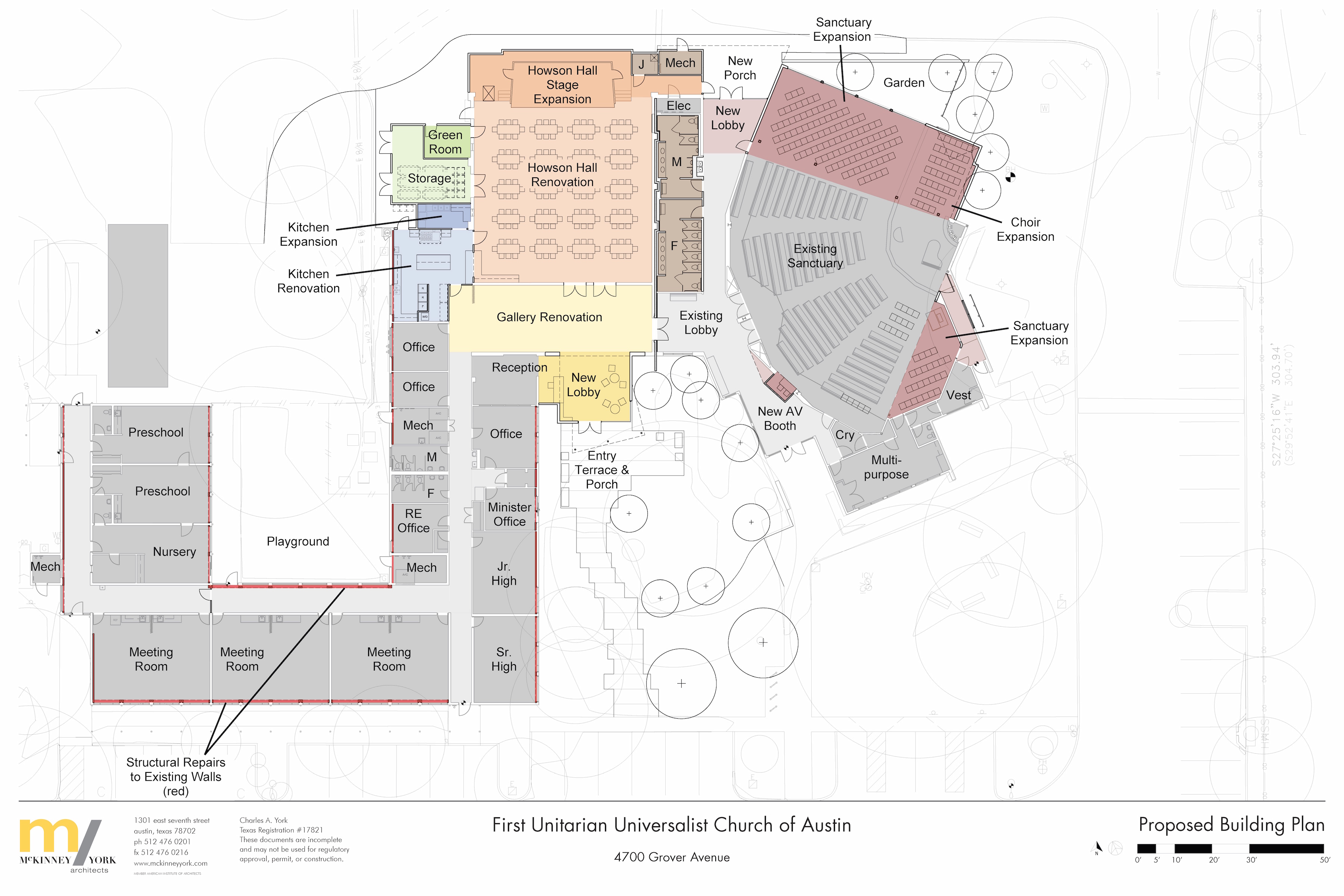
Our desire to provide a welcoming environment for new and old members alike takes us on a challenging path of renovation and expansion. McKinney York’s schematic design is the first phase of design. It is their statement of direction based on consideration of our wishes, the constraints and opportunities presented by existing conditions, code requirements, and our means. A significant portion of our budget will be devoted to the unglamorous but necessary work: meet modern building codes for life safety and accessibility; address life-cycle issues of aging heating, ventilation, and air conditioning equipment; refresh a tired kitchen; and replace the sorry bathrooms serving the sanctuary. Much of this work has to be done regardless of anything else we do. More dramatic contributions to the welcoming spirit of our church will be an expansion of the sanctuary, new entrance lobbies, an expanded gallery, a possible extension of Howson Hall, and a master plan and improvements for landscape, including the playgrounds. The religious education wing will receive new interior wall finishes and cosmetic improvements.

Construction costs in Austin are high, and McKinney York has advised us that we are hard against the budget raised by our capital campaign. Our next step is to hire a construction manager (contractor) to work closely with the architects and the build team to refine the cost estimates. Once we are comfortable with the alignment of goals and means, the architects will proceed with design development and, subsequently, construction documentation to refine our plans and prepare them for review by regulatory agencies and bidding by construction firms. The anticipated start of construction will be in late spring 2017.

(Click image to expand)

Schematic Plan


The sanctuary will be expanded to the north to provide additional seating and an expansion of the platform to accommodate the choir and musicians. The former choir loft will become seating. New lobbies on the north and south will offer more spacious and welcoming entrances, and the lobby restrooms will be rebuilt. The gallery will be renovated. Howson Hall improvements will include storage and a possible expansion to the north. The kitchen will be enlarged. The structural repairs required along the walls of the Religious Education wing will result in new interior finishes.

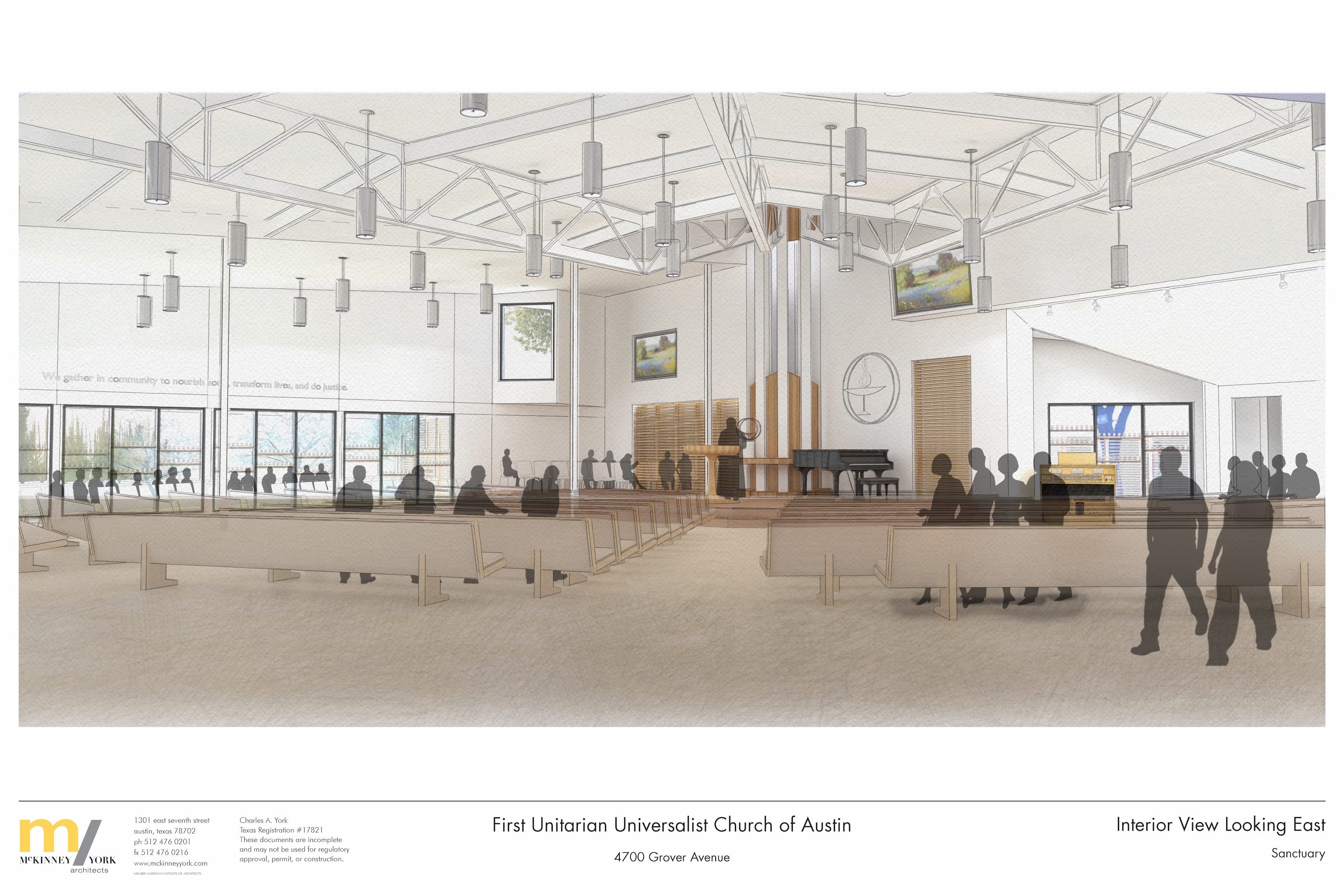
(Click image to expand)

Schematic View Sanctuary


This view from the rear of the expanded sanctuary shows the proposed candle wall and, behind it, sanctuary garden, which will be similar in character to what we have now. An angled window above the new choir area will add eastern light, and a smaller candle wall will be opened along the ramp (now a hidden corridor) behind the organ console. The rectangles with landscape scenes on the wall behind the pulpit are tentative locations for video screens. The slender columns are structural supports that are buried in the existing wall and must be retained. The column behind the podium appears closer that it is. Seating will be arranged to minimize conflicts with sight lines.

Save

Save

Save

Save

Save

Save

June 5, 2016 Congregational meeting

This is your official notice for our regularly scheduled congregational meeting on Sunday, June 5, 2016, 1:15 p.m.–2:30 p.m. in the sanctuary.

Copies of the meeting packet, including the agenda and budget, are available in the copy room at the church and by clicking on the link below:

6-2016congregationalmeetingpacket

The voting list will be posted by Fri. May 20 in the copy room and in the welcome center board at the church. Please check the list and let Chris Jimmerson know if you have any questions or believe you have incorrectly been omitted from the list. Chris may be reached at chris.jimmerson@austinuu.org and (512) 452-6168.

The church bylaws specify the following regarding voting eligibility: “Individuals who have been members of the church for 30 days or more and who have (as an individual or part of a family unit) made a recorded financial contribution during the last 12 months and at least 30 days prior to the meeting, have the right to vote at all official church meetings.”

We will be providing childcare during the meeting. Please RSVP to childcare@austinuu.org.

We look forward to seeing you at the meeting!

Make New Mistakes

Rev. Meg Barnhouse
May 8, 2016
First UU Church of Austin
4700 Grover Ave., Austin, TX 78756
www.austinuu.org

“Make New Mistakes” If you can’t be the good witch, can you be the good-enough witch?


Meditation
Rev. Dr. Maureen Killoran

Let us tell the stories of mothers … stories that could be true.

Let us tell of warm mothers, soft and round, likely to be found with flour on their nose, and always ready to pour you a glass of milk to go with the cookies on your plate. These mothers are increasingly rare.

Let us tell of mothers who are like bubbles of champagne: they surprise your senses, leave you giggly, but when you least expect it they erupt with an unexpected ‘pop.’

Stories that could be true.

Then there are grouchy mothers, stressed mothers, exhausted mothers, faces lined with worry and spirits tired and grey.

Other mothers are wise and reliable; not prone to many words or to a lot of noise – but you know that when you need them, they’ll be there.

Let us tell of fierce mothers, the ones who’ll love you even when you’re wrong.

Let us tell also of absent mothers, whose memory shimmers at the edges of your heart.

Let us tell of distant mothers … cruel mothers … loving mothers … giving mothers. There are walk-away mothers … save-the-world mothers too-busy mothers … mothers you cry because you lost them, and mothers who make you cry because you can’t …

Stories that could be true.

May we hold in our hearts the mothers we have known; those who loved us-and those who tried.

May we forgive the mothers who didn’t get it right, and try to release the knots of disappointment … anger … grief … pain.

May we hold in our hearts the truth that mothering-nurturing-is a task that belongs to us all.

However old or young you are, whatever your gender, may you make extra room for nurturing in your life this week.

May you say something real to a harried store clerk, give a co-worker a genuine compliment, take time to listen deeply to a friend.

In our shared silence may we remember, and reflect, and create anew, the stories of love and nurture, from this point forward, stories that can be true.

Sermon

I worked for around 15 years as a therapist, and I heard a lot of people talk about feeling like a failure. When we explored that feeling, it seemed that anything less than perfection felt like failure to some people. They felt they had disappointed their parents. “What did your parents expect from you?” I asked “They wanted me to be perfect.”

Many of us are more critical of ourselves than anyone else could be. Our mistakes glare at us when we survey our lives. Things we’ve said, things we hadn’t thought of that we should have thought of. Damage we’ve done. Businesses we’ve attempted that didn’t make it. Relationships that didn’t last. Times when you yelled at your children when you had resolved not to yell.

Speaking of that, happy Mother’s Day. Parenting is a minefield of mistakes. Mother-guilt is the worst, as you look around and imagine that every other woman is a better mother than you are. You try to teach good values, manners, conversational skills. You wonder sometimes if your kids are already damaged by something you did while you were still building them in your body, or by something you forgot to protect them from, or by something they are doing that you should have known about even though they were trying with all their skill and might to keep it from you. For your own protection and peace of mind.

I’ll tell you how to be a good mother (and father.) Understand that they are watching what you do, along with listening to what you say. Be the person you would want them to be. Don’t only talk about your values, live them. Heal yourself. Ask what you would want them to do in the situations in which you find yourself, and then model that.

Back to my therapy office. I had a cartoon on the wall (and I’m not a big cartoon person) that showed Glinda in her psychiatrist’s office. She’s saying “Everyone wants something. This one wants a heart, that one wants courage …. It’s too much.” The caption underneath reads “Glinda learns just to be the good-enough witch.”

Some of us will go to great lengths to avoid making a mistake. It can keep you from trying new things. Mostly it’s the first borns and only children. Some of us grew up with people who would joke “I’m never wrong, except for this one time in 1993, when I thought I was wrong, but it turns out I wasn’t. … ” The family joked that the headstone on my grandfather’s grave should be engraved with “Often in error, never in doubt.” Sometimes people do the same things over and over, even though they’re not working, just because to try something new would be scary and odd, and these, at least, are familiar mistakes.

The world’s best wisdom says mistakes, even failures, are generative, they are necessary for growth. Mistakes are how you get to new knowledge. Thomas Edison said “I’ve not failed. I’ve just found 10,000 ways that don’t work.”

Danish Nobel Prize winner, Niels Bohr, says, “An expert is a person who has made all the mistakes that can be made in a very narrow field”.

The drive to avoid mistakes can lead to a certain kind of success. There is nothing wrong with this. Out of the 23 first NASA astronauts, 21 were first borns. This is not the case for inventors, though, many of whom are people who are more sanguine about trying things. They are more ok with making mistakes, doing things that turn out not to work. My older son and I were playing around with a puzzle. Nine dots in rows of three, making a square. The challenge was to draw a line, without picking your pencil up, connecting all nine dots. We had worked on it for about ten minutes, trying this or that, and my younger son came over to see what we were doing. He picked up the pencil, drew a line that ran, shockingly, out of the square, and then back down to connect the rest of the dots. They hadn’t said not to move out of the box, but we had imagined that rule for ourselves.

This congregation is vigorously living our mission, trying to figure out whether we want to be a Sanctuary Church, or just be a church that does sanctuary when it’s called for, and works with several refugees at a time trying to keep them from being in a situation where they have to leave their homes and families and go into sanctuary. We might make a mistake. We might have to say “Hmm. This isn’t working. We made a mistake. Let’s do something different.” You’re not irresponsible if you make a mistake doing things no one else is doing nor knows how to do. You’re not an idiot. You’re just trying a new thing.

We are moving forward on a building expansion and renovation project. We are using the best expertise we know how to use. We raised money at the top of the range of what churches can raise, 5 times our annual giving. You all are a tremendous success. Will we spend it all perfectly? We’re going to try. Might we make a mistake? What if we do?

What do you do when you make a mistake? You see what part of it was yours. You take responsibility and let go of the self-defense.

Then you say you’re sorry.

Then you try to learn and heal that part of yourself that led to the mistake. And you try to make amends.

“I’m sorry. I love you.” Repeat. To the universe. As you heal yourself, you heal others.

I made a mistake this week. I know better. I said things that hurt someone I like and respect a good deal. I realized I’d caused hurt, and I apologized. I was laughing about something just because it made me uncomfortable, I said, which was the truth. I was understood and forgiven on the spot. I didn’t forgive myself, though. That takes longer. Looking at what happened, I made a plan to get more comfortable with that issue. In order to say fewer hurtful things, some people try to watch what they say. That never works.

The beauty of working on yourself, on the thoughts and love level, is that you don’t have to watch what you say if you see more clearly, if you judge less and understand more.

“I don’t know what to say to these people,” I heard someone say.

Well, first of all, there is no “these people.” There are just people. There are those of us who are Democrat and those of us who are Republican. There are those of us who are comfortable financially and those of us who are struggling. There are those of us who are straight and those of us who are gay, and a lot of people on the continuum in between. There are those of us who are male and those of us who are female and there are those who move in-between on the continuum. The wider we draw the circle the less we have to wonder what to say to “those people.” They are us.

Go ahead and mix with folks you don’t know what to say around. You will make mistakes. Look forward to it. It’s the way we learn, and we love learning.


Podcasts of this and other sermons are also available for free on iTunes. You can find them here.

Most sermons delivered at the First UU Church of Austin during the past 16 years are available online through this website. You will find links to them in the right sidebar menu labeled Sermons. The Indexes link leads to tables of all sermons for each year listed by date (newest to oldest) with topic and speaker. Click on the topic to go to a sermon.


Prayer beads for UUs

Rev. Meg Barnhouse
May 1, 2016
First UU Church of Austin
4700 Grover Ave., Austin, TX 78756
www.austinuu.org

How might UUs use prayer beads? What is prayer for UUs? How does having something tangible in in our hand help our mind and spirit?


Call to Worship

from “Help Thanks Wow: The Three Essential Prayers”
by Anne Lamott

Gorgeous, amazing things come into our lives when we are paying attention: mangoes, grandnieces, Bach, ponds. This happens more often when we have as little expectation as possible. If you say, “Well, that’s pretty much what I thought I’d see,” you are in trouble. At that point you have to ask yourself why you are even here. […] Astonishing material and revelation appear in our lives all the time. Let it be. Unto us, so much is given. We just have to be open for business.

Meditation

by Annie Dillard

The mockingbird took a single step into the air and dropped. His wings were still folded against his sides as though he were singing from a limb and not falling, accelerating thirty-two feet per second per second, through empty air. Just a breath before he would have been dashed to the ground, he unfurled his wings with exact, deliberate care, revealing the broad bars of white, spread his elegant, white-banded tail, and so floated onto the grass. I had just rounded a corner when his insouciant step caught my eye; there was no one else in sight. The fact of his free fall was like the old philosophical conundrum about the tree that falls in the forest. The answer must be, I think, that beauty and grace are performed whether or not we will or sense them. The least we can do is try to be there.

Sermon

You were given three beads as you came in this morning. What we are going to do is talk about prayer beads. The reason for beads is that people want to pray. We want to meditate. We want to slow down and take ten deep breaths for our blood pressure, but we don’t. We want to remember to say kind things to our partner or spouse, we want to say the lovingkindness meditation during the week, but we don’t. Beads are there as a tangible reminder, something to hold, to help us keep track, to catch our attention, to ground us with their texture in our hand, to connect our meditation with our senses.

Beads have been used from time immemorial to help people pray. Of course they don’t know for sure when people began using beads to pray. There are beads that look like prayer beads from Egypt as early as 3200 B.C.E. In a museum in central Europe, there is a fossil of a necklace of shell and bone. We don’t know if it was used just for decoration or for prayer. These days, most of the world’s inhabitants — nearly two-thirds of the planet’s population — pray with beads. Maybe they relate to the abacus. Maybe ancient people did what the Christian third century Desert Mothers and Fathers did, carrying a particular number of pebbles in their pockets, which they dropped one by one on the ground as they said each of their prayers.

INDIA
In India, sandstone carvings dating from 185 B.C.E. show people holding prayer beads. The same strand of prayer beads, called a japa mala, is still used, designed for wear around the neck. It has 108 beads for repeating mantras or counting one’s breaths. Japa means saying the name of God, and mala means “rose” or “garland” in Sanskrit.

BUDDHISM
Buddhists inherited the mala from Hinduism, since Buddhism is an offshoot of Hinduism. They use 108 beads or a number of beads that goes into 108, so you would go around the circle of beads twice or three times to make the 108. In Tibet, malas of inlaid bone originally included the skeleton parts of holy men, to remind their users to live lives worthy of the next level of enlightenment. Today’s bone malas are made of yak bone, which is sometimes inlaid with turquoise and coral.

The 108 beads represent the number of worldly desires or negative emotions that must be overcome before attaining nirvana. Buddhists believe that saying a prayer for each fleshly failing will purify a person.

CHRISTIAN
It’s interesting that the word mala means “rose,” or “garland.” Roman Catholics and Anglicans use a Rosary as prayer beads. It’s name comes from the Latin “rosarium,” meaning “rose garden.” The beads were also sometimes made of crushed and cooked rose petals. Praying the rosary is a traditional devotion of the Roman Catholic Church, combining prayer and meditation in sequences (called “decades”) of one Our Father, ten Hail Marys, and a Glory Be to the Father, as well as a number of other prayers (such as the Apostle’s Creed and the Hail Holy Queen) at the beginning and end. The Desert Fathers (third to fifth century) switched from using stones to using knotted ropes or a piece of leather to count prayers, typically the Jesus Prayer (“Lord Jesus Christ, Son of God, have mercy on me, a sinner.”) The rosary is given ceremonially to a Greek Orthodox monk as the second step in the monastic life. It is called his ‘spiritual sword’.”

ISLAM
In Islam, prayer beads are referred to as Misbaha, and contain 99 beads, corresponding to the 99 Names of Allah.

NATIVE AMERICAN
Beads have always had a spiritual significance to Native Americans; neck medallions as early as A.D. 800 served as talismans. Certain items of jewelry and other ornamentation using beads were often central in healing ceremonies.

AFRICAN
The Yoruba believe that using beads enhances the power of ritual objects. The Masai find beads so meaningful to their culture that their language includes more than 40 words for different kinds of beadwork.

PRAYER
We’re Unitarian Universalists. How do we pray? From not at all through all types of meditation to traditional asking God for help. People think and talk about prayer in such different ways. For most religious people of every faith, prayer is asking God to do something. You beseech the Lord, you beg, you plead. Some people teach that God is a good parent, that God knows what you need without being asked, but that the asking is for your benefit. That is how I was taught. Other people act like God is an arrogant and forgetful king, who could do anything he wanted to do for you, but, unless you beg pretty, unless you do everything exactly right and say just the right thing, with just the right tone, just the right level of faith, having sent seed money to the right religious enterprise, God will not do what you need for him to do.

I think prayer is putting our focus, our energy toward something, or being grateful for something or just holding something in our heart and mind. I think there is something important about paying attention, and that is a big part of praying. Paying attention to the thing. Anne Lamott says there are only three prayers you need: Thanks. Wow. And Help! Do you need to have traditional beliefs to be in a position to say “Help!” No. I like to believe that there is a river of love running through the world that I call God, and that I can call out to love for help. Does it come from outside me? Inside? From other people, from the animals, the rocks, the trees and the stars? From spirits of people who have died? From particles smaller than the bosun that respond to desperation with some kind of release of energy? Or is it just good for me to acknowledge that I need help? Does any of that really matter, when you’re desperate for help and some help arrives? But maybe it doesn’t arrive, and then you are left telling yourself stories about why it didn’t…. Choosing your beliefs is fraught with joy and heartbreak.

REPEATING PRAYERS
Maybe prayer, like ritual, is one way to change your consciousness at will. Medieval monks wrote that after several weeks of repeating a prayer for many hours a day, they entered an altered state. They said they could see a powerful light around them. One mystic described the condition as a “most pleasant heat,” a “joyful boiling.”

In the early 1970’s, Dr. Herbert Benson, president and founder of the Mind/Body Medical Institute at Harvard Medical School, documented a phenomenon he dubbed “the relaxation response”.

Benson experimented using Sanskrit mantras. He told his subjects to sit quietly and repeat the mantra either silently or aloud for ten to twenty minutes, to breathe regularly and to let all thoughts pass by, inviting the mind to be blank.

Benson found that those who repeated the Sanskrit mantras, for as little as ten minutes a day, experienced physiological changes-reduced heart rate, lower stress levels and slower metabolism. Repeating the mantras also lowered the blood pressure of those who had high blood pressure and generally decreased the subjects’ oxygen consumption (indicating that the body was in a restful state). Benson and his colleagues also tested other prayers, including “Lord Jesus Christ, have mercy on me, and found that they had the same effect. Even words like “one,” “ocean,” “love” and “peace” produced the response. It appears that Benson and his colleagues had uncovered a universal principle: repetitive prayer allows human beings to enter a relaxed state. More recently, researchers at U Mass and other institutions have discovered that meditation can lead to the thickening of certain regions of the brain. Gray matter is actually produced. There is a benefit to prayer that has little to do with belief at all.

We could use the three beads to: do the Buddhist prayer
1. yourself,
2. one you love
3. one you have trouble with

OR Do one thing you’re grateful for, one thing you are asking for, one thing you will give

OR Sets of ten deep breaths

I want you to think about the mission of this congregation. You could use the first bead to think about how your soul has been nourished, what nourishment it needs, how you have nourished the souls of others, and how you could do that today. The second bead is all about transformation. How has your life been transformed today, if it has? What kind of transformation would you like to experience? Could you help transform someone else’s life today? The third is the justice bead. How have you done justice today? What kind of justice do you need? Can you support someone else who is doing justice? We are not all activists every day: sometimes we are called to be in support. This is something you practice. I invite you to try it.


Podcasts of this and other sermons are also available for free on iTunes. You can find them here.

Most sermons delivered at the First UU Church of Austin during the past 16 years are available online through this website. You will find links to them in the right sidebar menu labeled Sermons. The Indexes link leads to tables of all sermons for each year listed by date (newest to oldest) with topic and speaker. Click on the topic to go to a sermon.