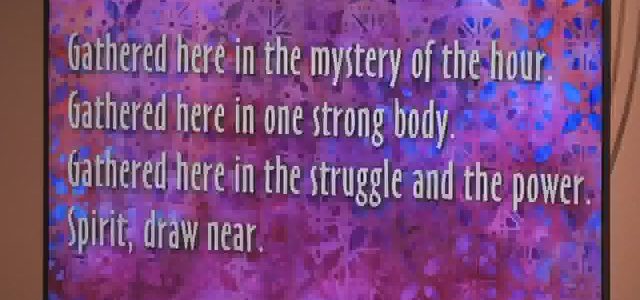
Gathered here in the Mystery of this Hour

Rev. Chris Jimmerson
December 30, 2018
First UU Church of Austin
4700 Grover Ave., Austin, TX 78756
austinuu.org

As we close out this year and look forward to the new year, the mystery and uncertainty of what is to come also opens up almost unlimited possibilities and creative potential.


All of this month of December, our faith development/religious eduction activities have focused on mystery. 

What does it mean to be a people of mystery? 

For a faith tradition such as ours, wherein both our Universalist and Unitarian forebears were the heretics, the questioners, the embracers of mystery and questions more profound than answers, I think this is a great topic for us to be exploring. 

What does it mean to be a people of mystery? 

And I think that exploring mystery and uncertainty can drive both a sense of humility and a sense of increased spirituality – humility over the enormity of what we do not yet know, some of which lies beyond the current tools available to us through science humility when we consider what a tiny part of the vastness of our universe we are; that our lives are but a blip in the magnificence of eternity. 

And yet I also find a sense of the spiritual in knowing that we are a part of and integrally interconnected with that great vastness, that eternal movement of time, that sacred web of all existence. 

And grounded in that sense of humility, embracing that we exist in uncertainty, diving into all that still remains mysterious to us, I think opens up the possibility of almost limitless exploration, creative opportunity and both personal and societal transformation. 

I want to share with you how Neuroscientist and author David Eagleman expresses this need to embrace uncertainty, mystery and what we do not know. 

Eagleman video 

Given the enormity of what we do not know, Eagleman goes on to talk about his discomfort with the duality going on in the debate between the so called “new atheists” and religious fundamentalists. He says that we know far too little to rule out the possibility of God with such certainty, and we know far too much to believe any of the world’s religious stories so literally. 

Now, whether or not you agree with him, he holds out the prospect that if we let go of the either/or thinking, and, like when science does not yet have the tools for measuring and observing certain phenomenon and must therefor hold multiple hypothesis at once, if we open ourselves to exploring the multitude of possibilities between these two extremes, we may find new opportunities for spiritual creativity and growth. 

He calls this possibilianism, a sort of mysticism rooted in reason and the scientific method – more on that later. 

Speaking of mysticism, I looked back at some research I did for a sermon on the subject a couple of years back and was reminded that mystic sects have developed within all of the world’s major religions. 

These are people who, depending upon their individual belief systems, have found that God or the Divine or enlightenment or nirvana or a sense of transcendence or an experience of the holy or peak experiences – these were to be found by embracing uncertainty, diving into mystery. 

Even non-theistic humanists and scientific naturalists have folks who find a sense of awe and wonder, connection to something larger than themselves by staring up at the vastness of the stars at night or marveling at the beauty of a sunset. 

And I have found this embracing of the unknown quite comforting as we move through all of the uncertainty generated by our construction and renovation process. 

In fact, I wrote us a call and response liturgy to help us embrace the uncertainty. You do not need anything in writing because it is very simple. I will speak, and then when I gesture toward you, please say with me, “It’s a mystery”. 

It’s more fun if we say it like that — like my South East Texas relatives would, “It’s a mystruy”. 

OK, ready? 

I wonder when we’ll get to use the new area of the sanctuary? It’s a mystery. 

I wonder when the new kitchen will open? It’s a mystery. 

I wonder when we’ll get our parking back? It’s a mystery. 

I wonder when we will lose the use of Howson Hall for a bit? It’s a mystery. 

The staff offices? It’s a mystery. 

The classrooms? It’s a mystery. 

All together three times now. It’s a mystery. It’s a mystery. It’s a mystery. 

OK, I do not exactly experience God or anything in that, but surrendering to the uncertainty does relieve some anxiety and I have a growing sense of excitement about the creative possibilities for growing our church and our faith that this time of uncertainty will eventually create for us. 

So let us embrace uncertainty and the vast mysteriousness within which we dwell, For the Israelites of biblical times, the mysteriousness of God was considered so vast and beyond human comprehension that even his name was beyond human ability to pronounce correctly. Even trying to say his name was blasphemy and could get you stoned to death by your neighbors. 

Well, your male neighbors as women were not allowed to participate in anything like stonings. 

Except in the imaginings of Monty Python that is. 

Python Video 

A humorous illustration of why Eagleman says we know too much to take ancient scriptures literally. 

So, mystery and uncertainty are a part of life whether we like it or not. Yet, they can also be, when we are willing to embrace the uncertainty, to swim in the mystery for a while, a powerful source of awe and wonder and creative possibilities. Mystery can stimulate transcendent experience and lead to spiritual transformation. 

I’d like to share with you just a part of author and world traveler Pico lyer’s talk, which he titled, “The Beauty of What We will Never Know”. 

VIDEO 

I loved the image of the Dali Lama having the wisdom to say, “I don’t know” when that is the simple truth. What powerful modeling of the wisdom to be found in a little humility in the face of circumstances for which we cannot have certainty. 

And I loved the quote, “the opposite of knowledge …isn’t always ignorance. It can be wonder. Or mystery, Possibility” and his observation that it is often the things we don’t know that push us forward even more more than the things we do. 

Later in that same talk, Iver also observes that mystery is a source of intimacy in our personal relationships – that we cannot ever know everything about those whom we love and that is actually a wonderful wellspring of continued growth and deepening of our relationships. 

I certainly have experienced this with my spouse Wayne, Even after 27 years, we still have more mystery in one another to explore. He still surprises me sometimes. We still have more to learn about one another. 

And even if it were some how possible to learn everything there is to know about someone else, which it isn’t because we will never have the same lived experience, even if it were possible, they would still be growing and evolving and changing. 

So the Wayne I met all those years ago and the Wayne I talked with over coffee before leaving the house this morning are not the same. And the Wayne I will meet for lunch later will not be exactly the same as the Wayne I was with this morning. 

We are always in a process of becoming with each experience and each passing moment, and for Wayne and I that has driven an abiding and ever deepening love and intimacy and an enchantment with the ever unfolding mysteries of one another. 

And so Iver says it is with our human relationships and our broader human lives and spirituality – the mystery creates almost unlimited possibilities and creative potential. 

I agree with him, and that brings me back to David Eagleman’s possibilianism that I mentioned earlier and called a sort of mysticism rooted in reason and the scientific method, 

Possibilianism says that we cannot claim certainty over that for which we have no way of being certain – the existence or none existence of God; even how we might conceive of such; how we find meaning; our place within this vast universe. 

Possibilianism requires that we be open to ideas that we don’t have any way of testing right now, be open to new, previously unconsidered possibilities and be comfortable holding multiple ideas in mind all at once. 

It also requires, though, that we apply reason to these ideas and when possible test them with scientific methods. 

I think it is also important to note that this is not agnosticism, a sort of passive response to questions we cannot answer, but rather an active diving into the mysteries. 

I loved this explanation of the difference: 

  • Agnostics end with the lack of an answer. 
  • Possibilians begin with the lack of an answer. 
  • Agnostics say, we can’t decide between this and that. 
  • Possibilians say, there are other choices than this or that. 
  • Agnostics say, I Don’t Know, it’s impossible to answer that question. 
  • Possibilians say, I Don’t Know, there must be better questions. 

For those of you desperately searching your smart phones about now, it’s possibilian.com. You can find links to articles and videos on the subject there also. 

It occurs to me though, that possibilianism might be one great avenue of exploration for we ever questioning, ever seeking, ever heretical Unitarian Universalists. 

As we move into a new year filled as it is with uncertainty and mystery over what is to come, perhaps we can all try on possibilianism for a while. 

Perhaps we can become that people of mystery. 

In doing so, we might just open up almost unlimited possibilities and creative potentialities. 

May it be so. Amen. 


Text of this sermon is not yet available. Click the play button to listen.

Most sermons during the past 19 years are available online through this website. Click on the index link below to find tables of all sermons for each year listed by date (newest to oldest) with topic and speaker. Click on a topic to go to that sermon.

SERMON INDEX

Podcasts of this and other sermons are also available for free on iTunes. You can find them by clicking on the podcast link below. 
PODCASTS

Lessons and Carols

Rev. Meg Barnhouse
December 24, 2018
First UU Church of Austin
4700 Grover Ave., Austin, TX 78756
austinuu.org

Readings and carols, candlelight on Christmas Eve. One of the church community’s favorite services of the year.


Introit: “In the Bleak Midwinter” (Harold Darke)
Katrina Saporsantos, soprano

Chalice Lighting:

Love is the spirit of this church, and service is its law; this is our great covenant: to dwell together in peace, to seek the truth in love, and to help one another.

Opening Words

The Persian poet Rumi wrote, 
God’s joy moves from unmarked box to unmarked box 
From cell to cell. As rainwater, down into flowerbed. 
As roses, up from ground. 
Now it looks like a plate of rice and fish, 
Now a cliff covered with vines, 
Now a horse being saddled. 
(God’s joy) hides within these, 
Till one day it cracks them open. 

Anthem: “Someday at Christmas” (Ron Miller and Bryan Wells)
Katrina Saporsantos, soprano

Reading: “Come into Christmas” by Ellen Fay

It is the winter season of the year 
Dark and chilly 
Perhaps it is a winter season in your life. 
Dark and chilly there, too 
Come in to Christmas here, 
Let the light and warmth of Christmas brighten our 
lives and the world. 
Let us find in the dark corners of our souls the 
light of hope, 
A vision of the extraordinary in the ordinary.
Let us find rest in the quiet of a holy moment to 
find promise and renewal. 
Let us find the child in each of us, the new hope, 
the new light, born in us. 
Then will Christmas come 
Then will magic return to the world. 

Reading: “The Shortest Day” by Susan Cooper

So the shortest day came, and the year died, 
And everywhere down the centuries of the snow-white world 
Came people singing, dancing, 
To drive the dark away. 
They lighted candles in the winter trees; 
They hung their homes with evergreen; 
They burned beseeching fires all night long 
To keep the year alive, 
And when the New year’s sunshine blazed awake 
They shouted, reveling. 
Through all the frosty ages you can hear them 
Echoing behind us – Listen!! 
All the long echoes sing the same delight, 
This shortest day, 
As promise wakens in the sleeping land: 
They carol, fest, give thanks, 
And dearly love their friends, 
And hope for peace. 
And so do we, here, now, 
This year and every year. 
Welcome Yule! 

Reading: “On Angels” by Czeslaw Milosz

All was taken away from you: white dresses, 
wings, even existence. 
Yet I believe you, 
messengers. 
There, where the world is turned inside out, 
a heavy fabric embroidered with stars and beasts, 
you stroll, inspecting the trustworthy seams. 
Short is your stay here: 
now and then at a morning hour, if the sky is clear, 
in a melody repeated by a bird, 
or in the smell of apples at close of day 
when the light makes the orchards magic. 
They say somebody has invented you
but to me this does not sound convincing 
for the humans invented themselves as well. 
The voice – no doubt it is a valid proof, 
as it can belong only to radiant creatures, 
weightless and winged (after all, why not?), 
girdled with the lightning. 
I have heard that voice many a time when asleep 
and, what is strange, 
I understood more or less 
an order or an appeal in an unearthly tongue: 
day draws near 
another one 
do what you can. 

Reading: Luke 2: 1-7 

Reading: by Anthony F. Perrino

A gentle kind of Gladness 
Comes with the end of December 
A winter solstice spell, perhaps, 
When people forget to remember – 

The drab realities of fact, 
The cherished hurt of ancient wrongs, 
The lonely comfort of being deaf 
To human sighs and angels’ songs. 

Suddenly, they lose their minds 
To hearts’ demands and beauty’s grace; 
And deeds extravagant with love 
Give glory to the commonplace. 
Armies halt their marching, 
Hatreds pause in strange regard 
For the sweet and gentle madness born 
when a winery sky was starred. 

Reading: “Each Night A Child Is Born” by Sophia Lyon Fahs

For so the children come 
and so they have been coming. 
Always in the same way they came-
Born of the seed of man and woman. 

No angels herald their beginnings. 
No prophets predict their future courses. 
no wise man see a star to show where to find 
The babe that will save humankind. 
Yet each night a child is born is a holy night. 
Fathers and mothers 
Sitting beside their children’s cribs- 
Feel glory in the sight of a new beginning. 
They ask “Where and how will this new life end? 
Or will it ever end?” 

Each night a child is horn is a holy night-
A time for singing- 
A time for wondering 
A time for worshipping. 

Reading: Luke 2: 8-14 

Reading: “In this Night” by Dorothee Solle 

In this night the stars left their habitual places 
And kindled wildfire tidings 
that spread faster than sound. 

In this night the shepherds left their posts 
To shout the new slogans 
into each other’s clogged ears. 
In this night the foxes left their warm burrows 
and the lion spoke with deliberation, 
“This is the end revolution” 

In this night roses fooled the earth 
And began to bloom in snow. 

Reading: Luke 2: 15-20 

Reading: “The Camels Speak” by Lynn Ungar

Of course they never consulted us.
They were wise men, kings, star-readers,
and we merely transportation.
They simply loaded us with gifts
and turned us toward the star.
I ask you, what would a king know
of choosing presents for a child?
Had they ever even seen a baby
born to such simple folks,
so naked of pretension,
so open to the wind?
What would such a child care
for perfumes and gold? Far better
to have asked one born in the desert,
tested by wind and sand. We saw
what he would need: the gift
of perseverance, of continuing on the hard way,
making do with what there is,
living on what you have inside.
The gift of holding up under a burden,
of lifting another with grace, of kneeling
to accept the weight of what you must bear.
Our footsteps could have rocked him
with the rhythms of the road,
shown him comfort in a harsh land,
the dignity of continually moving forward.
But the wise men were not
wise enough to ask. They simply
left their trinkets and admired
the rustic view. Before you knew it
we were turned again toward home,
carrying men only half-willing
to be amazed. But never mind.
We saw the baby, felt him reach
for the bright tassels of our gear.
We desert amblers have our ways
of seeing what you chatterers must miss.
That child at heart knows something
about following a star. Our gifts are given.
Have no doubt. His life will bear
the print of who we are.

Anthem: “Still, Still, Still” (Austrian Folk Song) 
Katrina Saporsantos, soprano

Reading: “A Ritual of the Winter Solstice Fire,” by Rev. Meg Barnhouse

Let us take into our hands a Christmas candle, a Solstice candle 
this is a night of ancient joy and ancient fear 
those who have gone before us were fearful of what lurked 
outside the ring of fire, of light and warmth. 
As we light this fire we ask that the fullness of its flame 
protect each of us from what we fear most 
and guide us towards our perfect light and joy. 

May we each be encircled by the fire and warmth of love 
and by the flame of our friendship with one another. 
On this night, it was the ancient custom to exchange gifts 
of light, symbolic of the new light of the sun. 

Therefore make ready for the light! 
Light of star, light of candle, 
Firelight, lamplight, love light
Let us share the gift of light. 

Candle Lighting: “Payapang Daigdig” (Felipe Padilla de Leon) 
Katrina Saporsantos, soprano

Reading: “The Work of Christmas” by Howard Thurman 

When the song of angels is stilled, 
When the star in the sky is gone, 
When the kings and princes are home, 
When shepherds are back with their flock, 
The work of Christmas begins: 
to find the lost, 
to heal the broken,
to feed the hungry, 
to release the prisoner, 
to rebuild the nations, 
to bring peace among the brothers, 
to make music in the heart. 

Carol: “We wish You a Merry Christmas” 

Closing Words: “Kneeling in Bethlehem” by Ann Weems

It is not over, this birthing. 
There are always newer skies 
into which God can throw stars. 
When we begin to think 
that we can predict the Advent of God, 
that we can box the Christ in a stable in Bethlehem, 
that’s just the time that God will be born 
in a place we can’t imagine and won’t believe. 
Those who wait for God 
watch with their hearts and not their eyes, 
listening, always listening for angel words. 


Most sermons during the past 19 years are available online through this website. Click on the index link below to find tables of all sermons for each year listed by date (newest to oldest) with topic and speaker. Click on a topic to go to that sermon.

SERMON INDEX

Podcasts of this and other sermons are also available for free on iTunes. You can find them by clicking on the podcast link below. 
PODCASTS

Spray it Gold and post it on Instagram

Rev. Meg Barnhouse
December 16, 2018
First UU Church of Austin
4700 Grover Ave., Austin, TX 78756
austinuu.org

Everybody else’s life looks glowy and great. How do they do it? Perfectionism can really get its claws into us at this time of year. We compare our insides with other people’s outsides and it makes us feel bad. How can we see beneath the surface, grow our roots, and strengthen our core?


Reading

Anne Lamott, Bird by Bird: Some Instructions on Writing and Life

Perfectionism is the voice of the oppressor, the enemy of the people. It will keep you cramped and insane your whole life,… I think perfectionism is based on the obsessive belief that if you run carefully enough, hitting each stepping-stone just right, you won’t have to die. The truth is that you will die anyway and that a lot of people who aren’t even looking at their feet are going to do a whole lot better than you, and have a lot more fun while they’re doing it.

Sermon

It’s natural to want to put yourself out there in the most positive light. No one writes Holiday letters saying things like “We’ve been fighting a lot. My business isn’t doing too well. One of the kids dropped out of school and I think one is in some sort of a gang. The dog is still making messes behind the couch. It’s driving me crazy …. ” We like to present cheer and stability and success if we can. 

I joined Instagram, a social media platform, because it’s where the pictures of my family appear. 

You choose certain people to follow, so you can peek in on the parts of their lives they choose to share. Smiling on the streets of NYC, sunsets in La Jolla, Delicious looking food, concerts, parties, celebrations. All of that is lovely. Then you have the “influencers,” people who have gathered or purchased loads of followers in hopes of getting someone to pay them to put ads on their feed. One sylphlike blonde woman poses on her perfect bed in her perfect bedroom in soft pink pajamas. There is an untouched plate of strawberry pancakes beside her. “Strawberry pancakes,” she comments, “the perfect start to a busy day.” I think the odds of her being a pancake eating person are small, but you can’t always tell. What takes this to another place, though, is that she has tied eight or ten shiny pink heart shaped balloons to the pillows, so she’s surrounded by party radiance. 

Really? For breakfast? Who does that? Who believes that? Who would think that is the way you’re supposed to do breakfast? There is a full bottle of Listerine on her bedside table, so they paid for that. I guess some people keep their mouthwash on the bedside table… 

Social media is grand in many ways, because it’s supposed to connect people. I love it because it’s like reading a hometown newspaper where I know all the people in the stories. When you have friends all over the place, it’s a good way to keep in touch. Instagram, though, has filters you can use to make everything look homey, or glowing, or extra sharp and saturated, so your own life looks dull in comparison. Other people’s children look angelic and their partners have loving faces. Their trips appear festive and their bodies look pain-free. Mental health experts are now fretting that scrolling through these windows into other people’s perfect looking lives creates shame and depression about your own all-too-real experiences. 

There is nothing wrong with presenting your life in the most positive way, but it behooves all scrollers to understand that this is what is happening. Some people get bitten by the fake perfection bug, and then they feel they must manufacture their own staged perfection, and make ourselves sick by presenting that. In fact, there is a web site called LifeFaker.com where you can buy packages of photos of parties, friends, travel and food to make your life look as good as the others on the platform. 

We can get bitten by the perfectionism bug all by ourselves without Instagram though. We have ideas about how we are supposed to be, what we are supposed to know, the books we should have read, the thoughts we should understand and agree with. We see and admire other people, but, as the 12 step program people say, we are comparing our insides to their outsides.

Some people won’t do anything they aren’t already good at. I’ve told you about my mom and her violin. She practiced every morning from 6:00 to 7:OO before going to work as a second grade teacher. She never got much better, but she loved it. I’m glad she didn’t get shamed into stopping just because she wasn’t good at it. It brought her joy. And scratchy strings were my morning wake up alarm. 

Some people fear mistakes so much that it makes them procrastinate, doing things finally under such pressure and with so little time that there will always be a reason for whatever it is to be less than perfect. That perfection is unattainable and unrealistic is something we already know, but all the staged pictures and the filters that make things look gentler or more real than reality continue working on us. We collect pictures on Pinterest of beautiful gardens, doorways, water features, clothes, jewelry, cakes, muffins, parties, etc. It’s so over the top that there is now a balancing site called “Pinterest fails.” You see the perfect photo from Pinterest, then you see a photo of how the cake actually turned out, or how the do-it-yourself project actually turned out. I bet there already is an Instagram balance site where people show the grittier realities of their lives, but I haven’t found it yet. 

Many of us don’t try to have a perfect life with strawberry pancakes on a bed made with snowy linen, pink heart balloons attached to our pillows. Our perfectionism comes in feeling ashamed that we aren’t better justice warriors, that we haven’t read that book everyone else is quoting, that we aren’t loving enough or intellectual enough. Forget the pink balloons, we want to have read and understood everything, to make scintillating conversation, to make meaningful days. 

Perfectionism is cunning, baffling and powerful. It waits around every corner. We have been raised within the air of our culture. We tend to focus on what is wrong with our work and the work of others, we have an easy time naming and describing what went wrong in a situation and it’s harder to name what went right. We hear things like “why should I thank them for just doing their job?” Thanking is one antidote to this culture of perfectionism. Practicing naming what went well, what is good in a situation or in a job of work. In Perfectionism culture, mistakes are personal. You making a mistake is almost the same thing as you being a mistake. We push back against this culture by being interested in mistakes, by being curious about mistakes, by taking time to reflect by ourselves and with others about how we can learn from mistakes, and then by forgiving ourselves and others for their mistakes, having the resilience to move on rather than crumple up and throw ourselves away. 

This is a hard time for so many among us. Some are joyous, and others are rattling, dry and hollow. It doesn’t mean you are doing something wrong if your house is lovely and your food is beautiful and your family is well behaved, and it doesn’t mean you are doing something wrong if your reality is harder. There is a lot of pain in this world. Pain in the war zones and pain at our own border. Pain in our cities and pain in the farmlands. If we can fill our lives with thank yous, with appreciation of the good, with doing small good things for the people around us and far away, we grow love. We don’t ignore the pain, and we don’t ignore the goodness. We celebrate the darkest time of the year, we embrace the return of the light at the same time that we grieve the losses in our own families and the death of a 7 year old Jakelin Caal Maquin in US custody. Creation and destruction, intertwined, goodness and corruption, hope and despair. That is our gorgeous terrible world. 

It’s our weak spots that give other people a place to hold on to us. The cracks are where the light comes in, as the poet Leonard Cohen says. The cracks are where the light comes in. 


Podcasts of this and other sermons are also available for free on iTunes. You can find them here

Most sermons delivered at the First UU Church of Austin during the past 18 years are available online through this website. You will find links to them in the right sidebar menu labeled Sermons. The Indexes link leads to tables of all sermons for each year listed by date (newest to oldest) with topic and speaker. Click on the topic to go to a sermon.

post

Prelude: “Maria Mater gratiae, Op. 47, No. 2” (Gabriel Fauré) Phillip Bernard, conductor “Magnificat, RV 610: Esurientes, Magnificat and Et exultavit spiritus meus” (Antonio Vivaldi) First UU Adult…

Prelude:
“Maria Mater gratiae, Op. 47, No. 2” (Gabriel Fauré)
Phillip Bernard, conductor

“Magnificat, RV 610: Esurientes, Magnificat and Et exultavit spiritus meus” (Antonio Vivaldi)
First UU Adult Choir and Orchestra
Brent Baldwin, Director of Music

Introit:

Love is the spirit of this church, and service is its law; this is our great covenant: to dwell together in peace, to seek the truth in love, and to help one another.

Lay Leader:

Hymn: #235: “Deck the Halls”

Together we nourish souls, transform lives, and do justice to build the Beloved Community.

Anthem: “Magnificat, RV 610 : Fecit potentiam and Deposuit potentes” (Antonio Vivaldi)

Placing Stones and Prayers:

Sermon: “Spray it Gold and Post it on Instagram” – Rev. Meg Barnhouse

Hymn: #226: “People Look East”

Offertory: “Magnificat, RV 610: Suscepit Israel and Sicut locutus est” (Antonio Vivaldi)

If you feel so led to donate to the church in order to support its mission, or to give to one of its various projects, log-in here for our secure donation site! https://secure.accessacs.com/access/oglogin.aspx?sn=156261

We extinguish this flame, but not the light of truth, the warmth of community, or the fire of commitment. These we hold in our hears until we are together again.

Postlude: “Magnificat, RV 610: Gloria Patri” (Antonio Vivaldi)

Glowing Embers

Rev. Chris Jimmerson
December 9, 2018
First UU Church of Austin
4700 Grover Ave., Austin, TX 78756
austinuu.org

As we celebrate the holiday season, it is good to remember the origin of these traditions and rituals, why they still matter to us, and how they may ground us in wonder, awe, and mystery.


Call to Worship

“Determined Seed”
By Laura Wallace 

As frozen earth holds the determined seed, 
this sacred space holds our weariness, our worry, 
our laughter and our celebration.

Let us bring seed and soul into the light of thought, 
the warmth of community, and the hope of love.

Let us see together, hear together, love together. 
Let us worship.

Reading 

“One Small Face”
by Margaret Starkey

With mounds of greenery, the brightest ornaments, we bring high summer to our rooms, as if to spite the somberness of winter come. 

In time of want, when life is boarding up against the next uncertain spring, we celebrate and give of what we have away. 

All creatures bend to rules, even the stars constrained. 

There is a blessed madness in the human need to go against the grain of cold and scarcity. We make a holiday, the rituals as varied as the hopes of humanity, 

The reasons as obscure as ancient solar festivals, as clear as joy on one small face.

Sermon

Well, here we are, back in the church if not quite yet back in the sanctuary, after the church went dark for two weeks, literally, as the building contractors had to cut the electricity so they could install the new power system. 

Last Sunday, we did our service over internet live steaming from our Senior Minister’s house. 

That was fun, but your ministers, Meg and I, have missed getting to be with you in person, as have all of our church staff folks. 

So, here we are, back in the building, but with the construction still ongoing and suddenly, (at least it seems sudden to me!) suddenly in the middle of the holiday season. 

We do plan to be able give ourselves and each other a great big gift of being able to return to our newly expanded and renovated sanctuary at least in time for our Christmas pageant and Christmas Eve services. 

Merry Christmas indeed! We hope! 

I’d like to talk today about the history and origins of some of the Christmas rituals and traditions we will be observing here at the church, and for many of us, with our families and loved ones. 

I will focus on Christmas traditions and practices because they are those that we have inherited most directly from both our Universalist and Unitarian forebearers. 

I want to note though, that I found a listing of almost 40 different religious holiday observances from a variety of religions throughout the world that have been or will be observed between November 1 of this year and the middle of January 2019. 

They include the Hindu Diwali festival of lights, as well as a number of other faiths that hold light festivals; Hanukka; Buddhists marking the day that the Buddha first experienced enlightenment; the Baha’i faith celebrating the birth of their founder; and the Zoroastrian faith observing the death of their founding prophet – just to name a very few. 

Each of these have their own traditions and rich histories, and, like with Christmas traditions and rituals, whether or not one believes the religious stories associated with them literally or not, I believe they help carry forward cultural memory. 

They convey understandings about the human condition and experience – indeed about what it means to be human. They carry forward a people’s values and priorities. They shape our relationships with one another and promote bonding and community building. 

And knowing something of the history and origins of our holiday observances may help us better understand the cultural memories they are conveying and the deeper meaning behind why they remain important to us. 

The rituals and traditions that we most commonly practice around Christmas here in the U.S. seem to have actually arisen from a variety, a sort of conglomeration, of sources. 

We also seem to have melded practices with secular origins and traditions from non-Christian practices with the Christian religious story of the birth of Jesus. 

Speaking of which, I love a meme that’s been going around that says, “Three wise women would have asked directions, arrived on time, helped deliver the baby, brought practical gifts, cleaned the stable, made a casserole and there would be peace on earth.” 

I also love how one of our Unitarian Universalist Ministers at First UU Dallas, Aaron White, recently summarized in one paragraph the biblical story of Christmas and the life of Jesus. He writes: 

“Jesus is born to an unwed, teenage woman of color. She, the child, and her husband cross national borders without documentation, … fleeing violence in their home country. The child grows up to be a homeless teacher who leads a radical movement of people that refuses the boundaries of creed, class, or role in society. He travels around giving a version of free healthcare to anyone who asks and feeds the poor without judgement. He preaches a love so radical, and an allegiance to relationship over power so compelling, that it becomes illegal. The most powerful military force in the world deems him a threat. He is then tortured and executed by the state … ” 

Not quite the version I was taught at the little Southern Baptist church we went to when I was a child. Something to think about as our government lobs tear gas at women and children seeking asylum at our border. 

Anyway, let’s talk about how we think some of our Christmas practices may have originated and including how they might have come to be associated with that Christian religious story of Jesus’ birth. 

Putting up Christmas trees reflects ancient practices of a number of societies that would decorate with evergreen trees, wreaths and garlands to remind themselves that life would return during this time of year when cold winters could make the world seem lifeless and bleak except for the evergreens. 

Because it was also the time of year for many societies when the days were short and there was far less sunlight, folks would often light candles on or near the evergreen elements they had brought into their homes. This is likely one of the places where our practices of lighting candles at Christmas, as well as decorating with Christmas lights originated. 

I’m sure glad we have LED lights now. Placing lit candles on tree branches seems like a fire hazard to me. 

It is thought that the Germans of the 16th century originated the Christmas Tree as we know it today. A popular play of the time about Adam and Eve had a prop called a “paradise tree” – a fir tree hung with apples to represent the Garden of Eden. Entranced by the paradise tree, Germans began bringing trees into their homes and decorating them. 

The Christmas Tree became popularized in America and Britain when in 1832, Charles Follen, a Unitarian Minister who had come here from Germany, and his wife put up a festively decorated tree, and their fellow abolitionist Harriet Martineau wrote glowing about it in the magazine, Godey’s Lady’s Book. 

In 1846, Queen Victoria and her German husband Prince Albert were sketched in the London newspaper standing around a Christmas tree with their children, which further popularized the practice both in Britain and in America. 

Another of our traditions, Santa Claus, comes from several legends about a Bishop in fourth century Asia minor called St. Nicholas. Left a lot of money by his parents who died when he was young, he helped the poor and gave secret gifts to people who needed them, especially children. This is likely part of from where the tradition of giving gifts at Christmas comes. 

In one of the legends, St. Nicholas helped the daughters of a very poor man who did not have enough money for a dowry so that they could be married according to customs of the time. St. Nicholas, so the legend says, secretly dropped a bag of gold down the chimney, and it fell into a stocking that had been hung by the fire to dry -likely the origin of both our current practices of hanging Christmas stockings and the idea of Santa Clause coming down the chimney to bring Christmas presents. 

Over time, the stories and images about St. Nicholas blended with myths about a gift giving Father Christmas in England and Kris Kringle in the U.S., and eventually these all kind of got combined together to form the myths, stories and practices we now associate with Santa Claus. 

So, how did these and other traditions get conflated the Christian story of Jesus’ birth get conflated, and how did we come to settle on December 25 as the date for it? 

Well, the truth is we do not know for sure. In fact, Christians thought in around 200 A.D. that the birth had taken place on January 6, based upon calculations folks and done using events of Jesus’ life laid out in the New Testament. In fact, the modern Armenian, Russian and Greek Orthodox churches still celebrate it on this date. 

I was not until the mid-fourth century that most Christians had moved the date to December 25. How and why that happened is still a matter of some debate, but here is the most common theory. 

During this same time of year that many cultures decorated with evergreens, most of them also had celebrations and rituals centered around solstice, the shortest day of the year, but that also harbingers the eventual return of the sun and longer days. 

Solstice falls on December 21 or 22 on our calendar, but in the Julian calendar of places like Syria and Egypt, it fell on December 25th and was celebrated as the Nativity of the Sun. It was observed with dramatic rituals where from within their shrines they would call out, “The Virgin has brought forth! The light is waxing!”. In Egypt, the new-born sun (that’s s-u-n) was even represented by the image of an infant. 

In Scandinavia, they celebrated Yule starting December 2, igniting huge Yule logs that would burn for up to 12 days. 

This time of year was also when wine and beer made during prior months was finally fermented and ready to start drinking – a fine tradition that many fine folks continue on Christmas even today. 

The Romans celebrated Saturnalia, a time of drinking and general debauchery during which the social order would be reversed and peasants would party and demand that those who were their masters the rest of the year give them gifts, food and libations to avoid being the victims of pranks and great mischief. 

As the theory goes, Christian church leaders kind of coopted these and other secular and pagan traditions and practices by placing Jesus’s birth on December 25, as a way to increase the chances that Christmas would get adapted through association with these existing rites. 

After this, and down through the Middle Ages, the practice of the poor celebrating raucously in a drunken, Mardi Gras-like atmosphere and demanding sifts from the wealthy continued, but only on Christmas day and only after first attending church that morning. 

Then, along came Robert Cromwell and the Puritans and spoiled the fun for everyone. They cancelled Christmas. Bill O’Reilly and Sean Hannity would have been incensed. 

In fact, in the U.S., the Puritans even made it illegal to celebrate Christmas in the City of Boston. 

Party animals our Puritan ancestors were not. 

It was actually the Universalists and some Unitarians who later began to restore the practices that have become how we now celebrate Christmas, especially the focus on home, peace, family, gifts for children and charity (though both the gifts to children and charity could and can still be used to reinforce the social hierarchy). 

So, that is a very abbreviated summary of at least some of the possible origins of Christmas traditions. 

I said earlier, that whether or not we believe in the the story of Jesus’ birth and life in a literal way, these practices and traditions convey cultural memory, human truths in metaphorical ways. 

Just in those that we have discussed today, a number of these human understandings emerge: 

  • The cycle of birth, life, death and rebirth – the amazing, evergreen tenacity of life; 
  • The magic and the creative potential of new life that a spark of the divine may manifest itself through anyone of us; 
  • Moving between seasons and again the circular patterns of nature; 
  • The values of generosity and charity, but also how these can be used to relieve social pressure and thus reinforce the existing social order; 
  • The importance of staying connected with family and loved ones; 
  • The power of ritual, communal bonding to hold societies together and support individuals even during challenging periods; 
  • The need for balance between light and darkness; 
  • And, finally, the ways in which we must prepare ourselves for moving through liminal times. 

It strikes me that those last three hold powerful meaning and beauty for us as we move through changes and disruptions at our church during this holiday season. 

Liminal times are those time periods when we are in transition, at a threshold, leaving one condition behind but not yet fully where we are going. 

Like for some of the the societies we have discussed who were in the transition from the shortest days of sunlight to the eventual return of the sun, limited by the shortened days and the coldness of winter – no crops to plant or harvest yet – travel and other activities limited by the cold and weather – uncertain yet of when this all would change again, these liminal times are often times of uncertainty and mystery. 

We are experiencing that here at the church. We have had to delay and reschedule activities due to the construction. We are worshiping in a temporary space, even as we dream of reclaiming a larger and more beautiful than ever sanctuary, where we hope to welcome many more from our area who might find a spiritual home here and join us on our religious journey. 

I am moved that during this very time of the year, our church itself was in darkness for a while to literally create enough power to make something new and even greater possible. 

That’s synchronicity. 

I do not associate light with all that is good and darkness with that which is difficult. For one thing, 1 think there is racist cultural baggage inherent in such an association. 

1 think, we need both. The seed needs darkness to germinate. The caterpillar goes into the cocoon before emerging anew as the butterfly. We need the night to sleep and restore ourselves. 

Likewise, too much light will burn the crops in the field, deprive us of healthy sleep and disrupt nature’s necessary cycles. 

For me, there is something mystical about this intermingling of light and darkness. This time of year, I love to sit at night with just the Christmas tree lights and fireplace on. There is something about that interplay between the darkness and the glowing but limited light that fills me with awe and wonder and binds my soul to those long ago ancestors we have been discussing today. 

This Christmas Eve, after the sun has set, we will do a ritual in which we all hold candles, and then we will turn off the lights, and light one another’s candles until all of them are glowing, and sing Silent Night together. Again, that interplay creates such a powerful, mystical and spiritual communal experience for me. 

I believe in the spiritual power of this religious community. 

I believe we have the rituals and communal bonds that will move us with grace through this liminal time. 

I believe we have the wisdom to value the interplay of light and darkness, knowing it is together that they bless us with amazing, evergreen tenacity and resilience. 

I believe that as we move through this holiday season and beyond it together, we will rebirth ourselves again and again as a religious community – a First Unitarian Universalist Church of Austin with all of the magic and creative potential of new life, manifesting the divine more and more in our world. 

Well, here we are – happy, joyous, blessed holidays. 

Amen. 


Podcasts of this and other sermons are also available for free on iTunes. You can find them here

Most sermons delivered at the First UU Church of Austin during the past 18 years are available online through this website. You will find links to them in the right sidebar menu labeled Sermons. The Indexes link leads to tables of all sermons for each year listed by date (newest to oldest) with topic and speaker. Click on the topic to go to a sermon.

Live from Pflugerville

Rev. Meg Barnhouse
Rev. Chris Jimmerson and Jules Jaramillo
December 2, 2018
First UU Church of Austin
4700 Grover Ave., Austin, TX 78756
austinuu.org

Meg, Chris, Jules, and Brent will be live-streaming from Meg’s house while you worship from your own cozy spot of choice since the church building is closed with no entry until Saturday, December 8th. We will be talking about mystery, family, and whatever else comes up as you call in on the live-stream page.


Call to Worship

THE FEAST OF LIGHTS
Emma Lazarus

Kindle the taper like the steadfast star
Ablaze on evening’s forehead o’er the earth,
And add each night a lustre till afar
An eightfold splendor shine above thy hearth
Clash, Israel, the cymbals, touch the lyre,
Blow the brass trumpet and the harsh-tongued horn;
Chant psalms of victory till the heart take fire,
The Maccabean spirit leap new-born.

Reading

C. JoyBell

“I have come to accept the feeling of not knowing where I am going. And I have trained myself to love it. Because it is only when we are suspended in mid-air with no landing in sight, that we force our wings to unravel and alas begin our flight. And as we fly, we still may not know where we are going to. But the miracle is in the unfolding of the wings. You may not know where you’re going, but you know that so long as you spread your wings, the winds will carry you.”

Reading

To be hopeful in bad times is not just foolishly romantic. It is based on the fact that human history is the history of cruelty but also of compassion, sacrifice, courage and kindness. What we choose to emphasize in this complex history will determine our lives. If we see only the worst it destroys our capacity to do domething. If we remember those times and places, and there are so many, where people have behaved magnificantly this gives us the energy to act and at least the possibility of sending this spinning top of a world in a different direction. And if we do act in however small way we don’t have to wait for some grand utopian future. The future is an infinate succession of presents and to live now as we think human beings should live, in defiance of all that is bad around us, is itself a marvel.


Text of this sermon is not available. Click the play button to listen.

Podcasts of this and other sermons are also available for free on iTunes. You can find them here.

Most sermons delivered at the First UU Church of Austin during the past 18 years are available online through this website. You will find links to them in the right sidebar menu labeled Sermons. The Indexes link leads to tables of all sermons for each year listed by date (newest to oldest) with topic and speaker. Click on the topic to go to a sermon.