Presentation on “Status of Climate Crisis and What To Do About It

Presentation on “Status of Climate Crisis and What To Do About It

Presentation in Room 13 from 12:30 – 1:00 p.m. on Sunday, September 1st: “State of the Climate Crisis and What You Can Do About” It by Bob Hendricks.

Bob Hendricks is the top climate volunteer leader for the two largest grassroots climate organizations in Texas, chair of the state Sierra Club ExCom and state coordinator for Citizens Climate Lobby. He has given climate presentations at the national, regional, state, and local levels.

We will quickly note how the situation is worsening despite positive efforts to stop it. We’ll cover the challenge of tipping points which can accelerate global warming and cause irreversible damage. We’ll briefly cover the most important things we can do to stop it, most of which take little time or effort and do not involve significant lifestyle changes. Finally, I’ll summarize how we can help accelerate reducing U.S. carbon pollution through the Inflation Reduction Act, the most important climate legislation ever passed. The U.S. is the world’s worst carbon polluter over time and we must move faster to cut our carbon pollution.

We’ll provide sandwiches and drinks for those who come. See you there!

Climate Justice – September Week 1

Write Get Out the Vote Postcards

The climate crisis continues to worsen. Catastrophic events will become more frequent. We need action now. First UU has many leaders in the climate movement and has supported Austin climate organizations well, dozens of 1st UUers have already written postcards for our TX Climate PostCard Project, and dozens more have taken action to lower their carbon footprints. But we need to do more.

During this month, Climate Justice September at 1st UU will provide information and opportunities to learn and act, actions that take little time but have a large impact when done with others. September 1 – 7 Theme for First Week: Personal Actions to Take Every Sunday: Citizens Climate Lobby Postcard Project. Since public policy depends so heavily on elected officials, one activity we’ll continue each week will be writing postcards to get out the vote. We write to folks who want climate action but don’t always vote. Kudos to dozens of 1st UU members who’ve already written hundreds of postcards.

Sunday, September 1st from 12:30 p.m. – 1:30 p.m. Presentation “Status of the Climate Crisis and What To Do About It” by Bob Hendricks, Chair of State Sierra Club ExCom and State Coordinator of Citizens Climate Lobby. Bob will highlight the worsening situation, the improving solutions picture, and what each of us can do.

Tuesday, September 3rd from 6:30 p.m. – 8:00 p.m. – Climate Justice September Art Share, folks share songs, art, stories, poems, etc., in Howson Hall with a mostly vegetarian potluck starting at 6:30 p.m.

Climate Justice September

Climate Justice September Art Share

Come kick off Climate Justice September by sharing climate feelings, music, art, stories, and more with food and fellowship. No judgment, just appreciation for those of us willing to reveal ourselves. Anything goes (well, almost anything).

On Tuesday, September 3, the First UU Green Sanctuary team and the Sierra Club Climate Crisis committee will join creative forces. We will start with a mostly vegetarian potluck at six thirty in Howson Hall, surrounded by visual art community members have brought to share. At 7 p.m, we will share essays, songs, (our own or beloved, inspirational pieces by others) with a theme of nature we love and want to save or our feelings about threats to that nature and to life on earth, human and nonhuman.  And of course, art about solutions is appreciated as are personal stories of moving or disturbing nature and
climate crisis experiences.

All, including young artists, are warmly invited to share or to attend and enjoy. So we can get displays and presentation order roughly set, please let me, Victoria, know if you have something to read, say, or show as soon as you can email seastarvsh@aol.com or text at 512-567-5985 (text preferred).

What: Climate Justice September Art Share
When: September 3, from 6:30 to 8:30 p.m.
Where: Howson Hall in First Unitarian Universalist Church of Austin at 4700 Grover Ave.
Why: To inspire and connect with one another and kick off Climate Justice September

2024 Question Box Service

Listen to the sermon by clicking the play button above.

Rev. Chris Jimmerson and Rev. Michelle LaGrave
August 25, 2024
First UU Church of Austin
4700 Grover Ave., Austin, TX 78756
www.austinuu.org

Rev. Michelle and Rev. Chris will answer your questions about the church, life, the universe, and everything (though neither will pretend to have the answers to all that).


Chalice Lighting

This is the flame we hold in our hearts as we strive for justice for everyone. This is the light we shine upon systems of oppression until they are no more. This is the warmth that we share with one another as our struggle becomes our salvation.

Call to Worship

The marvelous thing about a good question is that it shapes our identity as much by asking the question as it does by the answering.

– David Whyte

Affirming Our Mission

Together we nourish souls, transform lives, and do justice to build the Beloved Community.

Reading

Courageous people willing to admit ignorance and raise difficult questions is usually not just more prosperous, but also more peaceful than societies in which everyone must unquestioningly accept a single answer. People afraid of losing their truth tend to be more violent. Questions you cannot answer are usually far better for you than answers you cannot question.

– Yuval Noah Harari, 21 Lessons for the 21st Century

Sermon

NOTE: This is an edited ai generated transcript.
Please forgive the omissions and/or errors.

Michelle
So today is our question box sermon. This is a time when we attempt to offer an answer to some of your questions. It may not be the only answer or the right answer or the best answer, but we will offer some answers, some potential answers and I also want to and we will do our best to get all of these questions I want so much to answer everyone they are so precious today we may not get to all of them but we will try and realizing each one could be a sermon in its own right. You’re asking two preachers. So double the trouble.

First question that we received ahead of time is a two-part question.

HOW SHOULD YOU RESPOND WHEN SOMEONE SINCERELY SAYS THEY WILL PRAY FOR YOU?

Michelle
My answer is most of the time to look them in the eyes with kindness and gratitude and say thank you because it is about them and their spirituality and they are offering you a gift in the best way that they know how. Some of the time that may not be appropriate. What I’m thinking about are instances relating to oppression, such as when someone offers to pray the gay away, or offers to fix your disabled body, or things like that. In those cases, I would not respond in those ways.

But if you’re in some time of crisis in your life, facing a hospitalization or surgery or grieving a loss, then gratitude is what I would offer as the best response to an offer of prayer.

The other half of that question is:

HOW ABOUT WHEN THEY ARE SARCASTIC OR NASTY ABOUT IT, SAYING, FOR EXAMPLE, YOU SURE NEED THESE PRAYERS?

Michelle
A simple ouch. Or, wow, is fine. You can call them on it and say, you know, that’s a really hurtful comment. It’s okay to name it and say it. Prayer is not and should not be a weapon.

Chris
Thanks, Michelle. I wouldn’t add a lot to that except I try to also remember that we don’t know what they think of as prayer when they say this to us. So for Since I do pray, but it’s not to a higher power, it’s kind of just putting my wishes for the universe out there. So if I say I’m praying for you, I’m sending you well wishes, is what I mean by that. If they’re sarcastic or nasty, I just tend to say, well, and I’m going to pray your hairdo gets better too. I don’t actually. I think that what I do consider sometimes with something like that is do I need to set boundaries and or is this a person I need to continue to have in my life?

The next question,
DID GOD CREATE HUMANS IN GOD’S IMAGE OR DID HUMANS CREATE A GOD IN THEIR IMAGE?

Chris
Yes.

Actually, that was a joke, but I’m going to talk in a minute about a theology that I hold that I think would answer that, yes, or both. And I also, though, want to get to what I think this question may be getting at, which is that when we create an idea of God that reflects ourselves, that we humanize, it’s too easy to cast our own selves into that God and to cast our own prejudices and our own hatreds and our own behavior into that God and thereby to excuse those things about ourselves. So I think that’s the danger of creating a God in our own image.

A theology that really supports me these days is called process relational theology and the idea behind it is though we think of ourselves and this pulpit as solid objects – we’re really not. We are processes of evolution or becoming so the very fact that we’re having this conversation today is changing us. As we have it the Buddhists would say, “That flame in our chalice seems to be a solid object but it’s really not.” It’s a process of fuel and oxygen repeatedly being burned….

…its tributaries is calling us to live in the ways of love. And so from that perspective, that river of love that I call God is both creating us and we are contributing to God and creating God at the same time. So I think that’s a lovely theology and it calls us by the very nature that we’re all processes to engage in liberation together because none of us can become…

Michelle
… so you may recognize that this question refers to an early line in Genesis about God creating humans in God’s image. And the interesting thing about the Hebrew is that it is actually plural, Elohim, in our images, that there are a multitude, a multiplicity of gods, not just the one monotheistic God that we have been taught to believe in.

The Hebrew Bible came into creation over at least 1,400 years, depending on how you do the math, possibly a few hundred more years than that, depending on which academic scholar you follow. And it took all of that time to come into what most Christians consider to be a solid monotheistic perspective that they have today. In the meantime, if we were to think about the ancient Israelites, such as those who the story is told about wandering in the wilderness for 40 years, they believed that there were other gods out there and that the God that we now call simply God was their God. And they imagined when they were fighting with other groups, with other cultures, other peoples, as in wartime, not simple conflict, that while the humans were battling on the field here on earth, their God leaders were also battling up in heaven. And it was the stronger God who would win.

So when we talk about God’s rod and staff, we’re really talking about the symbols of God that are carried in and before a people, especially during wartime, not instruments used to beat people, their symbols. That’s a complete misunderstanding of the Hebrew.

So long answer is, interestingly enough, now that we are U.S. who believe in a multiplicity of theologies and philosophies, we can go right back to the beginning of the Hebrew Bible that also believes in a multiplicity of gods. Hopefully ours won’t like go to war, though. Oh, and then the next question I have is:

I DO HAVE A QUESTION ABOUT THE DISCUSSION OF GOD AT THE UNITARIAN CHURCH. I WOULD IMAGINE THAT IF WE TOOK A SURVEY OF OUR CONGREGANTS AND ASKED IF THEY BELIEVED IN GOD, MOST WOULD SAY YES. NOW, OF COURSE, INDIVIDUAL BELIEFS IN GOD WOULD VARY TREMENDOUSLY. MY QUESTION IS: WHY DON’T UNITARIANS EVER DISCUSS THE SUBJECT OF GOD, EITHER FROM THE PULPIT OR IN SMALL GROUPS? I IMAGINE IT IS BECAUSE IT WOULD MAKE SOME UNCOMFORTABLE AND OTHERS FELT IT WOULD BE TOO CLOSE TO PRESSING A DOGMA. BUT IT SEEMS A BELIEF WOULD HAVE A BIG PART OF SPIRITUALITY WHICH I FEEL IS LACKING IN UU.

Michelle
This could totally be a sermon in response. That’s a very long question. So I have so much I would love to say about this.

One is that as Unitarian Universalists, we are a faith tradition of people who are come-outers. We do have our children that we raise in our faith and grow up and remain UUs. We also have many, many new people who are constantly leaving other faith traditions and coming into our faith traditions. They are bringing so much of their religious hurt with them that as a community in order to support them, we are often in the position of supporting people who are feeling really hurt and broken over concepts of God and religion…

…I’m not sure I want to call it standard Christianity, but mainline Christianity believes in this Greco-Hebrew amalgamation of a monotheistic god with all sorts of omnis attached to it doesn’t mean that’s the only definition of God.

We UUs have as much power and privilege to define God in the way that we see God as they do. So we can say that we believe in a God and define that God for ourselves, whether it is as a river of love or a force in the universe or the power behind evolution, all sorts of different kinds of ways. So yes, we often default to terms like eternal, sacred, divine, holy, universe, earth.

But we also have this opportunity to learn to translate in and amongst each other and with other faith traditions to make the theology work for ourselves. This is where it comes in of not being you, easy to be a UU. We have to work to be UUs, right? Amen. That’ll move us along. Next question.

WHAT IS YOUR SECRET FOR CREATING SUCH A POSITIVE, ENGAGING, EXCITING ATMOSPHERE FOR ALL AGES AT FIRST UU, BOTH IN THE SERVICE, ESPECIALLY IN THE SERMON, AND ALL AROUND THE CHURCH, IN SPITE OF ALL THE WORRIES THAT SURROUND US AND OUR DAILY LIFE, POLITICS, CLIMATE, VIOLENCE, ET CETERA.

Chris
Wow. There’s a whole other sermon here. So first, thank you. Questions like this help me keep that positive outlook. I think that for Michelle and I as spiritual leaders of the church, or at least speaking for myself, in order to do that, I have to know how to do that for myself. Where do I sustain myself? How do I find that positive energy even when things are hard?

And for me, I go back to that sustaining theology, process theology, that I was just talking about and try to make that real in my life, even when things are hard….

… I’m doing a whole sermon here. One of the professors, Sharon Welch, where I went to seminary, talked about when things are really hard, letting go of the outcome is so important and thinking about what are we going to do? How do we live? Can we find the joy regardless of the outcome? So, for instance, I think with the climate crisis, we do work toward an outcome that we hope for. And I think that outcome is possible. And I think we’re also seeing that we may not get the outcome we hope for. We’re seeing some really scary stuff. And if we only look at that outcome, it’s hard to fill the joy in what we’re doing now. And so living according to our values in the moment and working for what we dream about in the world, whether or not we know that’s going to happen, helps us maintain that joy.

The final thing I’ll say, many of you know what I’m going through in my personal life right now. As a young Southern Texas male I was taught that the way you deal with those negative things is to not feel anything at all. And let me tell you that is not the answer because feeling nothing at all I can tell you is worse than feeling grief and hurt and pain. We need those things because without those things, we also don’t feel love and joy. So let me tell you, the hurt is worth, the love is worth the hurt. It absolutely is. And please don’t try not to feel. Feeling, you have to feel. And that’s the whole gamut of things because if you anesthetize the pain, you anesthetize the joy and love.

Michelle
And I would just put that right back on all of you when I can walk in here on Sunday morning and pick up on so much energy and life and vitality and joy. It feeds my spirit so much. It’s the best part of the entire week for me is when I arrive here at church on Sunday morning. And I don’t know if any of you online can pick up on that or feel it at all. I hope that you can. And I assure you that it is here. And that is from all of you.

And on top of that, I walk into working with this great staff team with Kinsey and Shannon and Brent and Aubrey and everyone else and they are just amazing to work with and you are so lucky to have them and I feel so lucky and blessed to work with Rev Chris to minister with him I am just having the best time doing that. So, that really feeds my joy. Next question.

I WOULD LOVE TO KNOW MORE ABOUT WHAT HAPPENS WHEN A MINISTER GOES ON SABBATICAL OR OTHER LONGER TERM LEAVE HOW IS THE WORK OF THE CHURCH CONTINUED. WHO COVERS FOR THEM.

Michelle
This is a very relevant question right now. So as many of you know, Chris’s husband is in hospice. So he will be facing bereavement leave at some point. And we are going to hold and support him through that whenever that happens. Also, Chris is due for some sabbatical time this year and I will let him share in a moment about what he might do on his sabbatical.

I am also facing some surgeries this year. So as a congregation that has a form of policy governance which requires us to have a continuous operation plan. The basic plan is basically you are going to have one minister all year with periods of two ministers for maybe a couple of weeks at a time here and there.

So this is a joy today to actually be with Chris before he goes out for another couple of weeks. So Chris will be out for two weeks in September, for sure. He will be out for sabbatical in November and December. I will be going out for a total knee replacement in January and February, Chris will be going out for sabbatical in March and April. I will be saying goodbye to all of you in mid-June and then taking another opportunity for my other knee, total knee replacement and moving to wherever I go next. So between the two of us, we are planning to have a calm, stable, sustaining year. We’re probably not going to do a whole bunch of brand new, huge initiatives. It’ll be more like little tweaks and improvements here and there, and also just keep one of the reasons I chose to come to this church is because you are vital and alive and thriving post-pandemic. So we want to keep that going and that’s basically the plan.

Chris
Great. I wouldn’t add a lot except just to let you know that I was actually due for my sabbatical and then the pandemic happened. And then I was talking about taking it and then our minister Meg retired. So it’s been a while coming. I look forward to it. The reason we do sabbatical is to refresh ourselves a little bit and to get some time that we can think about, what in the world am I going to preach about next?

Right now, what sounds good to me for sabbatical is to load my two pups in the car with me and have a general idea where I’m going and then just drive. So I would love to do that for a little bit. I will also mention that we will bring in some help, some coverage part-time. We have talked with Aaron Walter, who you’ll remember was one of our interim ministers last year, and she will be helping us out. So I do want to get to a couple of these, and we’re running out of time. So one of the questions that just got asked is:

WHY DID MICHAEL SERVETUS GO TO GENEVA WHEN EVERYBODY TOLD HIM NOT TO?

Chris
Because he was a Unitarian. Just kidding.

WHAT DO YOU FIND MOST FULFILLING IN YOUR WORK AS A UU MINISTER?

Michelle
Oh my gosh. So much. Like I already said, the joy and vitality of coming in here and being with you in person on Sunday morning. But the things that touch my heart the most are when you share your stories about how you are going through life and what you are learning and how you are growing and changing from it, how you are transforming.

Chris
So I think we’re running out of time. I agree with all that. I think the only thing I might add is that I want to be a part of a faith that makes a real difference for us and for other people in the world. I believe this church does that. It certainly does that in my life. Being with you’all makes a real difference. That is the thing I love the most. Our faith makes a difference in the world for the better.

Michelle
All right. Actually, I’ll close with a little story, and then we’ll sing. We just had a board retreat, and at the close of that board retreat, we came to a place where I felt like the entire board was on-board with really doing the work of dismantling white supremacy culture, and really turning in the way that they’re thinking about how to do the work of governing this church in a new way. And so I am so excited and fulfilled by having heard what they had to say.

And Chris and I were talking this morning about apologies for the past. For the first time, we’re excited about writing our monthly monitoring reports. Because a whole new world has opened up, and we’re going to be able to do it in such a better way. And I just love that.

Extinguishing the Chalice

We extinguish this flame, but not the light of truth, the warmth of community, or the fire of commitment. These we hold in our hearts until we are together again.

Benediction

As we go out into our world now, may we continue to explore questions more profound than answers. And may we also find some really good answers every now and then. May the congregation say amen. And blessed be. Go in peace.


SERMON INDEX

Most sermons during the past 24 years are available online through this website. Click on the index link above to find tables of all sermons for each year listed by date (newest to oldest) with topic and speaker. Click on a topic to go to that sermon.

PODCASTS

Podcasts of this and other sermons are also available for free on iTunes. You can find them by clicking on the podcast link above or copying and pasting this link. https://itunes.apple.com/podcast/first-unitarian-universalist/id372427776


Renewal, Restoration, Reclaiming

Listen to the sermon by clicking the play button above.

Rev. Chris Jimmerson
August 18, 2024
First UU Church of Austin
4700 Grover Ave., Austin, TX 78756
www.austinuu.org

The challenges of life and our current world can exhaust our minds, bodies, and spirits. We often think of renewal as finding nourishment and new energy from sources outside of ourselves, and that can certainly be valid sometimes. What if another source of reinvigorating our spirit comes from within though? How do we release the spark of the divine within us so that it can burn brighter than ever?


Chalice Lighting

This is the flame we hold in our hearts as we strive for justice for everyone. This is the light we shine upon systems of oppression until they are no more. This is the warmth that we share with one another as our struggle becomes our salvation.

Call to Worship

STRIPPING AWAY ALL THAT IS NOT WHO WE REALLY ARE
by Alan Seale

Michelangelo said, “I saw the angel in the marble and carved until I set him free.” There is nothing to add to our souls, to ourselves, or to our societies in order to find out who we are as manifestations of Source, Consciousness, or God. Our job now is to carve away everything that keeps us from being who we really are … who we are called to be from the depth of our human spirit.

Affirming Our Mission

Together we nourish souls, transform lives, and do justice to build the Beloved Community.

Reading

THE UNBROKEN
Rashani Réa

There is a brokenness
out of which comes the unbroken,
a shatteredness
out of which blooms the unshatterable.
There is a sorrow
beyond all grief which leads to joy
and a fragility
out of whose depths emerges strength.
There is a hollow space
too vast for words
through which we pass with each loss,
out of whose darkness
we are sanctioned into being.
There is a cry deeper than all sound
whose serrated edges cut the heart
as we break open to the place inside
which is unbreakable and whole,
while learning to sing.

Sermon

As many of you know, but some may not, a few months ago my spouse, Wayne, had to go on home hospice care because of a hereditary, chronic immune condition. We have since tried one final potential treatment, but it caused dangerous side effects, so he is now on health maintenance and palliative medications only. He is pretty much homebound now.

We have some good days though, as well as some times that are hard. We are in a liminal space, where we have no way to know what to expect each day, though we do know we have fewer and fewer days left together, so we’d better get busy loving each other in each moment now.

But isn’t that really always true.

I start by sharing this with you this morning for at least a couple of reasons. One is just that, I know it can feel awkward to bring it up, even if to express your thoughts and support.

As we continue to build an even greater culture of caring in the church, we have to be OK with discussing these things. It’s OK to share what we’re going through. It’s OK to to express care and support for what others are going through. It doesn’t have to be awkward to raise the subject – even when it involves the minister. And, I want you to know how much your expressions of support have meant to both me and Wayne.

Now, in a church this size, it can become difficult though for folks to share updates with more than 400 people on an individual basis, so we’ve set up a system where the co-chairs of our First UU Cares Ministry and the ministers can let the church know what is going on with folks who are facing life challenges.

The same is true for me. I am keeping Rev. Michelle, and Susan and Toni of First UU Cares updated on our situation so that they can let you know what is happening with us, should you want to ask them. You can email First UU Cares through caring@austinuu.org.

The other reason I wanted to start with this it that today we are exploring how to find renewal when life depletes our energy and resources sometimes.

Wayne and I are pretty much having to find renewal every day in order to make the most of every moment we can, while we still can.

So, I thought I might share somethings that help me find renewal these days. Now, I didn’t just come up with this stuff myself – these are things out there in the literature that have been found to revive our spirits even during difficult circumstances.

And lets face it, we all go through challenges sometimes, whether in our own lives or more broadly – more broadly, like, oh, a pandemic, a climate crisis, an election where fascism will be on the ballot, witnessing and some of us experiencing experiencing ongoing, systemic racism and oppression, witnessing war, terrorism, genocide and more in world events – well, all of these and then some can kind of wear us down sometimes, can’t they – exhaust us, mind, body and soul.

And so here are some places we may find renewal even in challenging times:

  • Community,
  • Nature,
  • Rest and Reset,
  • Joy and Play,
  • the Sacred Self


COMMUNITY:
We so often find rebirth in relationship – find ourselves revived by the support of others.

Wayne and I are so fortunate to be held by so many wonderful communities of love and support, including this one.

And research is finding, for example, among social justice movements, that it is not possible to sustain our efforts, to consistently access these other sources of renewal without building community first.

Now, there is this interesting paradox about community though – sometimes we also need solitude in order to fully realize the depth of community. We have to go up to the mountain top alone in order to come back more fully interconnected and engaged than ever.

One morning recently, I snuck away to a little spot nearby that overlooks a babbling creek, just to have my morning coffee in solitude. And somehow, in that time alone, I sensed more strongly than ever how firmly held in community I truly am.

NATURE:
So many of us replenish our souls through being in nature, in solitude or in community with others. Our UU transcendentalist forbearers thought of nature as a source for communion with the divine. Getting out in nature is a big one for me – at least when it is not 105 degrees out!

Well, I could go on and about the renewing nature of nature, but why listen to me when we have the poetry of Mary Oliver.

WHEN I AM AMONG THE TREES
– Mary Oliver

When I am among the trees,
especially the willows and the honey locust,
equally the beach, the oaks, and the pines,
they give off such hints of gladness.
I would almost say that they save me, and daily.

I am so distant from the hope of myself,
in which I have goodness and discernment,
and never hurry through the world,
but walk slowly and bow often.

Around me the trees stir in their leaves
and callout, “Stay awhile.”
The light flows from their branches.

And they call again. “It’s simple,” they say.
“And you too have come
into the world to do this, to go easy, to be filled
with light, and to shine.”

REST AND RESET:
Becoming a caretaker, I’ve discovered, adds so much extra. It means helping someone else do the things we normally do for ourselves. The chores and errands of daily life – laundry, doing the dishes, getting groceries, picking up prescriptions, – things that were once shared, must now be done by just one. So all that extra also requires extra rest.

The problem, says activist, performance artist and founder of the Nap Ministry, Tricia Hersey, is that we are programmed not to let ourselves rest. She goes on to say, “There is deep power in taking a break, honoring your body and actively participating in your deprogramming from grind culture. We have been brainwashed to be violent towards our own bodies by pushing it to exhaustion… Rest is a form of resistance…”

So, we, I, have to know that we can, and must, reclaim the right to rest! Now, another paradox is that rest can at times come from things that may involve some exertion, but that also help us reset: our spiritual practices such as meditation or gratitude journaling, music, arts, gardening – whatever helps us enter a new mindset and thus, reset.

Again, paradoxically, physical activity can be one of the major ways to rest ourselves by resetting ourselves – dancing, for instance.

Now, even if we can’t dance like they do, we can dance however we are able, even if in our imagination!

So, dance like no one is watching, as the saying goes, or better yet, dance and be fine with whomever may be watching. I love the joy, humor and playfulness they infuse into the dancing we just watched.

And that bring us to joy and play.

JOY AND PLAY
There may be nothing else that restores us like engaging in play and experiencing joy.

One thing that Wayne and I have always shared is playful humor, and that shared humor is helping us through this current journey together, even if the humor gets a bit dicey these days, like when Wayne keeps insisting that he wants the processional music for his memorial service to be Baby Elephant Walk.

And that’s OK, because once again, movements for social justice are showing us that joy is integral to building the resilience, the continuing ability to find renewal so necessary for sustaining ourselves.

As an example, a group called Revival Resistance Chorus helps infuse joy into social action through their music. Here is how they describe themselves.

Resistance Revival Chorus believes in the words written by the poet Toi Derricotte when she wrote, “Joy is an act of resistance.” We believe in the words of Mr. Harry Belefonte who said “when the movement is strong, the music is strong.” We sing to revive the hearts of those who fight for social justice, and we sing together for freedom.

We’ll hear more from them shortly! Well, I want to talk last about perhaps our greatest source of renewal, last in part because I think that everything we have we have covered so far helps us to access this – what I am calling the sacred self.

THE SACRED SELF
What we refer to each week in our service as a spark of the divine within each of us. What a psychological theory called Internal Family Systems calls the authentic self – an ever renewing wellspring that is joyful, playful, calm, courageous, compassionate, pure and loving.

And part of renewal often involves putting aside parts of us that mask our authentic self – parts that have often helped us get through at times, but that may no longer be helpful and may in fact be wearing us down – other parts that may have been internalized through our family and our culture.

Parts such as the always ready fighter, the perfectionist, the people pleaser, the procrastinator, the constant helper of every one else, the self-medicator. What are some parts of you that may have once been helpful but may now be keeping you from accessing your sacred self?

Like Michelango carving aways the excess marble to free the angel within in our call to worship earlier – Like how restoring an old house often involves not so much adding new, but getting rid of the ugly seventies wallpaper, tearing out the regrettable shag carpeting in order to reclaim the beauty underneath – Our renewal often involves thanking these parts of us for the ways in which they have served us, and then quieting them, letting them rest, letting them rest so that our authentic self can light our way.

As we enter a new church year, face this election year, sustain our work for justice, deal with all that comes in our own lives and our world, together let us remember: community; nature, rest and reset, joy and play – these will release the sacred self.

These will refuel that true, radiant spark of the divine within us, so that it may shine forth again, and again, and again. Shine on, my beloveds. Shine on. Amen.

Extinguishing the Chalice

We extinguish this flame, but not the light of truth, the warmth of community, or the fire of commitment. These we hold in our hearts until we are together again.


SERMON INDEX

Most sermons during the past 24 years are available online through this website. Click on the index link above to find tables of all sermons for each year listed by date (newest to oldest) with topic and speaker. Click on a topic to go to that sermon.

PODCASTS

Podcasts of this and other sermons are also available for free on iTunes. You can find them by clicking on the podcast link above or copying and pasting this link. https://itunes.apple.com/podcast/first-unitarian-universalist/id372427776
Transformative Moments

Listen to the sermon by clicking the play button above.

Rev. Chris Jimmerson
August 11, 2024
First UU Church of Austin
4700 Grover Ave., Austin, TX 78756
www.austinuu.org

In life, we and everything around us are always changing, even if in sometimes imperceptible ways. Yet, there are moments that hold the potential for more transformative change. And such transformative moments contain seeds of change that can be constructive and beneficial, but that can also turn us toward destructive and harmful change. It feels as if we may be in such a moment in our world now. How can we seize the moment and reach for transformation that brings about even more creative possibilities, love, and justice in our lives and in our world?


Chalice Lighting

This is the flame we hold in our hearts as we strive for justice for everyone. This is the light we shine upon systems of oppression until they are no more. This is the warmth that we share with one another as our struggle becomes our salvation.

Call to Worship

We delight in the beauty of a butterfly, but rarely admit the changes is gone through to achieve that beauty.

– Maya Angelou.

Affirming Our Mission

Together we nourish souls, transform lives, and do justice to build the Beloved Community.

Reading

NO ORDINARY TIME, THE RISE OF SPIRITUAL INTELLIGENCE AND EVOLUTIONARY CREATIVITY
by Jan Phillips

We are attendants at the wake of the old way. And each of us through our actions, our thoughts, our work, our relationships is midwifing a new world into existence. This is our destiny, our meaning, our purpose. And when we come to our day with this awareness, when we are fully wakened to the tremendous privilege, when we sense the oak and the acorn of our being, then we will have the energy to move mountains and shift tides. It is an illusion that we are powerless. It is an illusion that someone else is responsible. It is an illusion that we cannot transcend these dualities and difficulties that are making a mockery out of our democracy. We are the people. This is our world.

Sermon

NOTE: This is an ai generated transcript. Please forgive any errors or omissions.

They were twins, sisters, born together, formed together, so much the same and yet not, perhaps the same coin but different sides. And then that day came in their late teens when the outsiders invaded their village. The outsiders burned the houses and buildings. They pillaged the supplies of grain and the other foods. They wrought death and destruction among far to many of their friends and loved ones, including massacring their father.

The sisters hid together until the outsiders left as suddenly as they had come, taking with them all that they had looted leaving the twin sisters and the remaining family and townsfolk in the smoke and ruins the stench of tribalism and hatred thickening the air and burning their lungs and she went into hiding. She became consumed with hate. She joined the group that would leave the village to inflict hatred upon hatred. She was among those who would hunt the outsiders doing to them what they had done, but she could not stop there. They moved from town to town among the outsider’s fellow clans, bringing to them the same fate her village had suffered. And eventually, she led them into skirmishes that transformed into war until both sides suffered injury upon injury, death upon death, including eventually her own.

But she – she turned to the love of her people. She turned to the work of rebuilding their village and healing their wounds. They went about the work of forgiveness and worked for peace and eventually they helped negotiate the end of war and brought reconciliation and reparations. She joined with those who created a new vision of peace and flourishing where there were no outsiders anymore.

And so in this wisdom tale, one twin emerges from a transformative moment as a butterfly that would bring more beauty to the world, pollinating more and more love and justice. And sadly, another sister becomes a wasp, losing more and more of herself with each hate and harm-filled sting until nothing is left.

Transformative moments are like this. They hold the possibility of both transformation that can be harmful and destructive as well as the creative potential for beauty and flowering. And so today we will explore how we can react to such moments more like butterfly sisters, a recently renowned subset of which have been referred to as childless cat ladies.

I think many of us are feeling like we’re in one of those transformative moments in our country’s history. Now, we have a big election going on and that is a huge part of this moment. And, as many of you know, that as a tax exempt non-profit the church cannot endorse any individual candidate nor can we endorse a political party.

We can, though, talk about issues related to our religious values. And our values around the separation of church and state mean we work against the state, mandating, endorsing, or sponsoring any particular religion, including even our own. And we can speak about how politics and eventually the public policy that will come out of it either contravene our religious values or uphold them. Values such as those of our Unitarian Universalist faith. Love held at our very center.

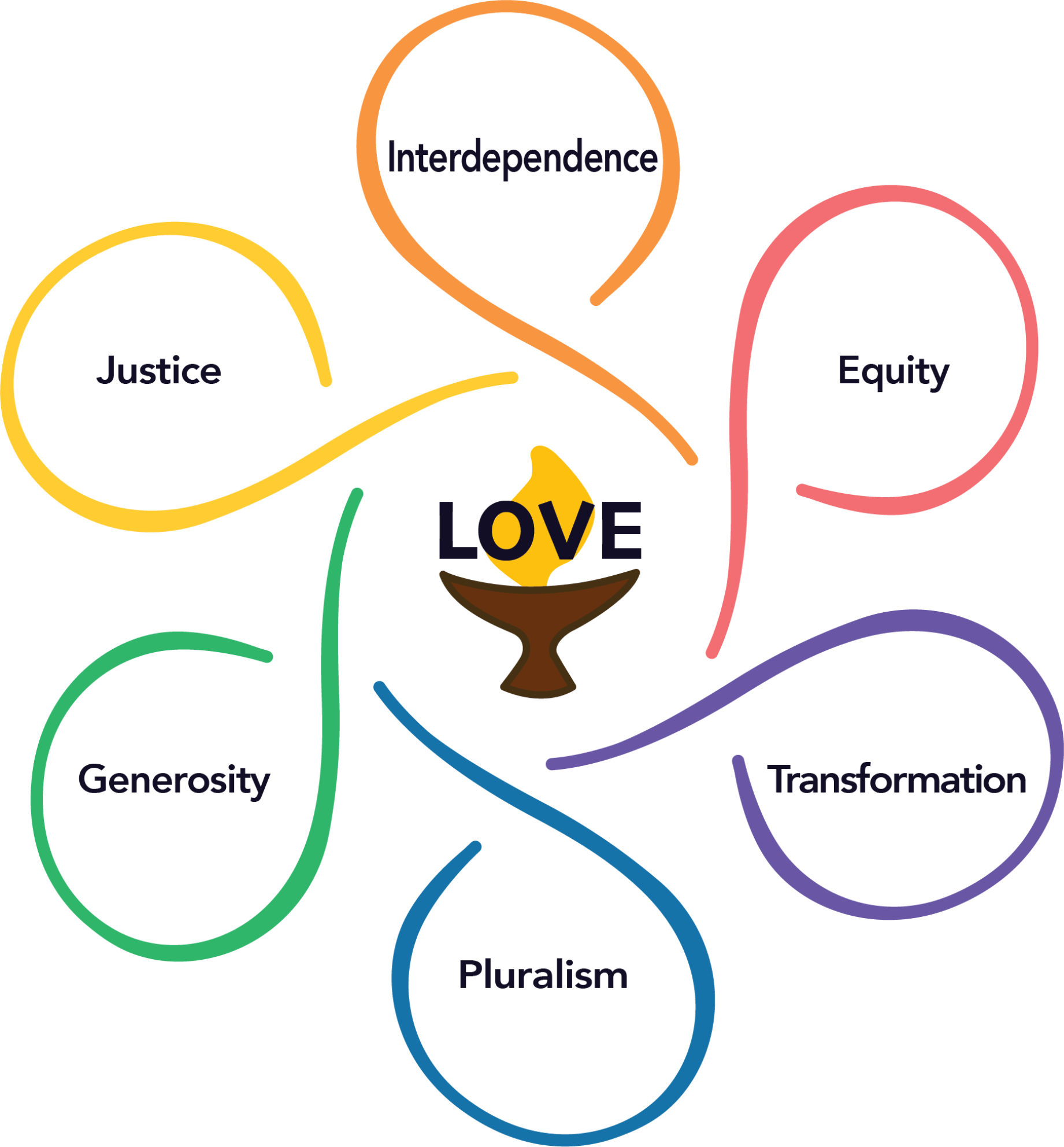
 Love Flower Graphic

Now, you may have noticed on the slides that both our UU faith and our church have one more value we uphold. Transformation.

Our UU faith defines transformation like this.

We adapt to the changing world. We covenant to collectively transform and grow spiritually and ethically. Openess to change is fundamental to our Unitarian and Universalist heritages. Never complete and never perfect.


Here at the church we simply say that transformation means to pursue the growth that changes our lives and heals our world. Personally, I like how our church defines transformation. It’s more concise. And I think it fits this transformative moment in which we find ourselves.

Because again, as our story earlier shows us, transformative times can lead to change that is healing, or they can lead to change that is harmful. And this transformative moment contains an element that looms even larger than the immediate election and that holds the potential to deeply violate our religious values.

A white, fundamentalist, Christian nationalist movement is alive and active in our country, and it has found political and public policy expression in a 922-page far-right conservative manifesto called Project 2025, created by the ultra-conservative lobbying and influence group, the Heritage Foundation.

Project 2025, in my opinion, would run counter to all that we value, decimate our democratic institutions and cause great harm to many, while greatly privileging, far, far fewer. Fewer who just happen to be mostly white, hetero-cis male theocratic fundamentalists.

Now, as a minister, I cannot, as part of an official church function, endorse a particular candidate either. I can, however, express what I think of their stance on particular issues, as long as I do so as only me, not on behalf of the church as a whole.

So, let me just say, not speaking on behalf of the church, he who was always white until a number of years ago when he happened to discover spray tanning and his running mate, J.D. Vanceypants have tried to distance themselves from Project 2025 and claim to know very little about it. Yet, J.D. Vance wrote the foreword for a book about it by the primary author of Project 2025, and more than 30 Trump associates helped create the document.

Trump has said of the Heritage Foundation, and I quote:

“They’re going to lay the groundwork and detailed plans for exactly what our movement will look like.”


But, I don’t know. Speaking only as me, maybe they’re not being entirely honest about this issue. That’s the pastoral way of saying they’re lying. Another more recent lie, as Project 2025 proves highly unpopular, the more people find out about it, is that they try to say that it has been put back on a shelf, as if they can’t take it right back off the shelf depending on how the election goes. And church member David Overton recently put together an excellent comparison of the party platforms in Texas. The legislation and policy proposals of one of those party platforms are derivative from and, if anything, more extreme than Project 2025 itself.

So what exactly is this Project 2025? Well, basically, it’s a blueprint for forming a theocratic authoritarian administration. As I said, it’s over 900 pages, so it’s impossible to cover all of their plans for every federal department this morning. Here, though, are just a few examples of what a presidential administration following Project 2025 would do, much of it within their first 180 days.

  • Eliminate job protections for and fire experienced qualified civil servants and replace them with partisans whose only job qualification would be loyalty to the conservative president.


They have already established a database of people who would serve in these positions.

  • Gut the Environmental Protection Agency.
  • End climate research.
  • Eliminate the National Oceanic and Atmospheric Administration, which includes the National Weather Service.
  • Reverse all LGBTQ plus federal protections and end all transgender health care under Medicare and Medicaid
  • Expel trans folks from the military as well as anyone requiring treatment for HIV.
  • Eliminate the Department of Education.
  • Revoke the Immigrations and Customs Enforcement Policy that prevents raids on churches.
  • Convert the Department of Health and Human Services to the Department of Life, tying benefits to traditional family structures,
  • Eliminating abortion as health care,
  • Utilizing the federal bureaucracy to effectively prevent access to abortion nationwide as well as to
  • severely limit access to contraceptives.
  • Restructure the Justice Department and the FBI to serve the aims of the presidential administration and
  • End enforcement of voting rights.


Well, these are just a few. It goes on and on and on. God, guns, and gays is back with a vengeance. And if anyone claims it is an overreaction to call Project 2025, a detailed plan for establishing a permanent white nationalist, Christo-fascist state. Listen to what Trump said just recently to a group of fundamentalists.

“Christians, get out and vote. Just this time, You won’t have to do it any more. You know what? Four more years, it’ll be fixed. It’ll be fine. You won’t have to vote anymore.”


Kevin Roberts, the president of the Heritage Foundation, was even more direct, saying, quote,

“We are in the process of the Second American Revolution, which will remain bloodless if the left allows it.”


To paraphrase Maya Angelou, when people tell you who they are, believe them the first time.

  • Interdependence
  • Equity
  • Generosity
  • Pluralism
  • Community
  • Courage
  • Compassion
  • Justice
  • Transcendence
  • Love

The kind of transformation we seek in our lives and our world, these are under seige by the wasp stings of a white suprimacist nationalism theocratic facist institutionalized patriarchy that has arisen during this Chrysalis time.

And so we, we must also raise up our religious values in the public square. We must become the pollinators of love and justice in our world, the butterfly siblings that dismantle all Project 2025 seeks to fortify and build in its place the beloved community.

So how do we do that? I don’t have all the answers. But right now, as Carrie mentioned in the announcements, we UU the Vote. Because when people vote, our religious values tend to become more actualized in public policy. So after the service today, join us in sending postcards, encouraging folks to vote. Consider serving as a poll worker during the election. Right now, we educate ourselves about Project 2025 And we inform and educate others about it because polling shows that even fairly conservative folks oppose it when they find out what is in it.

And right now, if you so choose, you can work for those who you believe are most likely to pursue laws and policies consistent with your values, values centered in love. Perhaps most importantly though, we must know that this transformative time will continue beyond this particular election. It will require more of us. Project 2025 will just try to become Project 2029 and so on.

So we take the long view. And one of the ways that we do that is by living our values in our daily lives. We build communities of love, joy, and justice such as this religious community. As our reading earlier said,

“We are attendants at the wake of the old way, and each of us through our actions, our thoughts, our work, and relationships is midwifing a new world into existence.”

And so in our lives, our actions small and large, our communities, our ways of being, we breathe our values into the world. We build a new way. We join with others bound for a new land of freedom and justice singing come and go with me along the way.


Author and activist Adrian Marie Brown writes,

How we are at the small scale is how we are at the large scale. The patterns of the universe repeat at scale. There is a structural echo that suggests two things.
  • One, that there are shapes and patterns fundamental to our universe.
  • And two, that what we practice at a small scale can reverberate to the largest scale.


Remember, my beloveds, we do what we can. How we live matters. How we live makes a difference. How we respond in transformitive moments has the potential to build the world about which we dream. This is our project.

Extinguishing the Chalice

We extinguish this flame, but not the light of truth, the warmth of community, or the fire of commitment. These we hold in our hearts until we are together again.

Benediction

I leave you with words from Octavia Butler.

All that you touch, you change.
All that you change changes you.
The only lasting truth is change.
God is change.

May the change we bring builds the beloved community.
Amen and Blessed be. Go in peace.


SERMON INDEX

Most sermons during the past 24 years are available online through this website. Click on the index link above to find tables of all sermons for each year listed by date (newest to oldest) with topic and speaker. Click on a topic to go to that sermon.

PODCASTS

Podcasts of this and other sermons are also available for free on iTunes. You can find them by clicking on the podcast link above or copying and pasting this link. https://itunes.apple.com/podcast/first-unitarian-universalist/id372427776
Foster and Adoption in Austin Info Session

Foster and Adoption in Austin

First UU Social Action Council is hosting an information session with Madison Pittman and Yaiika Fernandez, Foster Home Development Specialists from Austin’s SAFE Alliance (Stop Abuse for Everyone), on Sunday, October 20th at 12:30 p.m. in room 13.

Madison and Yaiika will be discussing the need for more foster, adoptive, and kinship parents, along with what people can do to support our current parents in the program if they don’t want to foster or adopt. They will be going over what is needed to become a foster or adoptive parent and provide information about the program (what they do, the process, restrictions, etc). 
 
Safe Alliance is the whole organization with 30+ programs in it, and their program, “Foster and Adopt in Austin,” is just a small part of it. Madison and Yaiika will also briefly go over other programs within Safe Alliance such as their Volunteer program and Safe-Line, and what those do in case anyone needs any of their resources. 

TXUUJM August

Border trip registration + UU the Vote

This is the last week to registefor the TXUUJM/Texas Impact border witness trip, coming August 18th – 21st, 2024. Continue here for more information and registration in the TXUUJM August newsletter. 

TXUUJM is also your source for Texas UU the Vote efforts this election year! We are thrilled to have a whopping 36 Texas UU congregations signed up for our TXUUJM Votes! efforts. We are more powerful together! 


NOTE: Action Hour is returning Thursday, August 15th.Thursday nights and the final Friday of each month — just in time for all the increased energy around the election. Sign up for TXUUJM emails, bookmark this page for events, and follow @txuujm on Facebook and Instagram.

2024 Pride Sunday

Listen to the sermon by clicking the play button above.

Rev. Michelle LaGrave and Carrie Holley-Hurt
August 4, 2024
First UU Church of Austin
4700 Grover Ave., Austin, TX 78756
www.austinuu.org

Come join us as we kick off LGBTQ Pride Week here in Austin! It takes courage to live authentically. We’ll have queer speakers, awesome music, and a glitter blessing. Come celebrate with us.


Chalice Lighting

This is the flame we hold in our hearts as we strive for justice for everyone. This is the light we shine upon systems of oppression until they are no more. This is the warmth that we share with one another as our struggle becomes our salvation.

Call to Worship

A PROTEST AND A PARTY
by Hannah Roberts Villnave

People sometimes ask:
Is Pride a protest
Or a party?

And the answer is
Of course
Yes.

And why not?

Why not
Rejoice as we resist
Dance as we demand change
Celebrate as we create community that delights in
All of who we are?

So bring all of that
With you this morning.

Bring your policy demands
Bring your glitter
Bring your supreme court broken heart
Bring your rainbow socks
Bring the emptiness you feel
For our siblings gone too soon.

Bring your Gloria Estefan remix
Bring your tender hope for change
Bring your most garish eyeshadow
Bring your spirit, tattered and battered
By a world that seems insistent on
Choosing fear and hate.

Gather up all these things
And bring them here
To a place where we don’t
Have to shoulder these burdens
Or celebrate these joys
Alone.

Come, let us worship Together.

Affirming Our Mission

Together we nourish souls, transform lives, and do justice to build the Beloved Community.

Reading

JESUS AT THE GAY BAR
By Jay Hulme

He’s here in the midst of it –
right at the centre of the dance floor,
robes hitched up to His knees
to make it easy to spin.

At some point in the evening
a boy will touch the hem of His robe
and beg to be healed, beg to
be anything other than this;
and He will reach His arms out,
sweat-damped, and weary from dance.

He’ll cup the boy’s face in His hand
and say,
my beautiful child
there is nothing in this heart of yours
that ever needs to be healed.

Sermon

NOTE: Carrie Holley-Hurt’s homily is an ai generated transcript.
Please forgive any errors.

Carrie Holley-Hurt

So, fun fact, pride at this church is actually my anniversary. Almost a decade ago I showed up at this church knowing nothing about you people and fell in love hard. So this is very exciting for me that I get to participate in this pride ceremony today. So when Reverend Michelle, who is generous, asked me what I wanted to do, how I wanted to contribute, I said, well, I want to give my testimony.

And I know that might be a little weird, but y’all, I come from a Pentecostal tradition, and so I’m going to give my testimony. And I hope that for those of you who were raised in a fundamentalist or otherwise soul-crushing church, that this does not trigger you. In fact, I hope my testimony is liberating and that it will inspire you to think about your own stories, your own narrative of growth and liberation.

So growing up I was different. I didn’t fit in at all. My body didn’t fit. My style didn’t fit. My mind didn’t fit. And I tried as best I could. I tried to act and look just like everybody else. I tried with clothes and hair, even got an eating disorder. I worked so hard to hide myself and to fit in all the right boxes. And then at some point that all just became too much. It was too hard, too stressful.

And after leaving my religion, I started to allow myself to be more me. And some of that included acting on my queerness. And it was freeing, but only up to a point, because I quickly found out that everyone I loved was not always loving about who I was. And so I stopped the process of coming out and went back into hiding, well, half-hiding because I couldn’t actually hide from myself anymore.

Then many years later, my own kid came out as queer, followed by several of my loved ones who are younger, and I realized that I never wanted them to go into hiding. I knew that they were perfect and wonderful as is. And I did not want the world to suffer because they felt the need to hide. So I came out again. I fully came out to my loved ones and this time I didn’t do it for their acceptance but as a display of my own acceptance and a really beautiful thing started to happen. I began the process of accepting all the parts of who I am, not just the queer part, but the neurodivergent part, the size of my body, my disabilities, in all of the ways that I will never conform to the societal standards of good enough.

I will never fit into those boxes. You see, in embracing myself I stopped embracing the boxes of patriarchy and internalized homophobia. When I decided I was going to fully embrace my queerness and stopped hiding it started to lose control over me. This to me is the beauty of queerness and those who have said yes to their queerness. They say, You, system of suprimacy, you don’t get to have control over me. I’ll not be confined by your boxes, the system that tries to punish me into conforming. You no longer get to call the shots.

So pride then is pointing to the liberation that is found in this act. Liberation on the most personal level. And please know that this message isn’t just for queer people. I love straight people. Some of my best friends are straights. Like my husband, who is a straight cis-man.

No, this message is for all of us because all of us need liberation. All of us feel the weight of the boxes that systems of supremacy try to force on us. The current contrived controversy with the Olympic boxers show us just how demanding and punishing these systems can be on all of us.

We all need the liberation of self. That deep embrace of our own inherent dignity and worthiness. And that comes when we stop conforming and we stop hiding ourselves. We embrace ourselves. And while I know not everyone can do this publicly, because it’s just not safe, I get it. When those of us who can – do. Let us all be those people. Let us continue to do the work of becoming a more radically welcoming church so that we can help others on their journey.

Thank you.


Rev. Michelle LaGrave

This is my story. Or a piece of it, anyway. A portion of the truth … that is me, that is my spouse, that is my family, that is you, that is all of us. Because I can’t really separate out my story from the stories of those I love, those I know, those I don’t know, but with whom I have crossed paths in some way. Our stories are interconnected because we are interconnected on the deepest level. Our stories go out into the world, shape and form each other, and then return to us, re-shaping and reforming ourselves, again and again.

This story is a Love story and I don’t mean a romantic, frilly sort of love, though that is a piece of it at times. I mean the kind of Love story in which people come to love themselves, and each other, in a most agonizingly authentic way and then have the courage to say to the world – “This is who I am!” and “This is who we are!”

The opening setting for this Love story, my Love story, is Andover Newton Theological School, a beautiful campus filled with tall trees and brick buildings, sitting on a hilltop just outside of Boston, Massachusetts, a rather typical New England scene. It began fifteen years ago, and I was deep in the process of ministerial transformation, of becoming a Unitarian Universalist minister. While my own faith tradition had a long history of welcoming, affirming, and marrying people of all sexual orientations, these were new practices, or emerging practices, for many of the faith traditions present at the school and were a frequent topic of theological conversation. As was the question of gender and gender identity. The very first openly transgender people were attending the school, and the very first transgender panel had recently been held. Gay marriage was only a few years old in Massachusetts and less than a year old in nearby Connecticut, where I am from. What I’m trying to say in setting this scene is that everything felt very new and fresh and groundbreaking in the area of GLBT rights. (Yes, it was still GLBT back then.)

And so it was within this cultural context, that I headed to the first day of class, Pastoral Care for GLBT People, with one of my best friends, Craig. We were joking around about something some of our friends had said about sexual attraction and how it works, and we decided to playa game, a bit of an experiment to bring back to the conversation. We would go to class and pick out the person who most immediately, without thinking about it, struck us as attractive and then share about it with each other later. As I scanned the room, I immediately noticed a very butch-presenting person – short, spiky hair, tats on her arms, thick, brown leather bracelet, cool sunglasses hanging around her neck. Oof. I immediately felt the attraction and wanted to get to know her, and so I went and sat kind of nearby. Afterward, I told Craig who I had chosen. It was the first time I ever admitted out loud to another person that I felt attracted to someone who was a woman or was genderqueer. I was in my late thirties.

About two months later, that person had become my girlfriend, my first, and only, girlfriend. Coming out on campus was relatively easy because I lived there, which was kind of like living in a fishbowl. I met up with her after an evening class and while walking around campus she took up my hand and held it. Boom! Done. I was out at seminary. Scary, but overall, not too painful.

What was terrifying was the prospect of coming out to my family and some of my friends. I was afraid of losing, or damaging, relationships with people I loved and cared about. And I did, but not the most important ones. Here’s where social location is important. I was a white, cisgender woman, well into adulthood, super well-educated, living in a liberal area of the country, following a calling to ministry in the most progressive faith tradition available. I had all of the advantages, all of the privileges, except for money, that would bode well for coming out, and still, coming out was terrifying. I risked, and experienced real loss. I lost relationships and I lost jobs. We all do. It takes courage to come out. Coming out is an act of resistance, coming out is an act of defiance, and coming out is an act of pride.

But my story, my Love story, did not end there. There was to be another coming out. Less than a year after meeting each other, my girlfriend came out as transgender. FTM, female to male, as we said back in the day. He had newly come into this identity, partly as a result of some of the work he had done at seminary. My girlfriend was really a transman. Many of you know him, as my spouse Micah. Yes, I married my ex-girlfriend. (That’s my favorite trans joke … Okay, it’s my only trans joke, but I really like it.)

So now we had a second coming out as well as a gender transition before us. These were hard, on both of us, in different ways. While I shared with you the story of my being attracted to a woman, having a first girlfriend, and using she/her pronouns to describe it all, that’s the story from my historical perspective. Now, both Micah and I avoid the use of his deadname and use he/him pronouns to talk about him at any age, long before he came out as trans, long before he came out as a butch lesbian, long before he played softball, long before he joined the Girl Scouts, back to when he was a little kid who played football on the playground with the other little boys, until they told him he couldn’t play anymore because he was a girl.

Returning to our Love story, that summer right after graduation, Micah came out to his family and friends, shared his new name and pronouns, and began gender-affirming care. We joined support groups for trans people and trans partners. We marveled at the way people began to treat us differently when they thought, incorrectly, that what they were seeing was a heterosexual couple. I got through some terrifying moments when I was afraid for his safety. One or the other of us often raged at the mistreatment he received, especially in relationship to his healthcare. And we got through it all, we still get through it all, with both Love and courage. By the next February, Micah had legally changed both his name and gender marker, and knowing we were to get married later that summer, also took on my last name and became Micah Shiloh LaGrave.

Our wedding was beautiful. We were married on the beach in Connecticut. I wore cargo shorts and a tiara. People who were walking along the beach joined in the circle of family and friends surrounding us for the ceremony, strangers welcomed in to the trans/partner wedding.

But before that, we worried that our wedding wouldn’t happen at all, or would only happen with great difficulty, at least legally. Because first we had to get a wedding license and even though Micah had all his gender marker papers in place, and even though gay marriage was legal in Connecticut, it wasn’t almost everywhere else. It was an exciting, but also fraught time. We worried the whole way down to get the license, and while standing in line, and while being helped. And we thought we were right to be worried, because as soon we handed over our papers it became clear there was a problem. The clerk took them in back and there was a lot of whispering and consulting going on before she came back and finally said, IIUmm, you both have the same last name? Are you related?/I We laughed with relief. They didn’t care that we were queer, they were concerned we might be committing incest! It never occurred to us it might be an issue that Micah had already taken my last name a few months back.

All of this is to say, that while there are moments of humor and misunderstanding, and lots of love along the way, coming out is long, hard, tough work. Coming out is never finally and fully over. It must be done again and again. And so it is, that we have Pride every year. We support those who are newly coming out and those who have been coming out for a long, long time. And we remember, that Pride began as a riot, led by trans women of color, as an act of resistance, and defiance, and of agonizing joy to throw off the cloak of oppression and finally act free by simply being ourselves – out loud, in public, and on the streets.

Pride says, still says – you cannot, will not hold me down. You policymakers, you legislators, you enforcers, you false prophets, you conservative religious fundamentalists, you oppressors, you the system, you cannot hold us down. We will persevere and we will survive as we have always done – whether we are lesbian, gay, asexual, bisexual, pansexual, polysexual, intersexual, transgender, non-binary, nonconforming, polyamorous, or plain old queer, we will persevere, we will survive! We are courageous! We are proud! And we will celebrate!

May it always be so, Amen, and Blessed Be.

Extinguishing the Chalice

We extinguish this flame, but not the light of truth, the warmth of community, or the fire of commitment. These we hold in our hearts until we are together again.

Benediction

As we go forth, we offer you this final blessing.

May you receive and reflect love, everywhere you go, and know-in your deepest heart and in every day – you matter and you belong.

May you hold on to hope and your inner sparkle even when discouragement and despair beckon.

May the beauty that is you shine out, bright as the stars from which we came and to which we will return.

Together may we make this a place of welcome and healing, of connection and plurality.

Together may we practice compassion and courage, seeing and celebrating and supporting each other.

Together may we be the sparkling force of love that our world needs.

Blessed by this community and by the divine, go forth and celebrate with pride!

Amen and Blessed Be


SERMON INDEX

Most sermons during the past 24 years are available online through this website. Click on the index link above to find tables of all sermons for each year listed by date (newest to oldest) with topic and speaker. Click on a topic to go to that sermon.

PODCASTS

Podcasts of this and other sermons are also available for free on iTunes. You can find them by clicking on the podcast link above or copying and pasting this link. https://itunes.apple.com/podcast/first-unitarian-universalist/id372427776
Veganistas Potluck Dinner

Veganistas Potluck Dinner

The Veganistas of Austin UU invite you to a Vegan Potluck Dinner on Saturday, August 10th at 6:30 p.m. in Howson Hall.
 
Sponsored by the Veganistas of Austin First UU and cosponsored by the Austin Vegan and Vegetarian Association.
 
All dishes will need to be vegan, meaning no animal products at all. i.e. no meat, fish, milk, cheese, animal broth, gelatin, or honey. This makes it so everyone in our group, vegans, vegetarians, and omnivores can eat anything at the potluck. It is helpful to bring a list of ingredients or even copies of your recipe! As a courtesy, be prepared to give information about allergens. 
 
For more information, to sign up for the potluck, or to ask questions about veganism please get in touch with Suzie Riddle at szriddle@gmail.com