

Podcast: Play in new window | Download
Listen to the sermon by clicking the play button above.
Nancy Mohn Bernard
June 22, 2025
First UU Church of Austin
4700 Grover Ave., Austin, TX 78756
www.austinuu.org
How centering love can help us build bridges during polarizing times.
Chalice Lighting
This is the flame we hold in our hearts as we strive for justice for everyone. This is the light we shine upon systems of oppression until they are no more. This is the warmth that we share with one another as our struggle becomes our salvation.
Call to Worship
He drew a circle that shut me out,
heretic, a rebel,
a thing to flout.
But love and I had the wit to win.
We drew a circle that took him in.– Edwin Markham
Affirming Our Mission
Together we nourish souls, transform lives, and do justice to build the Beloved Community.
Reading
From SACRED NATURE
By Karen ArmstrongThe Golden Rule “Do not do to others what you would not have done to you.” was developed independently by all the great religious traditions. It seems deeply rooted in human morality. It requires us to look into our hearts, identify what causes us pain, and then refuse to inflict that on anybody else. What’s more, this benevolence cannot be confined to your own congenial group. It has to be applied to everybody without exception. Compassion is the essence of religion and morality, and it is essential to the survival of humanity. That we constantly fail to put it effectively into practice is perhaps not surprising in that as it runs counter to our engrained selfishness, insisting that we dethrone ourselves from the center of the world. It requires us to regard others as equal to ourselves, refuse to put ourselves into a privileged category, and deem the needs, desires, and ambitions of our fellow human beings to be as valuable as our own.
Sermon
NOTE: This is an edited ai generated transcript.
Please forgive any omissions or errors.
A couple of weeks ago I finished my UU internship whereas my fellow seminarians chose to complete internships within the congregation or in social justice contexts like Texas UUJM. I chose to do my internship within the context of pastoral care.
And so for the past nine months I have been a chaplain resident with Seton Ascension. This experience can only be described as intense and I suspect it’s going to take me quite a while to process all the things that I have experienced during this time. In the role of chaplain I’ve been with people at their lowest and at their most vulnerable. I’ve been with the psychotic, the incarcerated, the dying, and the sick. I’ve looked suffering in the face and wrestled with the injustices of the world. I’ve been humbled again and again, humbled by the courage of others, humbled by my own ineptitude, and humbled by the mystery of life, in which there are no easy answers. Needless to say, I am not the same person that I was when I first started this position in August of 2024. My experience has been one of transformation.
Being a hospital and it’s one of the most challenging things I’ve ever done. I’ve sat with family members after suicides. I’ve comforted parents who have lost young children. And I’ve seen firsthand the damage caused by gunshot wounds, which, by the way, often take multiple surgeries before they can heal. There were times when I felt like quitting and times that I dreaded going to work. But what helped me get through these times and these low points, believe it or not, was our Unitarian Universalist theology. When I felt stretched to my limits, when I felt so burned out that I wanted to quit, I leaned into love.
Indeed, over this past year, I’ve spent a considerable amount of time reflecting on our article two revisions and I must say the changes have been a touchstone for me throughout my residency. Specifically I often found myself asking what it means to put love at the center both in terms of self-care and in terms of care for others for there were many times throughout the residency in which my ability to love was challenged by patients who are radically different from me and my beliefs. In other words, I’ve had many opportunities to put our theology to the test. And I’ve truly come to believe that centering love is the antidote that we need in today’s challenging world.
For the world in which we live is one of chaos. It’s a world that’s full of rapid changes. In the past five years alone, we have witnessed the advance of technology and AI, extreme geopolitical shifts, a fractured news media, and furthering climate change. And let’s not forget the recent pandemic. Ten years ago, it seemed as if we were moving towards a society that was progressive, open, and tolerant, and now we are seeing these reforms be upended. And those who are not cis-gendered, straight white men in general are being threatened. I’m not overstating things when I say that we live in a world that’s more polarized than ever.
It’s easy to get down about the state of the world, and yet my residency actually gave me hope. Gave me hope that there is power in the centering of love. When we center love, we are actually being subversive. Centering love is exactly what this administration does not want us to do. For when we put love at the center, we are able to build bridges, and building bridges is the only way that polarization will come to an end.
I’d like to begin with a story in which I was able to build such a bridge and put politics aside. During my first unit as CPE, Trump was elected president, and as a super lefty individual, I was angered by the outcome of that election. I was scared for all that his election implied, and I was scared for my friends and my family and my community. Almost immediately, I began to encounter patients with radically different political perspectives. One patient must have clocked me as being liberal the instant I walked through the door. I guess I looked very liberal. After introducing myself, the patient immediately returned his attention to Fox News, which was blaring loudly from his wall-mounted TV. He soon launched into a tirade about the messed-up state of America, explaining how Trump was going to fix all that was wrong. And as he spoke, he kept side-eyeing me as if daring me to challenge him.
And though I’m loath to admit it, I immediately felt the anger spark within. I knew he was trying to give a reaction out of me and to my chagrin it was working. Now I have no poker face at all and my face was actively growing warm and I’m sure turning super red in the moment. How could I possibly be expected to provide spiritual care to someone like this, especially when my emotions were written all over my face. I wanted to turn around and just march right out of the room. But instead I hit pause and I forced myself to take a deep breath or two. And then the many trainings that I had spent training took over the many hours I spent training. Instead of listening to his words, I tried a different tactic. I tried listening for his emotions and for his needs, a technique that I learned from the book Nonviolent Communication.
And suddenly I heard something very different from this man. I heard someone who was angry and I heard someone who felt forgotten, unheard, and unseen. In the instant I identified these emotions, a funny thing happened. My anger began to dissipate, and my heart began to feel with empathy. For I too have often felt unseen and unheard. I too know what it’s like to feel invisible, and how that can lead to anger.
When he finally took a pause from talking, I decided to do a perception check with him and asked about the feelings of anger and abandonment that I was hearing. Naming those emotions had this strange effect of silencing him, and to my surprise he suddenly grew tearful. Next thing I know, the conversation shifted, and he began to tell me about his loneliness and lack of support. He felt abandoned in the hospital, and he was scared for the outcomes of his health. We went on to have a deep and meaningful conversation. Our differences had disappeared. We were no longer conservative or liberal, but rather two human beings moving through life with all of its pain and beauty.
In this moment, I suddenly understood what it meant to put love at the center, at least in my specific pastoral care context. To center love is to look for the commonality, the humanity, and the vulnerabilities that we share with others. It means acknowledging that we are more alike than not, that we are interdependent, and it asks that we lead with this assumption. When we center love at the heart of our experiences and interactions, the other seven values, justice, equity, transformation, pluralism, interdependence, and generosity, they are the natural offshoots.
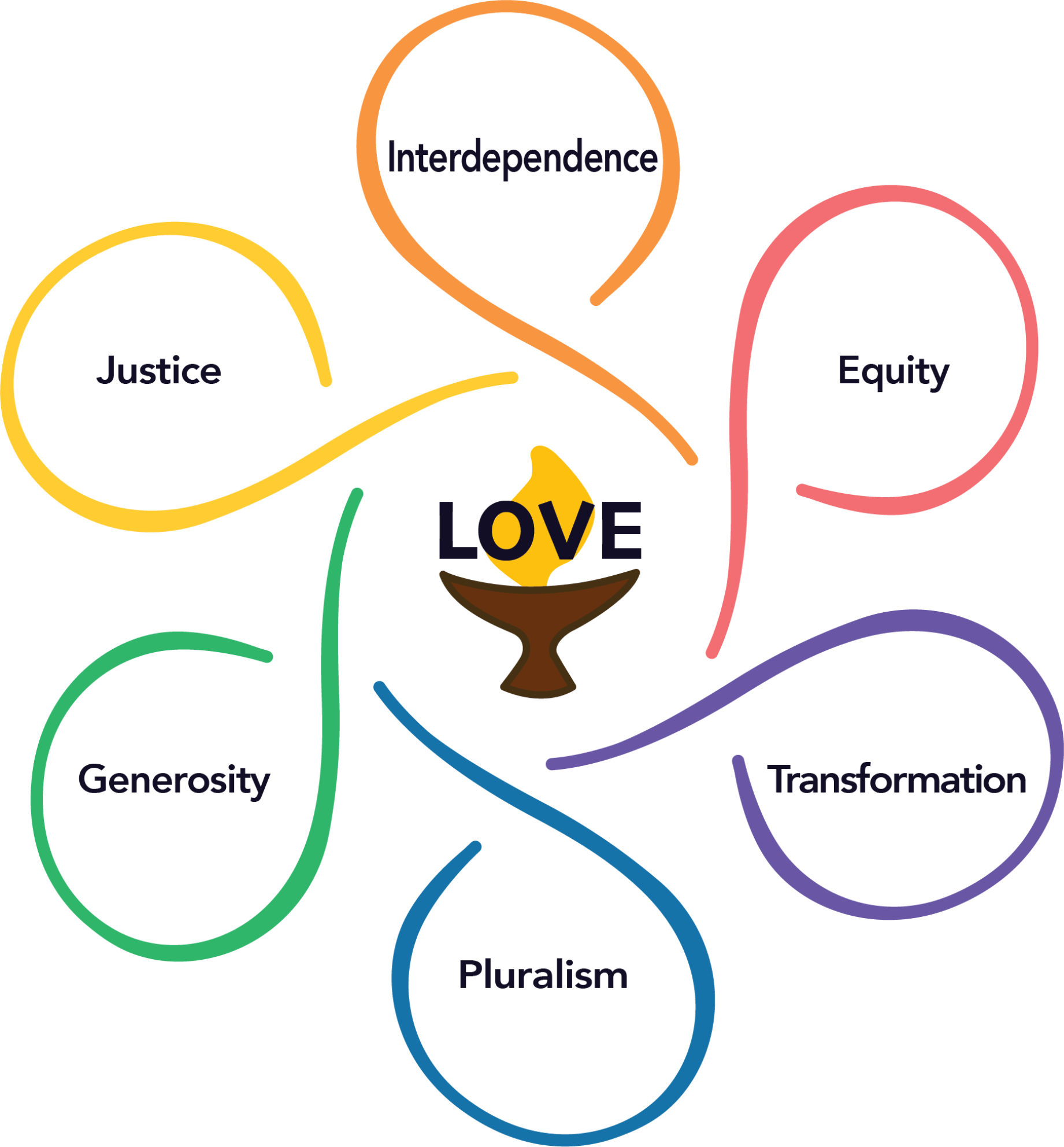
Indeed, I most often thought of archaeology during the first six months of residency, which I spent at Shoal Creek, the now closed psychiatric hospital for Seaton Ascension. It was there that I began to understand the Article Two revisions on a deeper level. It was at Shoal Creek that I learned how the aforementioned values are twined with the centering of love. It was at Shoal Creek that I witnessed firsthand the power of our theology in building bridges.
From the first day I walked through the doors, I fell in love with Shoal Creek. As a teaching hospital, it was staffed by doctors, residents, nurses, and social workers, all of whom were passionate about their jobs and strove to provide equitable and just care to a radically diverse group of people.
As mentioned, Shoal Creek was part of the Ascension Seed and System, which is Catholic and non-profit. And as such, Shoal Creek was charitable and did not turn away the uninsured. The resulting patient population was diverse from an array of backgrounds.
While many of the patients were experiencing homelessness, there were also wealthy private pay patients who didn’t want the stigma of a psychiatric hospitalization on their medical record. At a quick glance, it may seem unreasonable to expect these two populations to form a loving and supportive community. But being hospitalized, particularly in a psych ward, is the great equalizer, especially when half the people are wearing disposable blue paper pajamas.
Such hospitalizations strip away the trappings of society that mark our differences. With such trappings stripped away, the patients were able to see the humanity and the suffering in each other. And when one is able to share in the suffering of another, empathy occurs and a beautiful thing happens. Time and time again, despite their socioeconomic differences, I witnessed patients becoming friends and forming communities of care and support. The dispossessed and the wealthy, the young and the old, all found solace in each other’s company and wisdom. Despite the restrictions, despite the lockdowns, these patients somehow managed to discover something that eludes so many of us. At their lowest point, these patients saw themselves in the faces of their peers, a realization that led to empathy in the centering of love. They discovered that despite appearances, we are more alike than not. Everyone suffers. Everyone despairs. And everyone is in need of human connection.
Indeed, I heard again and again from patients there that there was something just magical about Shoal Creek. Now many of them had experienced multiple hospitalizations, and many of them had been to facilities much nicer than Shoal Creek. Shoal Creek indeed, some said, were the worst facilities by far. But nonetheless, it was still their favorite place. It was their favorite place because of the love and the care that they received from the staff. Such love and care allowed them to kind of relax a little bit and to connect and share done with each other.
The closing of Shoal Creek is arguably a social justice issue. They’re about to demolish the building itself sometime this summer, I believe. The psych population is one that is both marginalized and othered. Many psych patients are unemployed and therefore uninsured, and Shoal Creek is the only psychiatric hospital that would accept an unlimited number of uninsured patients. Unfortunately, this meant that the hospital operated at a significant and unsustainable budget and it has been forced to close its doors. Now much of this population will fall through the cracks. And while most hospitals do have a few available beds for the uninsured, most of those available beds can be counted on one hand.
The situation frustrates me. I know it’s unreasonable and unsustainable for systems to operate at such a deficit, and I’m grateful to see it in Ascension for allowing Shoal Creek to do so for so many years. But the truth is that the system is broken. We live in a capitalistic society that centers money and not love. We value the individual, and not the interdependent web of existence, of which we are all apart.
As many of our greatest minds have pointed out, we can judge a society by how its weakest members are treated. In this country, we choose to ignore our humanity when we choose to ignore the dispossessed. But when we center love, we become generous individuals. We are generous with our tolerance, generous with our judgments, and generous with our ability to see the commonality in humanity and others, even those who differ from us politically. It is generosity that truly fuels my care, and it is generosity that we need now more than ever in this world, for we must be generous with love and how we define it.
To truly put love at the center, we must find a way to build bridges, to focus not on our differences, but on our shared experiences of humanity. I saw suffering psychiatric patients do what many of us cannot, put politics aside, center love, and come together.
Now I won’t lie, placing love at the center is incredibly hard to do and I haven’t always been successful at this. When someone makes threatening or disparaging remarks towards the oppressed, my friends and family or my community, I get angry and not so nice words have been known to leave my mouth. And I wonder how are we supposed to love those who have no interest in trying to love us. How do we hear past the hateful rhetoric? Bridge-building sounds all well and nice, but how do we love those who are so determined to hate?
I admittedly don’t have all the answers to these questions, but I believe that a good starting point is Marshall B. Rosenberg’s book on Nonviolent Communication, which I mentioned at the beginning of this sermon. When we are faced with a vitriol of others, it can be helpful to try to listen to the emotions behind the words. So often people just want their emotions to be validated. So often they just want to be seen and to be heard.
To truly center love means approaching people with openness and curiosity, which admittedly is hard, especially when those very same people are doing their best to make us feel angry and defensive. But again, to do so is an act of subversion. It is choosing to not give in to the hate, for that is exactly what they want. When we give in to the hate and anger, we are feeding into a polarized culture, giving it sustenance. When we give in to the hate and anger, we allow the extreme rhetoric and hate to win.
Now, centering love and trying to find our shared humanity doesn’t mean that we agree with the haters. Indeed, once upon a time in this country, we knew how to have differences of opinion and still respect one another. We knew how to engage in discourse, to listen to one another even when we don’t share the same opinions. I am asking us to lean into our theology of centering love, because it’s the only way that we will be able to engage in such discourse again. I’m asking us to try and find the commonality to find a way to bridge this gap of polarization. For we must try, because digging into our differences is not working. It is only making the divisions wider and As these divisions grow finding a solution becomes an increasingly impossible task.
So as we leave here today I ask you to consider what putting love at the center looks like in your own lives. How can we hear past the anger, to build bridges and not walls. How do we lead by example and model the change that we hope to see?
Extinguishing the Chalice
We extinguish this flame, but not the light of truth, the warmth of community, or the fire of commitment. These we hold in our hearts until we are together again.
Benediction
BLESSINGS SHALL FOLLOW US
by Rev Dr. Rebecca A. SavageAs we end our time together today in spiritual community, may we depart this sacred space, knowing that blessings shall follow us all the days of our lives, if we live in and return to right relationships, if we extend grace and forgiveness to ourselves and others, if We behold mercy as a spiritual superpower, if we emanate the greater love that holds us close. May our lives radiate the blessings that we have been given, may kindness and compassion fall gently from us, and may there be peace in the world, and may it begin again with us.
Blessed be.
Most sermons during the past 25 years are available online through this website. Click on the index link above to find tables of all sermons for each year listed by date (newest to oldest) with topic and speaker. Click on a topic to go to that sermon.
Podcasts of this and other sermons are also available for free on iTunes. You can find them by clicking on the podcast link above or copying and pasting this link. https://itunes.apple.com/podcast/first-unitarian-universalist/id372427776
