Help make First UU a Truly Welcoming Space!

The church is especially in need of volunteer greeters and ushers. Both are great ways to meet your fellow church participants. To find out more about volunteering just send an email to info@austinuu.org

Our church connections ministry also needs folks to talk with their fellow church participants about how they might find transformative ways to participate in the life of the church. Email connections@austinuu.org to find out more.

Continuing Capital Campaign

The Continuing Capital Campaign kicked off Saturday, February 3rd, as part of an early “Valentine” celebration of the love we share. The CCC aims to pay off the current mortgage that was taken out to cover the renovations to the facility that exceeded the original campaign.  For more information about the CCC, please visit our table in Howson Hall and consider a commitment to this program! Our goal is $1.2 million to completely repay the debt and cover contingencies.

Monthly Service Offering for February

Mobile Loaves & Fishes is a social outreach ministry that has been empowering communities into a lifestyle of service with the homeless since 1998. Often referred to as the most talked about neighborhood in Austin, Community First! Village is a master planned development that provides affordable, permanent housing and a supportive community for men and women coming out of chronic homelessness. Check out this Goodness is Love in Action video and learn more mlf.org.

Denominational Connections

This is a busy time in our denomination. Here are a couple of things you may want to know:

1) Israel/Palestine
The UUA has issued a statement on “the Humanitarian Catastrophe in Gaza and Israel
Church leaders, including our UUA President Rev. Dr. Sofia Betancourt, have sent a letter to President Biden urging him to support demilitarization and humanitarian aid to Palestinians.

2) General Assembly – this is where UU’s come together to worship, celebrate, learn, and make decisions. For 2024 GA will be June 20 – 23, and will be completely virtual! This will make it much easier to attend and fully participate. Visit www.uua.org/ga for more information and registration. 

For questions about GA or other denominational activities, contact David Overton at denom@austinuu.org

Pi Day Party

Join First Unitarian Universalist church on Sunday, March 17 for a Pi Day Pie Contest.  Bake your favorite sweet, savory, or vegan pie for a chance to win a prize.

To Enter: 

  1. Bring a pie on Sunday, March 17 to Howson Hall before service. (3.17 is close enough to 3.14159265)
  2. Place pie on the correct category table. Savory, Sweet, or Vegan
  3. Fill out a contestant card.  

After service, we will announce the winners for each category in Howson Hall.

Extra pies to share and not compete are welcome too. 

Want to be a judge?  Contact Shannon at info@austinuu.org.

Chris Jimmerson’s Installation

Listen to the sermon by clicking the play button above.

Rev. Chris Jimmerson and a Host of Invited Clergy
February 17, 2023
First UU Church of Austin
4700 Grover Ave., Austin, TX 78756
www.austinuu.org

We come together as a church family with clergy and guests to joyfully celebrate Rev Chris Jimmerson’s formal intallation as our setted minister.


WELCOME: Gretchen Riehl

GREETINGS: Natalie Briscoe

CHALICE LIGHTING – Rev. Neil Newton

This is the flame we hold in our hearts as we strive for justice for everyone. This is the light we shine upon systems of oppression until they are no more. This is the warmth that we share with one another as our struggle becomes our salvation.

CALL TO WORSHIP: Rev. Kathleen Ellis

READING: Rev Jonalu Johnstone

“THAT WHICH HOLDS ALL”
by Nancy Shaffer

Because she wanted everyone to feel included
in her prayer,
she said right at the beginning
several names for the Holy:
Spirit, she said, Holy One, Mystery, God.

But then thinking these weren’t enough ways of addressing
that which cannot fully be addressed, she added
particularities, saying,
Spirit of Life, Spirit of Love,
Ancient Holy One, Mystery We Will Not Ever Fully Know,
Gracious God, and also Spirit of this Earth,
God of Sarah, Gaia, Thou.

And then, tongue loosened, she fell to naming
superlatives as well: Most Creative One,
Greatest Source, Closest Hope –
even though superlatives for the Sacred seemed to her
probably redundant, but then she couldn’t stop:

One who Made the Stars, she said, although she knew
technically a number of those present didn’t believe
the stars had been made by anyone or thing
but just luckily happened.

One Who Is an Entire Ocean of Compassion,
she said, and no one laughed.
That Which Has Been Present Since Before the Beginning,
she said, and the room was silent.

Then, although she hadn’t imagined it this way,
others began to offer names.

Peace, said one.
One My Mother Knew, said another.
Ancestor, said a third.
Wind.
Rain.
Breath, said one near the back.
Refuge.
That Which Holds All.
A child said, Water.
Someone said, Kuan Yin.
Then: Womb.
Witness.
Great Kindness.
Great Eagle.
Eternal Stillness.

And then, there wasn’t any need to say the things
she’d thought would be important to say,
and everyone sat hushed, until someone said

Amen.

PRAYER – MEDITATION – INVOCATION: Rev. Michelle LaGrave

ANTHEM: Brent Baldwin, voice, and guitar

“I STILL BELIEVE”
Dolly Parton

SERMON: “Exercises in Attention” – Rev. Dr. Nicole Kirk

ACT OF INSTALLATION


Gretchen Riehl:
No right is more precious to a free congregation than that of choosing its own minister. By the same token, no right is more precious to a Unitarian Universalist minister than that of choosing the congregation they will serve. This is fundamental to our sacred tradition of shared leadership.


It is with profound feeling, therefore, that we formally recognize the covenantal relationship now existing between the people of the First Unitarian Universalist Church of Austin and the Reverend Chris Jimmerson, whom we have freely chosen and who has freely chosen us.

Our choice is based not only on heritage but also on the hopes and aspirations we have for the future. This service symbolizes our dedication to new efforts.

We affirm by this act the goals toward which we strive and the ideals by which we are sustained and strengthened. Will the members of The First Unitarian Universalist Church of Austin please rise and join me in the following words.

Members:
We cherish our church for its historic achievements and for its dedication to our living traditions in which revelation is ever unfolding.

We celebrate its devotion to freedom and its commitment to building the Beloved Community.

We, the members of the First Unitarian Universalist Church of Austin, do hereby install you, Reverend Chris Jimmerson, as our settled minister.

For our part, we pledge to walk with you in the ways of truth, justice, and the spirit of love. We offer you a free pulpit, the cooperation of our hearts and hands, and our resolute goodwill as you take up your new path among us.

Rev. Chris Jimmerson:
With joy and a deep sense of responsibility, and with gratitude for your confidence, I take up the ministry to which you have called me.

I pledge to maintain the freedom of the pulpit, to speak truth in love, and to fulfill the many duties of ministry. Above all, I will cherish and cultivate the ways of love, justice, spiritual nourishment, and growth, working with you toward transformation within these church walls and beyond them.

I humbly and joyfully accept your offer of covenantal relationship and shared ministry.

Gretchen Riehl:
Will all who have not yet risen – colleagues, family, and friends please rise in spirit or in body to bear witness to this act of installation?

All:
We do hereby affirm this installation and this ministry. May congregation and minister both be blessed with strength and wisdom in the years of holy work ahead.


PRESENTATION OF GIFTS: Gretchen Riehl and Susan Thomson

CHARGE TO THE MINISTER Rev. Joanna Crawford

CHARGE TO THE CONGREGATION Rev. Dr. John A. Buehrens

CLOSING MUSIC Introduced by Rev. Michelle LaGrave

“ALL WILL BE WELL”
Rev. Meg Barnhouse and Kiya Heartwood

EXTINGUISHING THE CHALICE Rev. Lee Legault

BENEDICTION: Rev. Chris Jimmerson


SERMON INDEX

Most sermons during the past 24 years are available online through this website. Click on the index link above to find tables of all sermons for each year listed by date (newest to oldest) with topic and speaker. Click on a topic to go to that sermon.

PODCASTS

Podcasts of this and other sermons are also available for free on iTunes. You can find them by clicking on the podcast link above or copying and pasting this link. https://itunes.apple.com/podcast/first-unitarian-universalist/id372427776

Public Affairs Forum

Upcoming Speakers


Sunday, September 22: Bob Hendricks – “Citizens’ Climate Lobby”
 
Sunday, October 20: Brigid Shea  – “Travis County Commissioner”
 
November 10: Veronica Cortrez and Brian East – “Disability Rights in Texas”
 
Sunday, December 8: Dyana Limon-Mercado – “Travis County Clerk”
 
Sunday, January 12: James Harrington, Civil Rights Attorney – “Founder  of Texas Civil Rights Project”


Talkin’ bout a Revolution

Listen to the sermon by clicking the play button above.

Rev. Chris Jimmerson
February 11, 2024
First UU Church of Austin
4700 Grover Ave., Austin, TX 78756
www.austinuu.org

In our mission, we say that we “do justice”. What if truly doing justice requires not just new ways of thinking but new ways of being? Equity instead of equality? Liberation versus liberalism? Proximity rather than paternalism? What if we moved beyond charitable compassion to a love that is revolutionary?


Chalice Lighting

This is the flame we hold in our hearts as we strive for justice for everyone. This is the light we shine upon systems of oppression until they are no more. This is the warmth that we share with one another as our struggle becomes our salvation.

Call to Worship

If one really wishes to know how justice is administered in a country, one does not question the policemen, the lawyers, the judges, or the protected members of the middle class. One goes to the unprotected those, precisely, who need the law’s protection most! – and listens to their testimony. – James Baldwin

Affirming Our Mission

Together we nourish souls, transform lives, and do justice to build the Beloved Community.

Reading

To be hopeful in bad times is not just foolishly romantic. It is based on the fact that human history is a history not only of cruelty, but also of compassion, sacrifice, courage, kindness.

What we choose to emphasize in this complex history will determine our lives. If we see only the worst, it destroys our capacity to do something. If we remember those times and places – and there are so many – where people have behaved magnificently, this gives us the energy to act, and at least the possibility of sending this spinning top of a world in a different direction.

And if we do act, in however small a way, we don’t have to wait for some grand utopian future. The future is an infinite succession of presents, and to live now as we think human beings should live, in defiance of all that is bad around us, is itself a marvelous victory.

– Howard Zinn

Sermon

I want to share something with you.

VIDEO

That’s Danez Smith, award winning poet, writer, and performer who identifies as queer, non-binary, and HIV positive.

It is part of their poem “Principles”.

If you get the chance, it is well worth watching the rest of their performance, which you can find on YouTube. Their words demand to be heard.

Because Danez Smith isn’t calling for incremental fixes to a country filled with so many systems of oppression and denial that we can no longer believe that those systems are “broken”.

When year after year, we witness the continued killing of unarmed BIPoe folks by law enforcement – When one out of every seven police interventions results in bodily injury – When we know that one out of every eight black person in the U.S. will be sent to prison –

When year after year after year, despite both so called liberal and so called conservative interventions, inequities by race, gender and gender identity, sexual orientation and more continue to persist in employment, income, wealth, housing, healthcare, education, food and nutrition, well just about every facet of life in the U.S., every system and sector of our society, we have to face the reality that these systems are not broken.

They are functioning exactly as they are intended.

They are concentrating more and more wealth and power within the control of fewer and fewer folks.

And still, most of them white. Most of them male. Most of them heterosexual. Most of them Cis. Most of them already born into power and wealth to begin with.

That’s the system.

So, Danez Smith is crying out not to repair America around the edges, but to replace our fundamental societal structures with something entirely new that lives up to the values of justice, liberty, and the potential for human dignity and fulfillment we claim to hold.

Here is more of what they have to say:

i want to be a citizen of something new.
i want a country for the immigrant hero.
i want a country where joy is indigenous as the people.
i want a country that keeps its word.
i want to not be scared to drink the water …
i want a country not trying to cure itself of me …
I want a nation under a kinder god.
I want justice the verb not justice the dream.”

Danez Smith is “talkin bout a revolution”. My words, not theirs.

Well, those of Traci Chapman in the lyrics of her song we heard earlier.

And so, if are to make justice a verb, to do justice as we say in our mission, if we are to tear down the systems of injustice we have now and build new ones – build The Beloved community – we need a revolution in our ways of thinking and being in our world.

Folks as diverse as Bryan Stevenson, social justice activist and law professor to faith activist Rev. William Barber, provide what I think are at least fours ways in which we can create that revolution.

The first is to root our work for justice in a theology that moves and sustains us.

Now that word theology can sometimes freak out some Unitarian Universalists (UUs for short) because it can imply a creedal belief system involving a God or Gods.

But it does not have to involve these things.

Rev. Dr. Elias Ortega, of our UU Meadville Lombard Theological School describes how theology can be “practices of being, thinking, and acting in the world” that move us toward that which we hold most vital.

For Unitarian Universalism, our theology grows out of traditions embracing the unity of all life and creation and a universal love that flows through our universe and our lives.

Our is a living, ever evolving theology of collective liberation, that values all people and beings, especially lifting up those of us who experience marginalization and inequity.

It is a relational theology that recognizes that each of us can only reach for our fullest creative potential when all of us are able to do so.

In the famous words of Rev. Dr. Martin Luther King, Jr. “Injustice anywhere is a threat to justice everywhere. We are caught in an inescapable network of mutuality, tied in a single garment of destiny.”

We need one another.

The revolution, the Beloved community, can only become when it is co-created by us all.

And such a theology moves us to the second way we might build a justice revolution.

In the late 80s and early 90s, I was involved in non-profit HIV / AIDS research, education, treatment and humans services.

All greatly needed because so many people were suffering and dying from the disease.

And even though I could see every day how much this charitable work was necessary, I started to grow more and more depressed and disillusioned, as more and more people I had come to know and love died, one after the other.

I remember at one point looking through my contact list and realizing that at least a third of the people in it had died of the disease.

And so I began to realize that only providing charitable support, as much as it was needed, was doing nothing to address the systemic racism and anti-LGBTQ bigotry that were blocking people from learning how to keep from getting the disease in the first place and accessing treatment once exposed.

I began to see the complete lack of humanity in a healthcare system and drug development process that exist to worship the Gods of profit at the expense human life and wellbeing.

And so I knew I had to also get involved in activism and building new systems to replace those that were quite literally killing people.

Research from Darren Walker of the Ford Foundation reveals that the vast majority of charity in the U.S. actually goes from the wealthy to the wealthy – to healthcare facilities, institutions of higher education and the like that serve mainly the very rich.

And as I had discovered with HIV/AIDS, charity, wherein most often the powerful determine what and how to give to the less powerful, can frequently serve to uphold systems of inequity by alleviating just enough pressure to prevent the rebellion against them that might otherwise arise.

As educator and philanthropic innovation researcher Laura Arrillaga-Andreessen says, “Charity is about helping people survive. Justice is about helping people thrive.”

A theology of collective liberation moves us beyond charitable compassion toward a revolutionary love that dismantles the unjust systems creating the need for charity in the first place.

And this leads us to a third and corresponding way we can revolutionize how we do justice.

A relational theology requires us to be in proximity to those with whom we are trying to be in solidarity.

Mother Teresa once said, ” … it is fashionable to talk about the poor, it is not so fashionable to talk with them.”

We call for justice, yet we don’t want the multi-family, low cost housing project in our neighborhood.

We prefer to drive across town to volunteer for the charity health clinic.

And don’t put that homeless shelter in the old hotel down the street.

And lest we think this is a conservative versus liberal issue, research indicates that liberal enclaves are some of the most segregated in the country.

As our call to worship pointed out earlier though, to change systems, we have to be in conversation with those who are most affected by those systems.

And, further, collective liberation theology calls us to follow their lead.

In 2015, I joined a group ofUU’s from across the country in Selma, Alabama at the 50th anniversary commemoration of the march for voting rights across the Edmund Pettus Bridge.

Several of the mostly white UU s there had to be told that, no, they would not be at the front of the commemorative march across that bridge.

The black folks who had organized the event and whose lives had after all been most affected by the history being remembered were perfectly capable of leading their own march.

Here’s an example of when we’ve done better.

First UU helped to form the Austin Sanctuary Network, and from the beginning the sanctuary network has centered in its leadership folks most affected by our inhumane immigration system.

Collective liberation theology moves us from paternalism to proximity.

Finally, I believe that our faith is strong enough, our underlying theology powerful enough, that it can sustain us through the discomfort in which we will have to dwell at times in our journey toward transformation.

Discomfort?

What in the world is Rev. Chris on about now?

Go with me for just a moment into some discomfort that exists right here within this here very church.

We have had a lot of surveys, listening sessions, and the like in the church over the last couple of years, haven’t we?

Well, some themes around where we feel discomfort have occasionally emerged.

For instance, we want First UU to be a strong force for justice in our world.

And there is some discomfort talking about politics in church.

But you know, a lot of what happens regarding justice or injustice, is enacted through legislation or through court rulings, both of which are driven by politics.

So, while we are prohibited from supporting political candidates or parties, we must move through any discomfort around justice-related political issues, whether in church or in the public arena.

I can assure you our fundamentalist faith counterparts have no such discomfort.

And further, given the need for revolutionary change that Danez Smith proclaims in their poem …

And given that far too often our political choices these days seem to be between regressivism at worst and painfully slow incrementalism at best, we will need even more than political engagement.

We will need more than protests and marches.

We will be required to dream of new societal systems and structures and to begin living out them out, sometimes in rebellious ways, within our daily lives.

And that can be extremely uncomfortable for those of us for whom the current systems provide privilege.

As author and activist Arundhati Roy says of war, “Colorful demonstrations and weekend marches are vital but alone are not powerful enough to stop wars. Wars will be stopped only when soldiers refuse to fight, when workers refuse to load weapons onto ships and aircraft, when people boycott the economic outposts of Empire that are strung across the globe.”

UU theologian (and one of my favorite people), Sharon Welch, applies this to the many aspects of our lives in her book, “After the Protests are Heard“.

She writes that we must notice “the ways ways our everyday decisions already create more justice.”

And though that awareness may sometimes bring discomfort, changing even small acts in our daily lives, as our reading earlier described, germinates seeds of hope and transformation.

Here are some of Danez Smith’s thoughts on that hope.

VIDEO

My beloveds, rooted in faith, we can move the mountain. Sustained by a theology of liberation for all of us, every single one of us, now, now, we’re talkin’ bout a revolution.

Benediction

As we go out into our world now, may you carry with you a sense of the great river of love that flows through our universe and through each of us.

A revolutionary love that moves us toward equity, justice, and the realization of the Beloved Community.

May you also carry with you the love of this religious community, until next we are gathered again.

May the congregation say, “Amen”, and “blessed be”.

Go in peace.


SERMON INDEX

Most sermons during the past 24 years are available online through this website. Click on the index link above to find tables of all sermons for each year listed by date (newest to oldest) with topic and speaker. Click on a topic to go to that sermon.

PODCASTS

Podcasts of this and other sermons are also available for free on iTunes. You can find them by clicking on the podcast link above or copying and pasting this link. https://itunes.apple.com/podcast/first-unitarian-universalist/id372427776

2024 Animal Blessing Service

Listen to the sermon by clicking the play button above.

Rev. Chris Jimmerson and Rev. Michelle LaGrave
February 4, 2024
First UU Church of Austin
4700 Grover Ave., Austin, TX 78756
www.austinuu.org

Join us for an all ages service to bless the beloved animal companions in your lives. All friendly, well-behaved creatures young, old, great and small, furry and scaly are invited to this cherished annual tradition.


Chalice Lighting

This is the flame we hold in our hearts as we strive for justice for everyone. This is the light we shine upon systems of oppression until they are no more. This is the warmth that we share with one another as our struggle becomes our salvation.

Call to Worship

Ask the animals and they will teach you.
Or the birds in the sky and they will tell you.
Or speak to the Earth and it will teach you.
Or let the fish in the sea inform you.
Which of all these does not know the breath of the divine has done this.
In whose care is the life of every creature and the breath of all human kind.

– Job 12, 7-10

Affirming Our Mission

Together we nourish souls, transform lives, and do justice to build the Beloved Community.

Reading

THE SOULS OF ANIMALS
by Rev. Gary Kowalski

Sense a solitude you can never fully enter into or understand.

Be aware that this is a being who has known hardships and hurts you can never imagine. This is a being who has known moments of wildness and innocence that you can never share.

Yet this is a creature who has desires like you. It walks the same ground and breathes the same air. It feels pain and enjoys its senses – the dazzling warmth of the sun, the cooling shade of the forests, the refreshing taste of pure water – as you do.

And in this we are all kin.

In that kinship, all life exists. Through that kinship, we can find wholeness. Out of that kinship we can draw wisdom and understanding for the healing of our common home.

Sermon

Text of this sermon is not yet available.

Animal Blessing

For all the ways you enliven my days
I bless you.

For moments of oxytocin induced bliss
I bless you.

For knowing how I am feeling, often before I do
I bless you.

For so many moments of joy and laughter
I bless you.

For entrusting me with providing you with care and nourishment
I bless you.

For providing me with care and comfort
I bless you.

For helping me to find my center during times when I have struggled
I bless you.

For all the many ways you bless me more than I ever could you.
I bless you. I bless you. I bless you.

Benediction

“BENEDICTION FOR A PET BLESSING”
by Rev. Chris Jimmerson

Show joy when you first see your loved ones after being apart.

Except in the most dire of situations, retract your claws (unless it is all in good, playful fun).

Knock something off the shelf every once in a while, it’s fun and can open up new possibilities.

Delight in simple joys. Play a lot.

Never try to persuade humans to be reasonable.

Purr loudly or wag your whole body when you’re happy.

Sometimes a good howl or some hissing can help a lot, just avoid biting, which can get you in lots of trouble. Nap just for the pleasure of it.

Comfort others: accept comfort when you are able. Love freely, but never lose yourself in doing so.

May the congregation say, “Amen” and “Blessed Be”. Go in peace.


SERMON INDEX

Most sermons during the past 24 years are available online through this website. Click on the index link above to find tables of all sermons for each year listed by date (newest to oldest) with topic and speaker. Click on a topic to go to that sermon.

PODCASTS

Podcasts of this and other sermons are also available for free on iTunes. You can find them by clicking on the podcast link above or copying and pasting this link. https://itunes.apple.com/podcast/first-unitarian-universalist/id372427776

BIPOC Virtual Retreat

Bay Area DRUUMM and the Unitarian Universalist Church of Berkeley (UUCB) DRUUMM Members invite you to a virtual Zoom retreat this Saturday.

In the midst of life’s challenges, this retreat offers a sacred space for connection and healing. We will bring forth and delve into the wisdom of our ancestors as we explore timeless practices that cultivate resilience. Through guided discussions, reflective activities, and shared experiences, you’ll find solace in the company of like-minded individuals. 

This retreat is a sanctuary for fostering a sense of community, providing support, and discovering the strength that lies within each of us.  Come and embrace the power of shared stories, ancestral wisdom, and resilient activities to navigate the uncertainties of 2024 together. You are not alone; join us on this journey of healing and empowerment.  

Please RSVP to AdultEd@uucb.org to receive the Zoom Link for Saturday, February 10.


Mosaic

Ready to go deeper in your Anti-racism/Anti-Oppression/Multicultural transformation work in your congregation or organization? Are you eager to connect with others doing transformation work in their congregations?   

The next round of Mosaic Skill Up Learning and Practice Communities start in February! Sign up here!

Mosaic Skill-up Learning and Practice Communities are facilitated small group experiences helping leaders develop the skills and accountability they need to engage in effective AR/AO/MC transformation work in their context. These 3-month skill-up groups help you form meaningful connections, receive support and feedback as you implement your learnings, and tend to your own spiritual well being. Participants are expected to commit to the entire group.

What can I expect from a Skill Up group?

Groups meet every other week on Zoom and are led by trained facilitators. Groups include a combination of community building, personal reflection, learning about topics relevant to the participants’ contexts, and identifying an “accountability action” each person commits to doing between sessions to deepen their growth toward liberation.

What groups are available?

Groups will start in February. Our current sessions include:

Religious Professionals L&P Group (Wednesdays 4:00 PM Eastern / 3:00 PM Central / 2:00 PM Mountain / 1:00 PM Pacific / 12 PM AT / 11 AM HT)

General L&P Group (Tuesdays 12:00 PM Eastern/11:00 AM Central/10:00 AM Mountain/9:00 AM Pacific)

Wait—none of those work for me? Now what?

As we continue to expand this program we will offer more groups and different times. Watch for future announcements or fill out the form to be contacted as groups open.

BIPOC group coming fall 2024.

Is there a group you would like to see? Let me know.

Awesome! How do I sign up? Register for spring Mosaic Skill Up Groups

Interested in becoming a facilitator? Contact me or fill out this form.

Um, I still have questions. No worries—contact me! Or visit www.uua.org/mosaic


Looking forward to learning together

Melissa James

Make a Difference

Dear Living Creature and our Planet Champion,
 
Here is an easy way to make a BIG Difference! Our City Council will decide in February. So please act, 2 clicks, now.
 
As you know burning fossil fuels poisons our sky and heats up our climate. Our municipal utility, Austin Energy (AE), Controlled by us via our City Council, continues to burn toxic coal and gas and now proposes a, not green or clean, “hydrogen gas plant”.
Our Coalition, (Texas Public Citizen, PODER, Texas Sierra Club, MOVE Texas, Green Sanctuary Ministry, Foundation Communities,Citizen Climate Lobby, Sunrise Austin, Clean Water Action, Texas Campaign For the Enviroment, Enviroment Texas) is encouraging Our City Council & AE to build on the affordable clean renewables progress they have made not to backslide into more deadly fossil fuels burning.
The Austin City Council will only respond if lots of folks speak up. Council will decide in February.  
 
This is Public Citizen -Texas. Scroll down to “WHAT YOU CAN DO” -Choose Two Clicks: 1. “Reject Gas Plant” & 2. Retire Fayette Coal Plant”
We are arranging Council visits. Let us know if you want to join in. Who is your Council Member.? To get on a visit team contact: shane.johnson@sierraclub.org
You are helping save all living things and our home! Please share!
Love, Richard & Beki, First UU, Green Sanctuary Ministry, green@austinuu.org 512:917-6018*658-2599

A Church for All

Listen to the sermon by clicking the play button above.

Rev. Michelle LaGrave
January 28, 2024
First UU Church of Austin
4700 Grover Ave., Austin, TX 78756
www.austinuu.org

How do we build an accessible church where more and more people will feel included and welcome? We’ll share some stories of what it means to live a disabled life and how we can begin to dismantle ableism within ourselves and our community.


Chalice Lighting

This is the flame we hold in our hearts as we strive for justice for everyone. This is the light we shine upon systems of oppression until they are no more. This is the warmth that we share with one another as our struggle becomes our salvation.

Call to Worship

“TODAY WE CELEBRATE A DREAM AWAKENING”
by the Rev. Dr. Elizabeth M. Strong

Today we celebrate a dream awakening.
Today we worship with renewed hope in our hearts.
Today we act on an audacity of hopes and dreams for the future.
Today we, begin the hard work for justice, equity and compassion in all human relations,
for today is a day like no other and it is ours to shape with vision and action.
Let us worship together and celebrate a dream awakening.

Affirming Our Mission

Together we nourish souls, transform lives, and do justice to build the Beloved Community.

Reading

“MEANT FOR LOVE AND BEAUTY”
by Julian Jamaica Soto

I need you to know
that there is nothing
wrong with you, if you
find the world congealed
and unwieldy. You were
never meant to serve money,
to give loyalty to unprincipled
power, to spend your joy
frantically soothing yourself
in order to tend wounds
of being constantly
dehumanized. I need you
to know that your sense
of injury and anger is not
overdeveloped. You are meant
for love and beauty. You belong
where you are known and
where your future is not just a
resource, but a promise, which
you begin to fulfill by being
unmistakably, irrevocably
yourself.

-you are not wrong.

Sermon

Together, we nourish souls, transform lives, and do justice to build the beloved community. This is the mission of this church and this church is the most mission-driven congregation I have ever had the joy to minister. Together, we build beloved community and the love which is centered in the word beloved is a serious love, it is a liberating love.

Today, I’m going to talk about the liberation of a people we don’t talk much about. People with disabilities. All kinds of disabilities because we come in all kinds of bodies. Some bodies think differently, some bodies process pain differently, some bodies regulate emotion differently, some bodies work differently, some bodies see and hear and move differently. Differently how? Differently from “the norm”, differently from the way human bodies “are supposed” to be. As if there were a single magical template from which any deviation is a problem.

Before I go any further, I’d like to make a note about language. As with any group of people, disabled folx don’t all agree on language, or anything else for that matter. Just like able-bodied people don’t all agree on language or anything else for that matter. And language tends to change over time. So, I’ll say right up front that I choose to use the words disabled and disability. I think these words, disabled and disability, are the best way to get at the heart of what ableism is and why we need to do something about it. In other words, because ableism is still largely unacknowledged, talking about disability and disability justice helps to acknowledge the very existence of ableism. Maybe someday, when we live in a more just world, I’ll feel differently, and I will find a better way to talk about the experience of living in my human body.

Some folx experience themselves as disabled their whole lives. For me, I didn’t encounter any serious issues until I was close to 40 years old. I was serving a church in central Massachusetts in a hilly little village, and by little, I mean a population of around 1200 people. This is relevant because in order to have a Memorial Day parade it was all hands on deck. Including all clergy hands. Yes, the clergy were asked to march, as our own little unit, right behind the Fire Department. All 3 of us. And since it was a hilly and fairly long parade route, it was also how I measured the onset of my disability. I went from marching the entire route one Memorial Day, no problem, to not being able to march at all the next.

Perhaps even more difficult than adjusting to the chronic pain was the process of coming into a new identity, that of a disabled person. Using a cane, getting a disability tag for my car, climbing into a mobility scooter for the first time, deciding whether I wanted to use the word disabled to describe myself, all were big milestones, as was getting matched with my first service dog for mobility, Bella. So, too, were the obstacles I began to encounter and my realization of inaccessible and ableist the world was, even more milestones.

Ableism flies so far under the radar that it’s worth a moment to define it. Simply put, ableism is the unspoken and un-thought-about assumption that able bodies are normal bodies. As a society, we build houses, apartments, offices, stores, libraries, hospitals, rest rooms, and more with this assumption. We design classrooms and museums and other educational or learning opportunities with this assumption. We create transportation systems, cars, airplanes, and even bike racks with this assumption. And, yes, we design our churches and our worship services this way, too.

Which is why there is a new ministry team here at First UU. A few months ago, I was approached by Vicki Almstrum who wanted to start an accessibility ministry team. While some accessibility features were put in place a long time ago, especially in the newer sections of the building – think hearing loops, a ramp up into the pulpit, wireless receivers to better hear the service, door openers outside the sanctuary doors, support grips in the restrooms, braille signs and hymnals, and so on, she knew that accessibility is about much more than seeing, hearing, and using a wheelchair. The new team was approved, and she got to work reaching out to people who might be interested in joining the AMT – Accessibility Ministry Team. Their first official debut was at the Connections Fair in December where many of you submitted suggestions for ways that accessibility can be improved here.

Beginning today, you’ll start to see some changes taking place with both the worship service and the website, the two areas the team has identified to prioritize. Because accessibility covers such a wide range of needs and in so many different areas of congregational life, there is going to be a lot to learn, and I include myself in that. So, to share your ideas for accessibility or your kind, caring, and covenantally constructive feedback, the Accessibility Ministry Team has a new email address. You can send your thoughts to Access@austinuu.org.

Like I said, there is a lot to learn to do accessibility well and it will take lots and lots of practice, on all of our parts, including those of us who are disabled because we still need to learn about each other’s needs, which are different from own. This is all work that can and should be joyful. Before I talk a little bit more about what we’re doing, I’d like to say some more about why. And it’s all about that liberating love embedded right there in our mission statement.

Those of you with a Christian background will likely remember these words of Paul’s and the rest of you will probably find them familiar, too, as they are so well known. In First Corinthians, which is actually a letter Paul wrote to the church in Corinth about how to be together as a church, he said: “Love is patient, love is kind. It does not envy, it does not boast, it is not proud … ” and so on. Setting aside issues with Biblical translation for now, I’d like to share excerpts from something the Rev. Tess Baumberger wrote, which is based on this passage from First Corinthians. Here it is:


Love is kind with people but impatient with injustice.
Love is assertive and respectful.
Love listens to the anger of those who experience oppressIon
Without responding, without defending,
Without interrupting, without explaining.
It listens with compassion, seeking always to understand …
Love is willing to examine itself,
Its thoughts, actions, and unmeditated bias.
It recognizes one’s power to harm, or to be part of systems of harm
With or without awareness, but once aware it can only intend
To make amends, to right the wrongs, to change the systems…
Love is willing always to change,
Always to learn, always to heal.
Love rejoices in truth and in equity.
There is no limit to love’s steady presence,
Or it’s holding us, gently but insistently, to what is right.


This love she speaks of is a liberating love, a love that sets people free from oppression and systems of oppression. This love is a love that does what is right because it is right. And this love is a love that doesn’t give up because doing what is right is difficult to do. This love is willing to learn and willing to practice. This love is willing to change and to grow. This love is a joyful love. This love is a liberating love.

What does this kind of liberating love mean in action? Sometimes, it looks like new slides, in a different font, in a larger size, and a higher contrast color ratio. Sometimes, it sounds like purchasing more wireless receivers because hearing aid technology has changed. Sometimes, it smells like fragrance free soap, shampoo, and lotion. Sometimes, it speaks in American Sign Language. Sometimes, it means the time of silence isn’t actually silent. Sometimes, it means that the preacher’s image is left up on the sanctuary’s monitors. Sometimes, it means that people move around a lot during worship. Sometimes, it means that there’s a dog on the chancel. Sometimes, it means that the preacher speaks in plain language. Sometimes, it means that we get a little repetitive. (It’s okay to laugh at that one. I did it on purpose and I’m kind of making fun at myself.)

Now, I’m guessing that some of those ways of demonstrating a liberating kind of love that I just named feel easier or more challenging than other ways. Take the time of silence, for one. Silence is an age-old spiritual practice that does have many benefits for the inner spiritual life. And, it is challenging, stressful, and sometimes even impossible for some disabled folx to do. Never mind the non-disabled folx. Babies cry. Children fidget. And elders, well … a number of years ago, a noise audit was done for congregational worship. You know what they found? That the elders made more decibels of sound than the infants and children.

I’m guessing, though, that the most challenging way of becoming more accessible to more people for Unitarian Universalists is the use of plain language. We UUs (as a whole, not just this church) tend to pride ourselves on the number of college and graduate level degrees we hold, though it’s important to note , that’s not all of us.We are, on the whole, an educated bunch and we tend to intellectualize a lot. There’s not necessarily anything wrong with that. I can “geek out” on occasion along with the best of them. And people who have graduate level vocabulary tend to use it, without even thinking, most of the time.

Here’s an example. My mom, who holds a graduate degree, and gave me permission to share this story with all of y’all, spent much of her professional life teaching in special education. I often substitute taught in her classroom or volunteer chaperoned on class trips. The students, who were high school or college aged, sometimes couldn’t read or read at a 2nd or 3rd grade level.

So, one time, I was helping to chaperone a class trip and a student who also had mobility challenges was struggling to walk up a paved path. My mom said to her “Don’t worry, it’s only a steep incline.”

My eyes grew wide and I struggled to not burst out laughing immediately. Later on, she heard it from me though. “What was up with that steep incline, Mom? It’s a hill. It was a hill.” We are a family who love to laugh at ourselves, and that joke lived on for a long, long time.

My point in sharing that story is that while plain language is more accessible, it can be hard to change the way we talk, especially in worship and during the sermon. It does not mean, though, that our sermons and our services have to be any less deep or any less based on complex thea/ological ideas. Let’s face it, we’re only getting so far in less than twenty minutes anyway.

There are many stories I can tell about what it is like to live with a disability that causes chronic pain and limits my mobility. And many tips I can give about how to interact, or not interact with and near me.

A few quick ones, all of which have actually happened to me:
1. Never call someone else’s service dog to you while they trying to go down the stairs.
2. Never park your car or truck or other vehicle with one end hanging over the sidewalk.
3. Never cut off someone who is using a mobility scooter in a store, either with your body, your child, or your cart. Those things don’t have brakes, people!
4. Never glare at someone parking in a disabled spot. Many disabilities are invisible or nearly so. And, yes, it was amusing to see how quickly faces changed once Bella hopped out.

And one longer, and more humorous story.

One year, I went Christmas shopping for my spouse, Micah, in one of those dollar-type stores. I was looking for things to fill his stocking and I was there with my service dog, Bella, a beautiful black lab, whose jobs included picking up things I dropped on the floor, getting my cane when it was out of reach, and so on. I was stopped by the rack of crossword puzzles and word searches, wearing my glasses, and flipping through the pages of one of the books, when all of a sudden I heard two older men say, from partway across the store:
“She can’t help us. She’s blind.”
So, I turned in to find out:
(a) if they were really talking about me. (They were) and:
(b) what they were up to.

It turned out that someone, a niece apparently, had sent them to the store in search of some feminine products, without clear instructions, and they didn’t know what they were doing. I decided not to volunteer to help, curious to “see” what would happen. They did wind up getting some help, from a store clerk. My only regret was, they were not around when I went out to the parking lot, got in my car, and drove away.

The moral of the story is – we never know what anyone person’s needs or abilities are without actually getting to know them. We can learn how to put some good practices in place, but in the end, we are all different, and yet we are all the same. We are all human and we are all worthy.

Amen and Blessed Be

Benediction

As you go forth, in the many ways you go forth,
May your hearts and minds be open to the many ways of being in this world,
May your senses be open to new encounters, May the ways you experience the world,
lead you to transform this world,
all for the better.

Amen and Blessed Be.


SERMON INDEX

Most sermons during the past 24 years are available online through this website. Click on the index link above to find tables of all sermons for each year listed by date (newest to oldest) with topic and speaker. Click on a topic to go to that sermon.

PODCASTS

Podcasts of this and other sermons are also available for free on iTunes. You can find them by clicking on the podcast link above or copying and pasting this link. https://itunes.apple.com/podcast/first-unitarian-universalist/id372427776


2024 Austin CROP Hunger Walk

2024 Austin CROP Hunger Walk

We will gather with others in our community to fight hunger both here and around the world. We are looking for walkers and donors for the Austin CROP Hunger Walk, which will be held at Camp Mabry on Sunday, February 25. Join us at 2:00 p.m., the step-off will be at 2:30 p.m. and the route is accessible for wheelchairs and strollers.

This is a great event for families and a great way for your kids to learn about different ways to fight hunger from local agencies and just have a good time. There is a DJ, little passport booklets you can pick up and get stamped as you visit the Education Station, and new this year Kona Ice.

Check out our page to join the team or donate, or visit the Social Action table in Howson Hall for more information on walking, donating, or both.

For questions, please contact Ivy Speight at cropwalk@austinuu.org

Thank you for helping to feed the hungry in Austin and around the world!


Universal Love

Listen to the sermon by clicking the play button above.

Rev. Chris Jimmerson
January 21, 2024
First UU Church of Austin
4700 Grover Ave., Austin, TX 78756
www.austinuu.org

Our Universalist heritage professed that God is love and would save everyone – “universal salvation”. No one would be condemned to hell. We have come to think of this as a universal love that calls us to “love the hell out of this!world” (thank you, Rev. Joanna Fontaine Crawford). Universal love calls us to create universal salvation in this world and in this time.


Chalice Lighting

This is the flame we hold in our hearts as we strive for justice for everyone. This is the light we shine upon systems of oppression until they are no more. This is the warmth that we share with one another as our struggle becomes our salvation.

Call to Worship

“The moment we choose to love we begin to move against domination, against oppression. The moment we choose to love we begin to move towards freedom, to act in ways that liberate ourselves and others. That action is the testimony of love as the practice of freedom.”

– bell hooks

Affirming Our Mission

Together we nourish souls, transform lives, and do justice to build the Beloved Community.

Reading

IF BELL HOOKS WROTE FIRST CORINTHIANS
Rev. Sr. Tess Baumberger

Love is caring, affectionate, and loyal
It recognizes, knows, and respects the other.
Love is committed and trusting.
Love takes the risk of loving
Love is never hurtful, abusive, or neglectful. It does not coerce or dominate, Neither does it spoil or over-indulge.
Love is ethical, accountable and responsible.
Love does not lie to avoid conflict or to manipulate.
Love does not lie to trick or deceive.
Love is open and honest, but with a positive slant.
Love lives with integrity that wills cooperation
Though it is satisfying to love, Love is not about getting one’s needs met, nor solely about meetings others’ needs. True love is made of mutuality.
Love is a generous giver, and in giving it learns to receive.
Love places another’s interest on the same footing as our own.
Love is not so much a feeling as an action, A continuing active choice to nurture another’s wellbeing.
There can be no love without justice and equality. Therefore love requires that we subvert patriarchy, white supremacy, consumerism, ableism, anti-queerness, and all other forms of oppression.

Sermon

“Love is the doctrine of our church: The quest of truth is its sacrament, and service is its prayer. To dwell together in peace, To seek knowledge in freedom, To serve humanity in fellowship, To the end that all souls shall grow in harmony with the divine Thus do we covenant with each other.”

Those words are from a covenant written by early 20th century Universalist minister, Rev. L. Griswold Williams that many our our fellow Unitarian Universalist congregations still affirm during their worship service each Sunday, including our Texas sibling, First Unitarian Church of Dallas.

Actually, it originally ended with “Thus do we covenant with each other AND WITH GOD, but the God part got removed in many later versions because, rather than reclaiming the term, we seem to have sometimes developed an allergy to the word “God”. In fact some of our churches use a similar version of it, written by a Unitarian Minister, that begins with “Love is the SPIRIT of this church”, instead of “doctrine. Rather than reclaiming it, we also seem to have developed an allergy to the word “doctrine”.

But I digress. Anyway, I wanted to start with this heritage of centering our faith in covenant, the promises that we make to one another about how we will be together in the ways of love, which we inherit from both our Unitarian and Universalist forbearers.

Today we’ll be particularly considering how our Unitarian Universalist or UU faith has begun to much more explicitly reclaim also centering our faith in a theology of universal love, bequeathed to us by that second U, Universalism.

Now, this religious community, our church, has a covenant that we call our “Covenant of Healthy Relations”, which I think is wonderful, because it acknowledges that love is not just a feeling.

It is also a verb.

We have to know what actions we will take, how we can live out love as a religious community on an ongoing basis.

At our December congregational meeting, we adopted a new version of our covenant, as a result of the great work of our healthy relations team, Julie Paasche, Tomas Medina, and our lay leader this morning, Margaret Borden.

They listened carefully to you all, folks from the congregation and engaged with another in some great discussions to discern how our covenant might better help us embrace things like our UU 8th principle and its call for us to dismantle racism and oppression.

So to begin, I would like to invite Julie, Tomas, and Margaret to lead us in a unison reading of the result of their great work – the new version of our covenant.

As a religious community, we promise:

To Welcome and Serve by:


  • Being intentionally hospitable to all people of goodwill Celebrating all aspects of diversity
  • Treating others as they wish to be treated
  • Being present with one another through life’s transitions Encouraging the spiritual growth of people of all ages


To Nurture and Protect by:


  • Communicating with one another directly in a spirit of compassion and goodwill
  • Ensuring those who wish to communicate are heard and understood
  • Speaking when silence would inhibit progress Disagreeing from a place of curiosity and respect Interrupting hurtful interactions when we witness them Expressing our appreciation to each other


To Sustain and Build by:


  • Affirming our gratitude with generous gifts of time, talent, and money for our beloved community
  • Honoring our commitments to ourselves and one another for the sake of our own integrity and that of our congregation
  • Forgiving ourselves and others when we fall short of expectations, showing good humor and the optimism required for moving forward Thus, do we covenant with one another.


Many thanks to our wonderful healthy relations team! “Thus, do we covenant with one another.”

Thus, do we promise to dwell together in the ways of love.

And that love is love with a capital L – a Universal Love that we draw theologically from our Universalist heritage.

Now, differing variations of Christian Universalism go all the way back to the very earliest days of Christianity.

Universalism was, and for some still is, a belief that God is all loving and would never condemn any of us to an eternity of damnation in hell – that God would eventually offer salvation to all souls.

This is why the term All Souls often shows up in the names of some of our UU churches.

This idea that God’s love is pervasive and includes everyoneGod’s love is universal- shows up over and over again in some form throughout the history of Christian religion.

And the idea that God’s universal love leads inevitably to universal salvation has been extremely controversial, also throughout Christian history.

It turns out, a lot of people really hate it when you get rid of hell. More on that shortly.

It was here in America though that the IDEA of Universalism actually came to take the institutional form of churches and societies of churches.

Now, our origin myth and miracle story for how universalism came to America (and eventually our UU faith) involves John Murray, a Methodist preacher from England who had converted to Universalist beliefs there.

After the death of his first wife and their infant son, as well as then being thrown into debtors prison, a dispirited Murray, his faith in doubt, gave up preaching and immigrated to America in 1770.

Upon arriving on the American coast, Murray’s ship got grounded on a sandbar.

While waiting for his ship to get freed, Murray went ashore, where he met a farmer named Thomas Potter, who had built a chapel on his land to accommodate itinerant preachers.

Upon learning that Murray was a preacher, Potter was convinced that Murray had been sent by God to proclaim the gospel in his chapel.

Murray resisted, but Potter convinced him to preach if the ship was still not free by that Sunday.

God kept the ship stranded past Sunday (at least from Potter’s point of view), so Murray preached. He made such a great impression that he ended up getting invited to spread the good news of Universalism up and down the East coast of the American colonies, eventually founding a Universalist church in Gloucester, Massachusetts.

And like many if not most origin myths and miracle stories, this one is not entirely true.

It was more likely a seasonal lack of wind than God that got and kept Murray’s ship stranded.

Universalism had already taken root in several other religious sects in the colonies.

And, in fact, Murray didn’t even focus on Universal Love and Salvation in his preaching at first. It was more likely his charisma that got him invited to preach throughout the area, at least in the beginning.

So the story is more complicated than the way in which we often tell it. But complicated stories don’t make for very good miraculous origin myths!

Incidentally, it is absolutely true that we get a strong heritage of feminism from American Universalism.

Murray’s second wife, Judith Sargent Murray, was an essayist, poet, and playwright – in the 1700s.

She advocated for women’s progress, and, under pseudonyms, sometimes male, she published such articles as “Desultory Thoughts Upon the Utility of Encouraging a Degree of Self-Complacency, especially in Female Bosoms” and “On the Equality of the Sexes” in the 1700s!

In 1863, Olympia Brown became the first woman to gain full ministerial standing from any denomination in America when she was ordained by the Universalist Church.

Perhaps the most influential force in the development of Universalism though, was the self-educated minister, orator, debater and writer Hosea Ballou.

He espoused ultra-universalism, the idea that God would not condemn humans to hell for any period of time at all, which led to much controversy and conflict with more traditional Universalists who believed God would temporarily condemn the wicked to hell for some unspecified period of time before eventually saving all souls.

The leaders of other denominations that were firmly committed to hell as a means for controlling human behavior, REALLY hated the idea.

Ballou firmly asserted that God was the embodiment of eternal love and seeks the happiness of all humans. He was convinced that once people knew this, they would take pleasure in living a moral life and doing good works.

In a famous story, Ballou was traveling with a Baptist minister one afternoon. The Baptist minister looked at him and said, “Brother Ballou, if I were a Universalist and feared not the fires of hell, I could hit you over the head, steal your horse and saddle, and ride away, and I’d still go to heaven.”

To which Ballou replied, “If you were a Universalist, the idea would never occur to you.”

Another time, an elderly woman, firmly committed to religious beliefs involving the depravity of human nature queried Ballou on whether he frequently asked his parishioners, “0, ye generation of vipers, how can ye escape the damnation of hell?”

Hosea Ballou responded, “No Madam. That class do not attend my church.”

I kind of feel that way about this church!

So, here is why I have given you this extremely brief and thoroughly incomplete taste, this smattering of stories from our Universalist inheritance.

As I mentioned earlier, our UU faith is reclaiming the relational, love-centered legacy of our Universalist heritage that has sometimes been overshadowed by the also extremely important focus on reason and individual autonomy of our Unitarian roots.

Though again, it is more completed than that. Both of our traditions contained elements of all of this and more.

Anyway in the time since our two Us merged in 1961, we have translated the Universalist concept of an all loving God, offering universal salvation after death, into a Universal Love that offers salvation in this world, in this life, in the here and now.

A Universal Love that like that big umbrella from our story earlier shelters us all under a shield of justice -love that when practiced moves us all toward liberation and freedom, as bell hooks wrote about.

The early 20th century Universalist minister and scholar Clarence Skinner wrote that Universalism answers the primal question of how we can “transform this old earth into the kingdom of heaven”.

My friend, the Rev. Joanna Fontaine Crawford, lead minister of LiveOak UU church, just says it calls us to “love the hell out of this world”.

Our UU theologian, Rev. Dr. Rebecca Ann Parker refers to what I am calling Universal Love as being “alive and afoot in the cosmos … ” In this church, we sometimes call it as a river of love that flows through our Universe.

We began the sermon today with exploring how our UU faith is centered in covenant.

The covenant that we make with our fellow UUs throughout our faith is contained in Article II of our Unitarian Universalist Association bylaws.

These are the promises that all UUs make with one another about how we will dwell together in the ways of love.

Well, for over 5 years, our larger UU faith has been engaging in a process to update that covenant between all UUs, just as we did for our church covenant, though we didn’t take nearly as long.

Now, I do not have time to go into the details today. You can find more information at www.uua.org

Here though, is a graphic representation of the values we would covenant to affirm and promote under this proposed update.
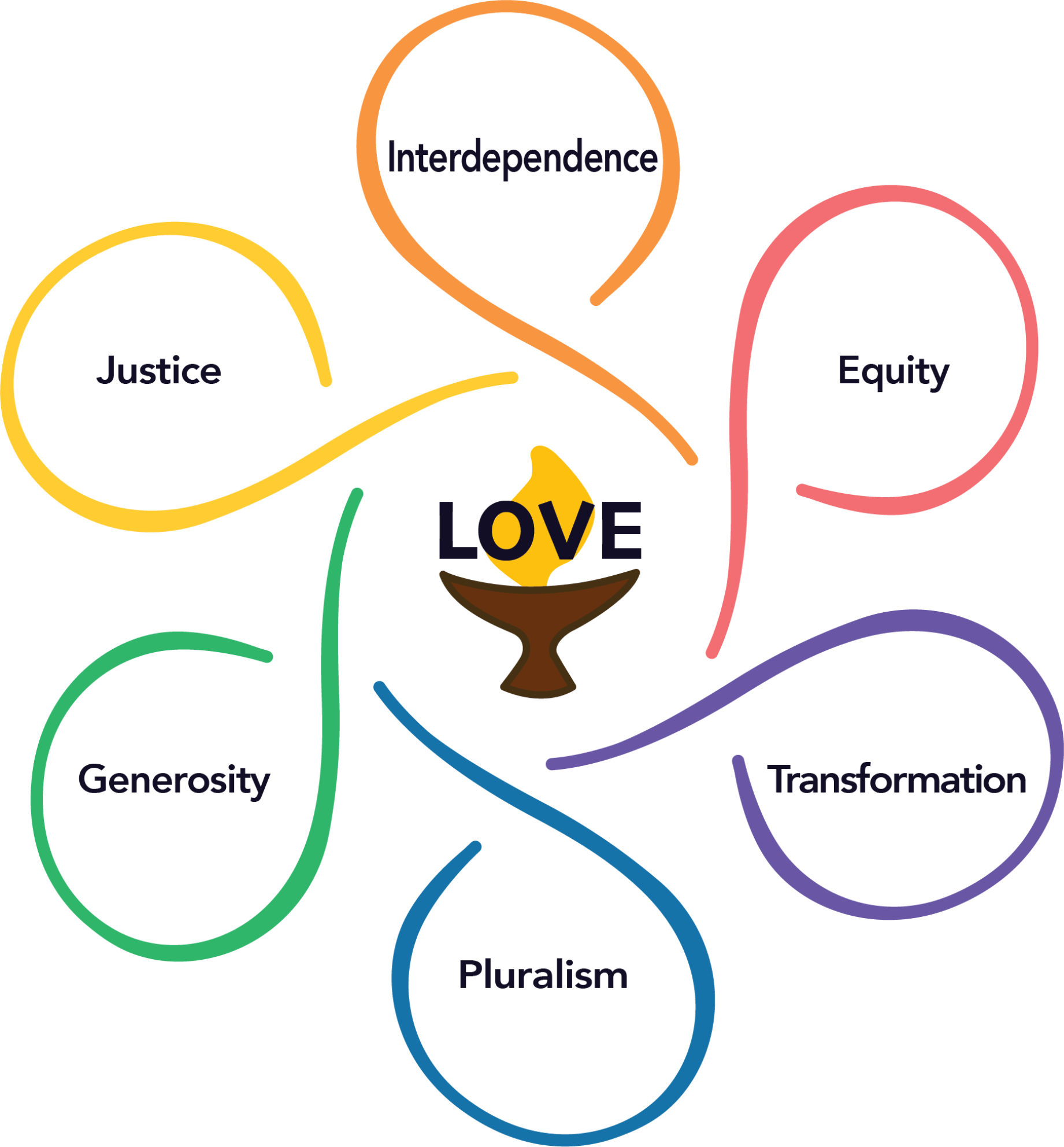
 Love Flower Graphic

Now being UUs, some of our folks affectionately refer to this graphic as “the love flower.” And some of our folks derisively refer to this graphic as “that love flower.”

However, you feel about the graphic, it does illustrate how we might center our covenant in love.

Universal Love practiced through the values of Generosity, Pluralism, Transformation, Equity, Interdependence, and Justice.

Universal Love that, when lived through these values, moves us “towards freedom, to act in ways that liberate ourselves and others.”

My beloveds, as we face the many challenges of this election year – the frankly terrifying wave of authoritarianism flowing through our country – the war and violence in our world – the rampant injustices – the ongoing violations of the inherit worth and dignity of so many – centering ourselves in Universal Love is going to be more vital than ever.

And perhaps, just maybe, by centering ourselves in that Universal Love – we can take George Harrison’s words from our anthem earlier and make them universal:

Give us, ourselves, one another, and our world, love Give us love
Give us peace on earth Give us light
Give us life
Keep us all free from birth.

Who knew George Harrison might be a Universalist?

Amen.

Benediction


TOUCHED BY AN ANGEL
by Maya Angelou:


We, unaccustomed to courage
exiles from delight
live coiled in shells of loneliness
until love leaves its high holy temple
and comes into our sight
to liberate us into life.

Love arrives
and in its train come ecstasies
old memories of pleasure
ancient histories of pain.
Yet if we are bold,
love strikes away the chains of fear
from our souls.

We are weaned from our timidity
In the flush of love’s light
we dare be brave
And suddenly we see
that love costs all we are
and will ever be.
Yet it is only love
which sets us free.


SERMON INDEX

Most sermons during the past 24 years are available online through this website. Click on the index link above to find tables of all sermons for each year listed by date (newest to oldest) with topic and speaker. Click on a topic to go to that sermon.

PODCASTS

Podcasts of this and other sermons are also available for free on iTunes. You can find them by clicking on the podcast link above or copying and pasting this link. https://itunes.apple.com/podcast/first-unitarian-universalist/id372427776