Building Communities of Trust

Listen to the sermon by clicking the play button above.

Rev. Michelle LaGrave
March 9 2025
First UU Church of Austin
4700 Grover Ave., Austin, TX 78756
www.austinuu.org

Trust is an important component of beloved community. How are communities of trust built? kept? restored? What does it look like when a community leads with trust in each other and the greater community?


Chalice Lighting

This is the flame we hold in our hearts as we strive for justice for everyone. This is the light we shine upon systems of oppression until they are no more. This is the warmth that we share with one another as our struggle becomes our salvation.

Call to Worship

THE LONGING FOR SOMETHING MORE
by Gretchen Haley

Every little thing that breaks your heart
is welcome here
We’ll make a space for it
Give it its due time
and praise
for the wanting it represents
the longing for something more,
some healing hope that remains
not
yet

We promise no magic
no making it all better
But offer only this circle of trust
This human community
that remembers
Though imperfectly
that sings and prays
though sometimes
awkwardly

This gathering that loves,
though not yet enough
We’re still practicing
After all,
still learning,
still in need of help
and partners
Still becoming
able
to receive
all this beauty
and all these gifts
we each bring

Come, let us worship together.

Affirming Our Mission

Together we nourish souls, transform lives, and do justice to build the Beloved Community.

First Reading

LIFT OUR VOICES #120
by Erica Hewitt

I don’t have anything to say.

Well, I do, but it might not be interesting to anyone.

I have secrets inside of me and struggles, and I don’t know if I’m ready to share them.

I want to hear what you have to say.

I want to speak of the deepest things together.

I want to hear what you dream about, what you hope for.

I want to know how you have come to arrive at this resting point along your journey.

What if I speak and you don’t understand me?

I will listen and listen again until my hearing becomes understanding.

What if I can’t find the words to share the world inside of me?

I believe that wise words will emerge from you.

How can I trust you to hold my life’s stories? You, who I may not even know.

By knowing that as I receive part of your story, I will give you part of mine.

How will this work? What will happen? What awaits us?

We can find out anything by beginning.

Let us begin to listen and trust and to deeply know one another.

May it be so.

Second Reading

by adrienne maree brown

trust the people who move towards you and already feel like home.
trust the people to let you rest.
trust the people to do everything better than you could have imagined.
trust the people and they become trustworthy.
trust that the people are doing their work to trust themselves.
trust that each breach of trust can deepen trust or clarify boundaries.
trust the people who revel in pleasure after hard work.
trust the people who let children teach, remind us how to emote,
be still, and laugh.
trust the people who see and hold your heart.
trust the people who listen to the whales.
trust the people and you will become trustworthy.
trust the people and show them your love.
trust the people.

Sermon

NOTE: This is an edited ai generated transcript.
Please forgive any omissions or errors.

This morning I Will begin with an assertion Followed by many many questions Which in turn are sprinkled with a few stories and Almost no answers Our topic today is trust, specifically building communities of trust. And it is one that is particularly tender during this time, I think. And we are going to sort of preach this sermon together. So are you ready for something a little different, a little more participatory? We’ve got things for the introverts and for the extroverts today.

My assertion is this. Trust is an essential component of beloved community. If trust is not present, beloved community is not possible. Beloved community or communities are communities of trust, trust like beloved community must be built, created, and when broken restored. The higher the level of trust, the closer we come to true beloved community.

So I’ll repeat my assertion because this is the foundation of what we are going to do together this morning and it was kind of a lot packed into a few sentences. Trust is an essential component of beloved community. If trust is not present, beloved community is not possible. Beloved community, or communities, while we’re working on the greater community, are communities of trust. And trust, like beloved community, must be built, created, and when broken, restored. The higher the level of trust, the closer we come to true beloved community.

So my first questions, these are for the introverts because I’ll say them a couple of times and then I’ll pause for a few moments of quiet reflection. We have ideas about what beloved community might mean that come from the Reverend Dr. Martin Luther King Jr. and it has been many decades since we lost Dr. King and so ideas about beloved community have evolved since then.

So what does beloved community mean to you? And what is the role of trust in building Beloved Community? What does Beloved Community mean to you? Now, today. And what is the role of trust?

Next questions. How do we build trust? How do we create it? This is the participatory part where we get some ideas flowing. Reverend Aaron will call on a few people, let’s say maybe three, to share their ideas and then repeat what they’ve said into the microphone so we can all hear both in this room and online.

For those of you who are online, you can type your thoughts into the chat if that’s available to you and your method and begin a parallel discussion to ours here in the sanctuary. So here are the questions again. How do we build trust? In other words, where trust is already present, how do we increase or build our level of trust with each other? And how do we create trust? In other words, when we meet people for the first time or they are new to us, how do we begin the process of trusting each other? How do we build? How do we create trust? Some ideas.

So I think you can create trust with new people by using the platinum rule to treat others the way they want to be treated. And if people see that you treat them the way that they like to be treated, they might trust you more. Awesome.

Okay, Nick said that with new people in particular, but with anyone, right, we can create trust with the platinum rule. And if you haven’t heard of the platinum rule, that’s treat others the way they would like to be treated, right? So that requires us to invite them to tell us and to notice how they’d like to be treated. Thank you, Nick.

LP, who has an amazing bow, said that one way that we can build communal trust is through shared cooking and that sacred process of breaking bread together. Thank you.

Inconveniencing yourself for others so that people know when they really do need to ask that you’ve demonstrated that they won’t be a burden and you’re willing to do things. So did I kind of get that close? Awesome, thank you.

Russell said, “To really sincerely be open when you meet someone to demonstrate that sincerity and openness in your listening.” And I felt that in your responsiveness as well, a quality of presence and openness. Thank you all, thank you.

Thank you. Those are some wonderful ideas to get started.

  • So yes, we can allow ourselves to be known. We can share our stories, we can open ourselves to those more vulnerable places inside that go even deeper, help us move even deeper into relationship.
  • We can listen deeply without judging, without interrupting, without spending our time while listening, actually planning to say what we’re going to, how we’re going to respond.
  • We can hold confidences when they are shared with us.
  • We can act with integrity, which is one of our UU values.

And I think we can see, without my saying too much about it, why if my assertion about trust is true, our chalice circles and wellspring groups, which for those of you who are new, are small group ministries where people share deeply about monthly themes like trust, which is this month’s theme, are so important. They’re not just important for our spiritual growth, but also for building trust and building the health of our community.


So, I have a story. Long ago, just before I headed out to seminary, I was a preschool teacher. And one day I was presented with an opportunity to get to know one of the teachers better. I shared with her, confidentially, that I had felt called to ministry and would be going to seminary in the fall. Not long after that conversation, I got called to the office and asked about my future plans. The other teacher had betrayed my trust and shared with the director that I would be leaving.

An uncomfortable conversation ensued and I shared my plans with the director in a way and with a timing that I had not chosen. I was hurt and what I thought of as a newly developing friendship was damaged. I later came to understand that she was operating out of what she thought of as the best interests of the students and the school. She did not want me to wait too long to share my news and risk my position going unfilled. Of course, I would have preferred she come to me with her concern and share that and encourage me to share my news instead of doing it for me.

But I need to honor within myself that she did have good intentions. And what she did not know was that I was considering two options, one that would have required me to move away and live on campus and leave my position as a teacher and the other which was nearby and would have allowed me to take classes in the evening and maintain my job teaching during the day for the next few years. I had not shared my plans with the director because I had not yet decided which path I would take to becoming a minister. And then I felt rushed in making that decision because the director then wanted to know.

At the time, I did not have the skills to address this break in relationship with the other teacher. If I had I would have asked her to share with me why she made the decision she did and listen to what she had to say and then I would have shared my perspective including my feelings of hurt and betrayal and also the missing information she did not have and then to ask if there was a way we could restore our relationship.

So I’m not naive. I think few of us are. We know that every time we choose to trust, we are choosing risk. There is always the possibility that confidences will be broken, that our trust will be betrayed. Trust is broken in ways little and big all the time. We are imperfect humans. The key is to trust each other enough to work to restore trust, to do the work of repair, and to know that sometimes this doesn’t happen, that the work of repair doesn’t happen, that people can and do decline our overtures to restore relationship. And still we must find a way to be at peace with their decision, a decision which is outside of our control. And yet still all remain in beloved community together.

We also want to acknowledge that sometimes in certain very extreme circumstances we really need to shift how we understand trust for our own spiritual and mental health. There are, after all, people who are sociopaths and psychopaths out there in this world. Yes, I’m using the lay terms here.

In these circumstances, when someone is incapable of being trustworthy in the way we usually think of trustworthiness, we can still trust them to be who they actually are. I learned this from speaking with someone recently about the challenge of finding hope within our current political climate. She shared with me that she trusts a particular leader to mess up so badly at some point that he will actually wind up creating an opening for change. She trusts him to be who he actually is instead of who she wishes he would be, and she does it in a way that creates hope. She trusts him to mess up, to create the opening, and therein lies the hope.

By the way, since this is a sermon after all, faith is actually trust, plus an element of the transcendent. Whether that is God or some universal force bigger than ourselves. So it would also be appropriate if you’d like to think of all of this in the terms of the word faith.

So returning to relationships here in this congregation, in this community, with people being people, with people being imperfect, with people being prone to messing up unintentionally or otherwise. Can we trust that when trust is broken, as it will be, that we have a covenant and a team and processes that can help us find a way through to restoring relationships?

Can we trust that when we do the work of restoration, Sometimes we don’t do it as well or as smoothly as we’d like, and yet there still is integrity to engaging that process. Can we trust that this congregation or whatever other setting you may find yourself in is healthy enough to allow for places of discomfort, such as when apologies or olive branches are not immediately accepted. Can we trust this congregation, this community, to still hold and love us all, to know and accept that we all belong even in our imperfection.

There’s a lot to think about and I don’t have all of the answers. I am looking to all of you to help with finding the answers within. Especially since I will be leaving soon and this will remain your community, but not mine. I will say that I do believe you can do this, that I have faith in all of you.

One last story, and then a final challenge. I once worked at a church as an interim. You know that I’ve moved from church to church to church traveling around the country doing this interim work specialized work. And as usual I began with a startup workshop where a consultant from the UUA’s regional office came in and worked with all of us about roles and responsibility and making sure we had clarity about who had the authority and expectation to do what between the minister and the board and the congregation and the RE teacher. So in this case, the consultant asked the assembled group, the congregation, if it was okay for the ministers to speak up on their have. This was meant to be a provocative question that would open a great deal of discussion. Instead, the response was, “Yeah, of course. We trust our ministers to speak up for us.” The consultant was a bit flabbergasted because most of our congregations do not allow for this.

And this is where the challenge comes in. First UU is one of those congregations that prohibits its ministers from speaking up in public on their behalf. Ministers are free only to speak for themselves. It’s a little bit of splitting hairs when you’re out there in public to say I speak only for myself, but I am the minister of this congregation. People don’t really hear it that way anyway. This has been how it has been in most UU congregations. But I wonder, I wonder if it’s time for a change. We are living in a world and in a nation which is rapidly changing. We are living in a time of rising fascism.

The prohibition of ministers speaking up on behalf of their congregations may have served its purpose and its time, and there may have been reasons for it, good, valid reasons. But is it still helpful now? Does this time call for something different? For a new way of being in the world? What would it be like to trust your ministers to speak up with the full weight of the congregation behind them? Out there in the public square while we are fighting authoritarianism and fascism.

What would it be like to trust your ministers to be able to speak up immediately about the wrongs they see in the world and in this nation without having to go through a many months long process of congregational discernment and resolution making. What would it be like to trust your ministers to be able to judge for themselves when a particular issue is too sensitive to speak out about immediately and to trust that the ministers will take you through that process of congregational discernment when necessary. What would it be like to be able to trust on this level?

There are stories in this congregation and in all of our congregations about ministers being human, that’s a rumor, from making relatively minor mistakes to doing serious harm to outright misconduct. What would it look like for a congregation, for this congregation, to fully heal from the past, to accept that mistakes were made, that problems arose, and then to trust that a new way can be made.

This, by the way, especially for those of you visiting with us today, applies just as well to our families and our workplaces as it does our congregation. What would you as a congregation or some other group of people be able to do in this world if your leaders were well and fully trusted? What would you be able to do in this world if you well and fully trusted each other?

I don’t have all the answers for you. Just a few ideas and a lot of questions. What I do know, though, is that whatever you would be able to do with this level of trust would be nothing short of absolutely transformative, just like it says right up there in your mission. Transform lives. And I have faith that this community can find a way.

Amen and blessed be.

Extinguishing the Chalice

We extinguish this flame, but not the light of truth, the warmth of community, or the fire of commitment. These we hold in our hearts until we are together again.

Benediction

May we remember that trust, like love, grows in small moments:
In promises kept and confidences held,
In boundaries respected and amends made,
In showing up again and again.
May we be brave enough to risk trust,
Patient enough to build it slowly,
And gentle with ourselves and others when it breaks.
Amen.

by the Rev. Angeline C. Jackson

SERMON INDEX

Most sermons during the past 25 years are available online through this website. Click on the index link above to find tables of all sermons for each year listed by date (newest to oldest) with topic and speaker. Click on a topic to go to that sermon.

PODCASTS

Podcasts of this and other sermons are also available for free on iTunes. You can find them by clicking on the podcast link above or copying and pasting this link. https://itunes.apple.com/podcast/first-unitarian-universalist/id372427776


Joy is Resistance

Listen to the sermon by clicking the play button above.

Rev. Kiya Heartwood
March 2, 2025
First UU Church of Austin
4700 Grover Ave., Austin, TX 78756
www.austinuu.org

In these challenging times, Joy is one of our super powers. Learning to stay in the struggle with rest, community, and joy. That’s how we win.


Chalice Lighting

This is the flame we hold in our hearts as we strive for justice for everyone. This is the light we shine upon systems of oppression until they are no more. This is the warmth that we share with one another as our struggle becomes our salvation.

Call to Worship

Joy doesn’t betray but sustains activism. And when you face a politics that aspires to make you fearful, alienated, and isolated, joy is a final act of insurrection.

– Rebecca Solnit

Affirming Our Mission

Together we nourish souls, transform lives, and do justice to build the Beloved Community.

Reading

God of Shadows, our fear of the unknown keeps us from moving at all. Help us not to know. Protect our minds when anxious thoughts about the future refuse to leave us alone.

Deepen our breath. Bring us into communities who can be trusted when they tell us we are safe. Comfort us when our minds become frenzied trying to determine what we cannot possibly know.

When questions of what is to come or who will stay with us haunt us, make us kind with our own self-talk, tender to our bodies, loving with all we do have control over. When no amount of courage can diminish fear’s power over us, remind us that we too have power as we rise to meet it, provide a way to peace, we will not fear the dark. Ase.

– Cole Arthur Riley

Sermon

NOTE: This is an edited ai generated transcript.
Please forgive any omissions or errors.

This sermon is called, “Joy is Resistance.” The phrase “Joy is the act of resistance” comes from a poem by Black Poet Toi Delacorte. It is a joy in resistance mantra that bears repeating.

Let me hear you say it. “Joy is Resistance!”

You got the you got the gist of this. Okay. What do I mean by joy, now I mean joy is everything about us that helps us thrive. Our laughter, our food, our favorite bad TV, watching bad TV or dancing cat memes, podcasts that spice up our lives, our outrageous outfits, board games, line dancing, hand-drumming, cool tattoos, playing Sufi music while we vacuum, singing loud or living louder.

Why? Joy is resistance.

Yes. We celebrate our choice in families, our beautiful friends, our fierce happiness in the face of insurmountable odds and crushing oppression. We go swimming or hiking and drink coffee or bubble tea, let the dog take you for a walk or nap with our cats. We go sunbathe in our rip Scooby-Doo t-shirt with our pet turtle.

We take our time. We just be. Joy is a priority. It makes the whole world better. Those of us who have been activists most of our lives, those of us who come from marginal groups, a lot of us here you know what

I’m talking about you’ve got to build for distance. Change takes time – fighting takes time – and we can’t burn out we’ve got to stay alive the entirety of everything for everyone the whole world gets better.

Let me hear you say it – Joy is resistance. We don’t just survive – we Revel, Revel in our dreams, our sexualities, revel in changing our minds, learning new things, and reviving old things, fixin’ things.

Yeah, we innovate, we recreate, we do do-overs, find a way out of no-way, find a way out of no-way, that’s what we do. We’ve done it our whole lives, they’ve done it for more than 2000 years. That’s how we make change. That’s how we make the world a fit place to live for our kids.

That’s how we do it. Let’s do it find a way out of no-way. We are those people. We explore our gender expressions – our communities – our shared power structures. We are fierce and kind. We are here for everyone all of us. Nobody is left out. Nobody is expendable.

So we study our ancestors. They were scrappy, they were stubborn, they were resilient, they were underestimated. We stand in a long line of beautiful brave humans and we all matter.

We all matter. Let me say it one more time in a presbyterian kind of way. We all matter. Every single one of us. So we can learn to ask for help. We can learn to ask for help. Sometimes we need help. And help when and if we are asked. You get me? Okay. Don’t quit. Rest.

Because joy is resistance. Can I get a witness?

It is a gloom and doom, mega depression, cocktail nightly, with dire predictions at every turn. But friends, let me speak the gospel of change to you.

The future is unwritten. The future is unwritten. “The future is unwritten.” That comes from “The Clash”, by the way, Joe Strimmer (1952 – 2002).

Though those of you who are theists may think there is a master plan and that God’s got it, but at best I subscribe to a more universalist approach in that we are wonderfully made. Yeah, and we can change the stuff we want to change. There’s a lot of stuff I want to change, how about you?

We are resilient, persistent, and focused. We come from a long line of activist, stubborn, civil rights warriors, suffragettes who believed a woman could be president even before women could vote.

We are too blessed. We come from strong and sturdy stubborn people who knew they could make a world they wanted who believed The future is unwritten. If you don’t know any other clash lyrics. This is a good one.

Let’s take a moment and call our ancestors. Who do we need to emulate right now? John Lewis, Alice Paul, Medgar Evers, Shirley Jackson Lee. Pete Seeger. Molly Ivins, Woody Guthrie, “This land is your land and my land” and it’s its own land and the ones who were here before us and those who will be after.

Friends we stand on holy ground in a world that needs us to be ourselves. Call out their names. Who are you calling? Who are you calling? Call them out. Call them out. (Names called out from the audience.) Theodore Parker.

Amen my people.

We need to get a grip. Our one sacred planet needs us now. We must stand up for justice now.

The future is unwritten. The future is unwritten. That means we can write it. We can write it. We can R-I-G-H-T it.

Jewish philosopher Martin Buber, who wrote a book in 1920 called “I Thou.” He contrasted the relationship we have with everything in our capitalistic society as an “I it” relationship. Is it kind of user relationship? That’s kind of what we have right now. We think about how to market to people and we don’t treat them as three-dimensional beings with hearts and minds. We think of them as people who can do our laundry. That kind of thing. That’s what I’m talking about.

Ourselves and what we use relating to the planet other people and everything as if it was all put here for exploitation. In my opinion that is how we have gotten in this mess we are currently in.

We have used ourselves into the climate crisis and the clock is ticking down. Damage has been done but we are still here. We are resilient and creative and the future is unwritten.

It is time to adopt a new philosophy, an “I thou” philosophy, approach to each other, to other beings, four-legged, winged, green, the entire holy sacred gift that being alive brings.

The future is unwritten.

Now is our time. We are here. We have each other. Risk some stubborn optimism friends, tenacity, Grit, hard work, joy, rest, lives built for the distance.

I want us to try and get past our despair because we’re in the middle of it. And it’s awful. It is awful. And I am not doing that kind of, you know, focusing or thing where everything is just fine, because it’s not. But that doesn’t mean that we aren’t built for this time. We are.

And we have enough friendship, and we have enough talent, and we have enough energy, and we can handle this. I don’t care how old you are. I don’t care what’s going on with you, it’s time.

Martha P. Johnson, she threw that brick. We’re going to put the T back in LGBT, right the hell now. You hear me?

So remember the joyous resistance – Don’t quit – Rest – Have fun, parties, dance, and cake. Cake – Tacos. Keep it going keep it going – Ice cream. What’s your favorite? Nice. Nice. Alright.

We know how to do this. We’re built for this. We’ve had plenty of people representing for us and now it’s our turn.

Alright. We’re reaching our goals. We’re gonna diplomacy, organizing, leadership, we’re going to get arrested when we need to. Y’all get me out of jail. I’m very claustrophobic.

We’re going to speak up and we’re going to love and we’re going to love and we’re going to love because the future is unwritten.

The future is unwritten and joy is resistance.

Amen.

Extinguishing the Chalice

We extinguish this flame, but not the light of truth, the warmth of community, or the fire of commitment. These we hold in our hearts until we are together again.

Benediction

Remember the way of the wind
And breathe and blow
Remember the way of the fire
Sparkle, Glitter and glow
Remember the way of the water
And ebb and flow
Remember the way of the earth
And grow.


SERMON INDEX

Most sermons during the past 25 years are available online through this website. Click on the index link above to find tables of all sermons for each year listed by date (newest to oldest) with topic and speaker. Click on a topic to go to that sermon.

PODCASTS

Podcasts of this and other sermons are also available for free on iTunes. You can find them by clicking on the podcast link above or copying and pasting this link. https://itunes.apple.com/podcast/first-unitarian-universalist/id372427776

Staying Sane and Strong Despite Tyranny’s Onslaught

“How do we stay sane and effectively resist the tyranny that besets our country?   How do we take care of ourselves and each other when times feel too hard?” “How do we avoid the kind of collapse that beset the German people when the Nazis were rising ?” To understand how tyranny works to keep us weak, for mental and emotional tools to fight despair and stay strong. and for specific resistance resources, come hear Victoria Hendricks speak on Tuesday evening, March 4th at 7:00 p.m. in Howson Hall.

Potluck first, starting at 6:30 p.m Victoria says “To provide what I see as a metaphoric survival kit for times of tyranny, I have drawn heavily  from Timothy Snyder’s excellent small book, On Tyranny, Twenty Lessons From the Twentieth Century and added bits from Elizabeth Warren, Beto O’Rourke, Joan Baez, Dan Rather and many more.  As Citizens’ Climate Lobby founder Marshall Saunders reminded us, we can’t afford to wait for rescue. “We are the cavalry.”

Let’s stay strong and connected in community for what may well be the fight of our lives. 

Veganistas / UUAM

Join the Veganistas group at this church to connect with others who care deeply about animals. You do not need to be vegan to participate; everyone is welcome!
 
Please come to our next meeting on Sunday, March 2nd at 12:30 p.m. after service in Room 17 or find the group online through Church Center. 
 
This is a group of First UUs whose spirituality is expressed and explored through compassion for all beings, advocating for animals, plus hosting fabulous vegan potlucks and other activities.
We are proud and excited to announce that our group here at First UU has recently been approved as a chapter of the Unitarian Universalist Animal Ministry. The group looks forward to creating goals and projects for the new year. 
 
Please join the Veganistas / UUAM group to explore your own spirituality as it relates to the interdependent web of life, and help guide the future of this group. 
 

Justice for All and All for Justice

Listen to the sermon by clicking the play button above.

Rev. Michelle LaGrave
February 23, 2025
First UU Church of Austin
4700 Grover Ave., Austin, TX 78756
www.austinuu.org

Rev. Michelle will reflect on this month’s theme of inclusivity and what this means for our mission of doing justice. So often we think about doing justice so that all will be included. But what might it look like to include all in doing justice?


Chalice Lighting

This is the flame we hold in our hearts as we strive for justice for everyone. This is the light we shine upon systems of oppression until they are no more. This is the warmth that we share with one another as our struggle becomes our salvation.

Call to Worship

WE GATHER TOGETHER

We arrive
as individuals as couples
as families
as neighbors
as friends

We got here by walking by biking
by riding
by driving
by connecting

We bring with us
our joys and our sorrows
our laughter and our tears
our worries and our fears
our questions and our beliefs
our ethics and our values

A ceramic mug of coffee sits on a table
next to an open laptop,
showing many people in Zoom cells.
Some of us
arrived early this morning
or joined us ten minutes ago
or encountered obstacles on their way
or will arrive just in time for the sermon
or will sign online later this week or even next month

We
are sitting in pews
leaning on walkers or canes
stretching in the aisles
settling in wheelchairs
and relaxing in recliners

We, members, friends, and visitors alike,
come from many paths
and join together as one congregation,
to lift up our highest ideals.

We have gathered.
Now, let us worship.

Affirming Our Mission

Together we nourish souls, transform lives, and do justice to build the Beloved Community.

First Reading

Micah 6: 6-8

Micah asks on behalf of the people: “With what shall I come before the Lord and bow myself before God on high? Shall I come before him with burnt offerings, with calves a year old?

Will the Lord be pleased with thousands of rams, with ten thousands of rivers of oil? Shall I give my firstborn for my transgression, the fruit of my body for the sin of my soul?”

Micah answers on behalf of God: He has told you, O mortal, what is good, and what does the Lord require of you but to do justice and to love kindness and to walk humbly with your God?

Second Reading

History, despite its wrenching pain,
Cannot be unlived, but if faced
With Courage, need not be lived again.

Lift up your eyes upon,
The day breaking for you.
Give birth again,
to the dream.

– Maya Angelou

Sermon

NOTE: This is an edited ai generated transcript.
Please forgive any omissions or errors.

Micah was a prophet who lived in ancient Israel during the 8th century BCE. His hometown was a small village called Morsheth, not too far from Jerusalem, and he lives in a time of rapid change. Much like we are today.

Commerce was expanding, Trade was increasingly moving away from a barter system and toward a monetary system. Fraudulent weights and measures had become common. Land was being accumulated in large quantities by the hands of wealthy landowners and at the expense of small farmers. And the gap between rich and poor was increasing greatly and rapidly. The powerful dictated what they desired. Judges and other officials are taking bribes, people are lying, and the families, families are falling apart due to lack of trust in each other.

Does any of this sound familiar?

Micah lived during a time of rising power, wealth, and corruption. And so he went out into the marketplace and prophesied. During ancient times, people brought other people to court for breach of covenant and were heard by a judge. In Micah, as elsewhere in the Hebrew Scriptures, God brought the people of ancient Israel to court and indicted them for breach of covenant with the mountains, the hills, and the earth for witnesses, similar to the ways in which human courts worked. In God’s case they were out of covenant, out of right relationship with God. Of what were the people guilty of? Injustice. Injustice in the land was flourishing.

And so the people cried out as we still tend to do during a crisis, atheist or not, and ask, “What does God want from me? What do you want from me, world, universe? What do you want from us? How much would you take from us? Everything we have and more?” And Micah reminded the people that God has already told them what is good, What is required of them? And that is to do justice and to love kindness and to walk humbly with their God.

Micah’s story is an age-old story and one we are in many ways reliving today, though now the threat of our own government comes from within and not from the Assyrian Empire. And Micah’s answer to the people is still a good one, a good lesson for us today. We are to do justice, love, kindness, and walk humbly, which in, you know, 3,000 years ago language meant remain in covenant, walk humbly, remain in covenant with the holy.

So today I’d like to talk just a little bit about why it is we do justice as Unitarian Universalists. At least enough to establish that doing justice is well within our living tradition. Micah is only one of many examples from the Hebrew scriptures, which are sacred to both Judaism and Christianity, of justice-seeking as a requirement of being in right relationship with the divine. Jesus’s ministry as well was a liberatory one and his teachings are foundational to Unitarianism and Universalism which both emerged out of Christianity.

Over time, our theological underpinnings have expanded as more and more people have joined us from more and more faith traditions and backgrounds, and as we have continued to grow in our spiritual and theological understandings. Today, justice is one of Unitarian Universalism’s shared values. We have covenanted with each other, congregation to congregation, to work to be diverse, multicultural, beloved communities where all thrive, to dismantle racism and all forms of systemic oppression, and to support the use of inclusive democratic processes within our congregations, our association, and society at large. That’s right in our bylaws, in our Unitarian Universalist Associations bylaws.

Finally, let us not forget that doing justice is right up there on our wall in this congregation’s mission statement. Together we nourish souls, transform lives and do justice to build the beloved community. So having established that we are indeed a justice-seeking, justice-building, justice-creating, justice-making people, let’s who it is that does or does not do all of this justice-making and how it gets done.

At times, I’m a little sad to say this, it seems that within Unitarian Universalism, and I imagine elsewhere, the loudest voices for justice are all about marches and protests and visiting legislators at the Capitol and sit-ins and die-ins and civil disobedience that results in arrest.

Do you know what all these have in common? Anyone want to guess? They require people to either be able-bodied or to put their disabled bodies on the line at a much higher, higher risk than is generally taken by non-disabled people. Yes, that includes even visiting legislators at the Capitol.

I tried to do this once. Earlier during my time here in Austin, I wanted to visit the Texas State Capitol. So, being physically disabled, I did my usual research into what I would need to know to visit a new place I had never been.

First, I found out that there was a special webpage called Capital Accessibility Services with all of the information that I would need. And right at the top of that page was an assurance that all capital, capital extension and capital visitor center facilities are accessible to persons with disabilities, as well as a link to an accessibility guide. Great, we’re off to a good start here.

Then, with further reading, I discovered that it was actually a considerable distance to walk from the parking garage to the building where I wanted to go and an even farther walk from that garage to the only accessible entrance to that building which was actually on the other farther side from the garage. In other words I’d have to walk all the way around the outside of the building to get inside without using any stairs or very many stairs.

Then I thought, well, I can rent a motorized scooter for the day. Most recently, I often use a rollator, but I have often used motorized scooters at large events and in large stores, though I don’t actually own one myself. No problem, I thought. There are rental places which will deliver a scooter to my destination. I don’t even have to figure out how to transport it there myself.

And then I read, motorized scooters are not allowed on the capital grounds. Okay, now that’s out too. So how am I supposed to get into the capital?

So, I kept reading. A wheelchair was the last option. To get it, I would have to walk from the parking garage to the visitor center, which was in the opposite direction of the Capitol building itself, get the wheelchair, and then wheel myself back past the parking garage and all the way around the Capitol building and to the other side to go in the accessible entrance. There was no way. I don’t have the arm strength for that. That’s why we have motorized scooters in addition to wheelchairs.

And then I realized that the only possible way I or anyone with limited leg mobility and arm strength could go to the Capitol was to be pushed in a wheelchair by someone else. My spouse Micah was unable to take me on that particular day and it was too late at night to call by that time and make arrangements with anyone else. Besides I wondered who could I ask? Who would be willing? I mean it’s a pretty big ask to call someone and ask them to spend the entire day with you pushing you around in a wheelchair. And what do people who don’t have anyone in their life who could help them do? And what about all the people who can only use a motorized scooter? There is no circumstance under which they could make a visit to the Capitol. Despite the website’s promises, this was not and is not accessibility.

I share this story, not, NOT, to get you all fired up and headed down to the capital to demand change on my or any disabled person’s behalf, but to give a glimpse into just a very little slice of only one person’s disabled life on only one evening trying to plan only one outing. There are many, many more stories out there with different or worse or better experiences than mine.

And there are many, many more of my own stories that I could share, but I chose this one because in it I was attempting to do justice while being disabled. People who are disabled need to be more than the subjects of doing justice. We need to also be full participants in justice-making.

The point I want to make today is that there are as many ways of doing justice as there are of being human. So, so many people are living in even greater than usual risk in this country today. Primarily people who are undocumented and people who are transgender and also people who are BIPOC, LGBTQ plus and disabled, as well as anyone who has a uterus and is able to get pregnant. We are living in a time of rising fascism and we are gonna need as many people as possible doing justice.

So it’s time to put away any of the old ideas about what it means to do justice the right way, or the best way, or the only way. We need lots of different kinds of justice-making, and we need justice-making and justice-doing to be as accessible as possible.

Some common justice-making actions are already pretty accessible to a lot, if not all people. Things like writing letters or making phone calls. There was a great example of a letter from one of our congregants, Denise Pierce, going around lately. In it, she called for a company, in a very positive way, to increase the accessibility of their website. She explained that she loved the company, really wanted to shop there, and why she wanted to shop there and then said that she would need them to make it more accessible for her in order for it to work.

There are lots of different ways, new or different ways that we can think about making justice-making more accessible. People can help with digital security or giving rides or digital communication or preparing food for justice organizers and events, and many, many other ways. We need to start thinking outside of the box.

Remember, we don’t have to make the entirety of any action or event fully accessible to everyone. That would be near impossible. But we can make different components of justice actions or events accessible in various ways for various needs so that more and more people are able to engage in a piece of the work. It is a duty, an imperative, doing justice in these times.

Here are just a few tips we can help make this happen just to get started.

The first thing we need to do is accept that no one can fully know what it is like to live in another person’s body or to live another person’s life. Each of us has the right to determine the level of personal risk we are willing to undertake or not in any justice-making, justice-doing we take on and no one else has the right to make judgments about whether or not someone else should have taken more or less personal risk bodily or otherwise and this goes for everyone not just disabled folks.

The second thing we need to do is to take care of our spiritual and emotional selves. We are facing tactics that are intentionally meant to overwhelm us or shut us down or cause us to freeze. We have a responsibility, a moral duty, to deal with the overwhelm so we can get unstuck and get moving in whatever ways we can and in whatever ways we do best. Take care of yourselves. Take care of each other. Give each other as much of a chance as possible to get unstuck and get unfrozen and get moving. We need as many of us to join the resistance as is possible. Every person and every action counts. No fake fights about our justice-making or anything else that might serve as a diversion from the moral, ethical, theological and spiritual imperative to do justice.

The third thing we need to do is pay attention to inclusion in any of the social justice actions or events we are planning. If someone can’t march or sit or stand or hear or see or walk or whatever else it is very well, what can they do? If someone is in a greater risk category because they are undocumented or black or queer or all of the above or some combination of the above, what might they need to better or more fully participate? We might not know, and if we don’t know, let’s make the effort to find out.

So to recap, These are my three getting-started tips.

  • Number one, we each get to assess our own level of personal risk, no second guessing by anyone else.
  • Number two, we need to take care of ourselves and each other so we can, if possible, get unstuck and live up to our responsibility to do justice.
  • And number three, pay attention to inclusion in any social justice events or actions we are planning.

By keeping love at the center, we can continue to widen the circle of concern farther and farther. And by including more and more people in the work of justice-making, we can do more justice.


As Maya Angelou says, “Let us give birth once again to the dream.”

May it be so. Amen and blessed be.

Extinguishing the Chalice

We extinguish this flame, but not the light of truth, the warmth of community, or the fire of commitment. These we hold in our hearts until we are together again.

Benediction

In all of the ways that our bodies and our minds work, both literal and metaphorical, I say to you, go now in peace with love in your hearts, kindness on your lips, and compassion at your fingertips. Blessing all others as you yourselves are now blessed.

Amen and blessed be.


SERMON INDEX

Most sermons during the past 25 years are available online through this website. Click on the index link above to find tables of all sermons for each year listed by date (newest to oldest) with topic and speaker. Click on a topic to go to that sermon.

PODCASTS

Podcasts of this and other sermons are also available for free on iTunes. You can find them by clicking on the podcast link above or copying and pasting this link. https://itunes.apple.com/podcast/first-unitarian-universalist/id372427776
UPLIFT Book Talk

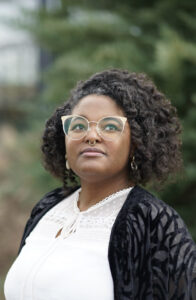
Book Talk with “Imani Rituals” Author, Ayanna Kafi

Thursday, February 27th @ 12:00pm ET 

Join us for a rich discussion of disability and black spirituality as I interview my friend and colleague, Ayanna Kafi about their upcoming skinner house release, “Imani Rituals: Nurturing African Spiritual Heritage.”

We’ll discuss the book writing process, the intersection of race and disability, and ways to adapt rituals for individual access needs.


Ayanna Kafi (they/them/theirs) is a neurodivergent, nonbinary, Black woman living on occupied Creek land, commonly known as Stone Mountain, a beautiful city within the collective of cities known by locals as Atlanta. They cohabitate with their partner, teenager, and granddog. They believe that their ministry springs from their embodiment, home, and community so they strive to fill their life with laughter, music, movement, intentional rest, and the discipline of ever-expanding joy.

That’s Amore

Listen to the sermon by clicking the play button above.

Rev. Chris Jimmerson
February 16, 2025
First UU Church of Austin
4700 Grover Ave., Austin, TX 78756
www.austinuu.org

We have just celebrated another Valentine’s Day, so let’s explore the practices that help us create healthy, successful romantic relationships and how many of those same practices might also enhance our love for family, friends, and others – and might even lead us to Agape – selfless, unconditional, divine love.


Chalice Lighting

This is the flame we hold in our hearts as we strive for justice for everyone. This is the light we shine upon systems of oppression until they are no more. This is the warmth that we share with one another as our struggle becomes our salvation.

Call to Worship

Even after all this time,
the sun never says to the earth,
“You owe me.”
Look what happens with a love like that.
It lights the whole sky.

– Hafiz

Affirming Our Mission

Together we nourish souls, transform lives, and do justice to build the Beloved Community.

Anthem

DIRAIT-0N (translated as “AS THEY SAY”)
Morten Lauridsen
The first UU Adult Choir; Brent Baldwin, Conductor; Valerie Diaz, Piano

Translation of the lyrics that captures the poetic intent:

Wildness surrounding wildness,
Tenderness touching tenderness,
It is your own core that you ceaselessly caress, …. as they say.

It is your own center that you caress,
Your own reflection gives you light.
And in this way, you show us how Narcissus is redeemed.

The words in French are from a collection of poems about roses by Rilke, a European poet who wrote in the early 1900’s. Rilke often wrote lyrical, mysterious poetry, and often wrote about roses. In this poem, on one level, Rilke is describing a rose. In this interpretation, Rilke sees a rose and its petals as “wildness surrounding wildness,” and yet “tenderness touching tenderness.”

He marvels that the wild and delicate rose petals are caressing the core, the center, of the rose.

Rilke then refers to the sad story of Narcissus, the vain youth from Greek and Roman mythology. When Narcissus saw his own reflection in the water of a river for the first time, Narcissus fell in love with his own reflection, not realizing it was himself. He was so in love with himself, that he refused to eat, and soon wasted away and died. To help remember him, the narcissus flower grew where he had been.

In some versions of the story, Narcissus’s soul descends to hell, where he is doomed to look at his reflection forever, and may never see another person. In Rilke’s poem (and in this song), the wildness, tenderness, and self-awareness of the rose is contrasted with Narcissus, and perhaps Rilke is suggesting that the rose can show us how Narcissus can be redeemed – that is, freed from his fate of eternally gazing only on himself and not being aware of the world or people around him.

On another level, Rilke could also be describing a lover – a lover who is “wildness surrounding wildness,” and “tenderness touching tenderness.” Again, on this level, perhaps Rilke is suggesting that a wild and tender lover can show us, how to be freed from our own narcissistic self-absorption.

Reading

From STILL LIFE WITH WOODPECKER
by Tim Robbins

Love is the ultimate outlaw.
It just won’t adhere to any rules.
The most any of us can do is to sign on as its accomplice.
Instead of vowing to honor and obey,
maybe we should swear to aid and abet.
That would mean that security is out of the question.
The words “make” and “stay” become inappropriate.
My love for you has no strings attached.
I love you for free.

Sermon

Happy Valentine’s a couple of days after the actual date.

Gretchen shared with us the four types of love earlier, and, of course, Valentines is all about love, particularly the type of love we call Eros or romantic love.

This was my first Valentines without my longtime romantic love, Wayne, so I’ve been thinking and reading a lot about what makes romantic relationships healthy – what makes them work – what made 33 years with Wayne work.

And, unexpectedly, to my surprise and grateful wonder, I have also had a valentine come into my life recently.

So I thought it might be fun, and, actually, soul nourishing, to think together a little bit today on what we know about how we might create and sustain healthy, mutually satisfying and beneficial eros love.

By far, the most common thread I found in the psychological research on the subject, is that the partners in a mutually life-enhancing romantic relationship establish as their shared goal for the relationship that each person in it fully thrive, fully flourish – they strive to support one another’s reaching for their greatest creative potential.

That rings true to me. I don’t think I would have ever become a minister, what I now know is my calling in life, if it it weren’t for Wayne.

That is a true gift he supported me in discovering.

And for each partner to thrive requires a sense of equity within the relationship.

Decision making is shared and communication is open and honest, even when it is hard.

Now, equality and being the same are not, well, the same.

So you might be better at cooking, and I might be better at organizing the kitchen, and that’s OK – we talk up front about who leads what, and we celebrate and learn from our differences, each of us becoming more creative and capable because of the other.

And by keeping communication open and discussing things up front, no one has to keep a ledger – equity is built into the ongoing interaction within the relationship.

Now, of course, there will still be disagreements.

What successful romantic partners do that help them navigate conflict though, is that they fight fair.

No personal attacks. No avoidance. No shutting down. No storming out of the room. No refusal to forgive.

Instead, the focus is on honest communication to identify where the true area of disagreement lies, make it explicit, and then find solutions that each of them can live with – or discover even better, more creative ways of addressing the issue than what either of them had come in with.

Here are some other ways that successful romantic partners support one another’s life-fulfillment:

• They infuse a sense of joy, fun, and playfulness into the relationship.

For example, they have fun, endearing “pet names” for one another. They approach their time together with humor. They schedule time to do things they both enjoy together – to play together. They reward each other with compliments and endearments freely and frequently.

• They recognize that each of us and each situation may be different as regards what might best support the other. So, they make this explicit. Instead of asking, “how can I help?”, one New York Times article suggests asking, “Would helping, hugging, or hearing you feel most supportive?”

The three “Hs”.

Recently, we’ve added a fourth “H” – Halo Top ice cream.

• Thriving romantic partners are creative about how they structure their life together – Marriage and family therapist Stephanie Yates-Anyabwile says that they throw out the relationship rule book.

So, for instance, if two people have very different traveling styles and habits, is it really necessary that their recreational travel be done together?

If they have very different sleeping habits, is sleeping under the same roof, just fine, even if they don’t always sleep in the same bed?

Several years after my stepdad, Ty died, my mom met Paul, who has become a wonderful and loving companion with her.

They decided not to move in together. They spend part of each week at her home and part at his, sometime even apart as their lives demand.

And they love it, and they love each other. Throw out the rule book and get creative!

• Here’s one more thing. Psychologist and relationship researcher John Gottman has found that relationships flourish when we pay attention to what he calls “emotional bids.”

Bids are “Fundamental units of emotional communication’ when we reach out to a partner with a request to connect. They can be big or small, verbal or nonverbal. We can be aware that we are making them or completely unaware.

An example of such a bid for connection might be if an avid birdwatcher, excitedly says to her husband, “Wow, I was just out watering the plants, and the most beautiful hummingbird I have ever seen flew right up to me and just hovered there staring at me!”

Now, her husband may not have much interest in birding himself, but if he recognizes this bid for connection and turns towards it by saying something like, “Really, honey, that’s amazing, what did it look like?”, he enhances their sense of connection.

However, if he turns away – “That’s great, honey, I need to finish this report for work” or turns against – “Why do you always interrupt me when I’m trying to work from home”, the connection is thwarted and the relationship may be damaged.

Successful romantic partners make these bids often, learn to recognize each others bids, and turn toward them the vast majority of the time.

And that requires us to risk vulnerability with each other.

One way Wayne used to make such a bid was to join me if I was on the couch watching TV or in bed reading and lay his head on my shoulder or upper arm.

I came to realize that this often meant he needed to talk about something that was difficult for him, so I learned to say something like, “It’s OK. Tell me.”

And he would.

And so we learn to turn toward each other. And so love goes. And so love grows.

Well, these are just a few examples I have found out there in the “literature on love”.

And it occurs to me that these practices that lead to flourishing eros love, are really spiritual practices that could also aide us in love for our friends and family, as well as that divine, pure, unselfish, and unconditional love for all called Agape love.

Supporting others in coming fully alive.

Equity.

Open communication, creative disagreement, valuing our differences. Joy, fun, and playfulness.

Hug. Hear. Help. Halo Top.

Getting creative about the ways we are in relationship. Making and turning toward bids for connection. Mutual flourishing as the goal.

All of these, it seems to me, are spiritual disciplines that can move us toward greater love in our lives AND living out our core Unitarian Universalist value – that Agape love.

Maybe Eros love is just how soulmates help each other practice Agape love.

Happy Valentines, my Beloveds!

Extinguishing the Chalice

We extinguish this flame, but not the light of truth, the warmth of community, or the fire of commitment. These we hold in our hearts until we are together again.

Benediction

Our benediction today is from words by writer and civil rights activist, James Baldwin:

The longer I live, the more deeply I learn that love-whether we call it friendship or family or romance- is the work of mirroring and magnifying each other’s light. Gentle work. Steadfast work. Life-saving work in those moments when life and shame and sorrow occlude our own light from our view but there is still a clear-eyed loving person to beam it back. In our best moments, we are that person for another.

May the congregation say, “Amen”, and “Blessed Be.” Go in peace.


SERMON INDEX

Most sermons during the past 25 years are available online through this website. Click on the index link above to find tables of all sermons for each year listed by date (newest to oldest) with topic and speaker. Click on a topic to go to that sermon.

PODCASTS

Podcasts of this and other sermons are also available for free on iTunes. You can find them by clicking on the podcast link above or copying and pasting this link. https://itunes.apple.com/podcast/first-unitarian-universalist/id372427776

DRUUMM

Beloveds,

We are excited to announce that DRUUMM is again sponsoring intersectional antiracism training facilitated by our partners at Justice Movement.

UU calls on us to center love and fight for social justice and equity. You’ve heard the term ally, and you want to be there for people. You don’t want to unconsciously contribute to sexism, ableism, racism, and other forms of systemic oppression in your life and community. But what to do? What to say? We’re here to help. Similar to last fall, we offer:

Introduction to Allyship 
This interactive Zoom session serves as an optional gateway to our comprehensive four-session intersectional antiracism “Aiming for Allyship” training series. This workshop is open to all and includes opportunities for caucusing. It will take place on Tuesday, March 4, 4:30 PM to 7:30 PM Pacific / 7:30 PM to 10:30 PM Eastern.

In this intro session you will meet Justice Movement founders Natalie Nguyen and Danya Xena Davis and guest trainer Atena Danner, be introduced to our intimate style of pedagogy, and engage in an example exercise that reflects our dynamic approach to education. This session is meant to give you a taste of what to expect in the four-session “Aiming for Allyship” course.

Each session is structured to challenge, inspire, and empower participants, culminating in a roadmap for active allyship that respects and enhances the dignity of all individuals. Don’t miss this chance to build your intersectional antiracism skills and continue your journey toward being an effective ally!

Scholarships for Introduction to Allyship are available and reserved for BIPOC participants; please request by Tuesday, February 18.

Register for Intro to Allyship


Aiming for Allyship 
This is a 12-hour multiracial intersectional antiracism training designed to deepen relationships, understanding, support, and commitment to living into our UU values. Join Justice Movement founders Natalie and Danya and guest trainer Atena as they guide you through a deep dive into allyship and accountability. The training will occur on four Tuesdays from 4:30 PM to 7:30 PM Pacific / 7:30 PM to 10:30 PM Eastern.

– Session 1: Tuesday, March 18
– BREAK/ Pod: Tuesday, March 25
– Session 2: April 1
– BREAK/ Pod: Tuesday, April 8
– Session 3: Tuesday, April 15
– BREAK/ Pod: Tuesday, April 22; Tuesday, April 29
– Session 4: Tuesday, May 6

The four Aiming for Allyship sessions will explore themes such as Intersectionality, Community Building, Emotional Regulation, and Effective Allyship Practices as informed by UU principles and values. Highlights include practical exercises on “Calling In/Out” with responses, discussions on “Socialization and Its Impacts,” and tools for “Navigating Difficult Conversations.”

Acting as an ally can feel and be complicated. We specialize in breaking down challenging topics and complex concepts into manageable and illuminating pieces. We prioritize intimacy and make learning to act as an ally deeply personal. Our goal is to build the confidence in our participants to address difficult topics with empathy and understanding.

To do so we will unpack how we have been socialized to behave, privilege, and why it not only enforces unhealthy power dynamics but also limits you personally. We will also investigate the ways we are guided by UU principles and how to turn them into action, plan and practice how to respond when you are called in or out, and how to do that for others. Learn in community about cancel culture, tone policing, radical love, and so much more. This course will be an opportunity to do some inner work, grow as a person, ask hard questions, and be a force for change in your congregation and beyond.

The training is open to all and includes opportunities for caucusing in racial groups. Scholarships for Aiming for Allyship are available and reserved for DRUUMM members; please request by Tuesday, March 4.

Register for Aiming for Allyship


Revolutionary Inclusion in the ways of Rabbi Jesus

Listen to the sermon by clicking the play button above.

Rev. Chris Jimmerson
February 9, 2025
First UU Church of Austin
4700 Grover Ave., Austin, TX 78756
www.austinuu.org

In the Sermon on the Mount, Jesus taught inclusion so rooted in love that it would become liberatory for all. Perhaps reclaiming the collective love and liberation that is at the heart of our UU Christian heritage is how we best counter an ideology of exclusion that has arisen in our state and our country.


Chalice Lighting

This is the flame we hold in our hearts as we strive for justice for everyone. This is the light we shine upon systems of oppression until they are no more. This is the warmth that we share with one another as our struggle becomes our salvation.

Call to Worship

It is not our differences that divide us. It is our inability to recognize, accept, and celebrate those differences.

– Audrey Lorde

Affirming Our Mission

Together we nourish souls, transform lives, and do justice to build the Beloved Community.

Reading

A BLESSING CALLED SANCTUARY
by Jan Richardson

You hardly knew
how hungry you were to be gathered in,
to receive the welcome that invited you to enter entirely
nothing of you found foreign or strange,
nothing of your life that you were asked
to leave behind or to carry in silence or in shame.

Tentative steps became settling in,
leaning into the blessing
that enfolded you, taking your place in the circle that stunned you
with its unimagined grace.

You began to breathe again,
to move without fear, to speak with abandon
the words you carried in your bones, that echoed in your being.
You learned to sing.

But the deal with this blessing is that it will not leave you alone,
will not let you linger in safety, in stasis.

The time will come when this blessing
will ask you to leave,
not because it has tired of you,
but because it desires for you to become the sanctuary that you have found-
to speak your word into the world, to tell what you have heard
with your own ears, seen with your own eyes, known in your own heart:

Sermon


    • Blessed are we when we seek spiritual truths; questions more profound than answers; revelation that is continuous rather than stagnate; mystery over certitude; a sense of our vast and sacred interconnectedness, eschewing the false and shallow reassurances of privilege through the exclusion of difference; the false idol of power through division.


    • Blessed are we when we love beyond our own group – that which is familiar. For though the cost of such boundless love is greater loss, even as we mourn such greater loss, we know a love that sustains and comforts even against injustice, despair, even against death.


    • Blessed are we when we are humble; when we embrace and share our vulnerabilities. This is how we find the courage to truly know others; we live wholeheartedly; we sense our place in the great web of all existence.


  • Blessed are we when we hunger and thirst for justice, not just for ourselves and our closest kindred, but for all. For this is how we know the fullness of love and the flourishing of our own spirits. It is how we become tributaries of the divine river of love that flows through our universe and washes away the sorrow of our world.

These are the waters that carry us toward liberation for us all. 

    • Blessed are we when we show mercy with no expectation of reward or return, for this is how we seed showers of compassion and empathy for one another and for all.


    • Blessed are we when we allow that divine river of love to flow through and occupy our hearts because this is how we experience the divine within ourselves.


    • Blessed are we when we work for peace, as peace for all is the only way through which each of us will know peace.


  • Blessed are we when we risk persecution by the forces of division and exclusion, oppression and injustice, because the Beloved Community we build together is more than worth such risk.

Because we shall overcome. 


We must shine the light of justice out into our world and among all beings, allow the love that is God and the God that is love to find physical expression through us.

The words I just spoke are a modernization of “The Beatitudes” from the beginning of the Sermon on the Mount found in Matthew 5 though 7 in the New Testament of the Christian Bible.

In the Sermon on the Mount, Jesus delivers a message of love, compassion, and selflessness. He encourages us to love our enemies, to forgive others. He urges care and justice for the poor and marginalized.

Jesus delivers a message of inclusion and a warning against exclusion and division.

The kind of exclusion and division we are witnessing in the halls of government in Washington, DC and the capitol building right here in Austin, TX.

At the federal level, we are seeing the implementation of Project 2025, a white, Christian Nationalist manifesto and plan created by the extremist right wing organization called the Heritage Foundation – a plan that aims to entirely restructure the levers and systems of our federal government to vest immense power in a cadre of ultra-wealthy, mostly white, mostly cis-gendered heterosexual males who call themselves Christians or at least stake claim to what they falsely call Christian tenets.

They are bent on exclusion – making women second class citizens once more, erasing the rights and existence of LGBTQ+ folks, particularly our trans siblings, destroying all of the rights and protections that had been put in place to try to break apart systems of white supremacy and racism embedded within governmental and societal institutions.

Make no mistake, in our current societal political context, “Make America Great Again”, means take America back to an era when BIPOC folks, LTBTQ folks, women, non-Christians, and so many more suffered even greater inequity, exclusions and oppression than now.

And even though we have yet to see true equity in America, even the gains that have been made are too much, too inclusive, too threatening to an ideology of white supremacy culture, hetero-cis-patriarchy, radical-capitalistic, caste-structured, fundamentalist Christian nationalism.

All in the name of Jesus, praise God!

I don’t need to go through the havoc they have been reeking upon our governmental systems intended to help and protect people, particularly those now targeted for exclusion – the mechanisms being put into place to concentrate wealth and power within a small plutocracy and its enablers, the only folks intended for inclusion.

You all have been watching, and I refuse to add to sense of overwhelm being intentionally created.

I know so many of you are doing what you can think of to try to stop the assault.

Here is something more I think we might do if we are to overcome though. What if we reclaim Jesus’ message of love, justice and inclusion that has so effectively been co-opted?

We embrace the true message of Christianity, out of which, after all, our own Unitarian and Universalist faiths arose – redefine its images and language for ourselves, knowing that we do not have to believe in superstition and irrationality to do so.

We have get over allergies to God and Christian language so many of us carry, often because of having been hurt by the misuse and desecration of that religion and its language in our pasts. Me included.

We have to be able to counter forces that are redefining the Beatitudes for themselves like this:

  • Blessed are we who know with certitude that God favors us.
  • Blessed is our own small circle of rich white dudes.
  • Blessed is our hubris.
  • Blessed is false righteousness at the expense of justice – that calls mercy the folly of fools.
  • Blessed are we who exclude from our hearts others who are different, even if we must use force, war, genocide and persecution to do so.

These are not the words and teachings of Jesus, and we have to be able to stand in the public square and say so. 


Because right now, right now, this is the ground upon which the struggle for the soul of America is being fought.

Now, I know that I am using strong language today, both to embrace the teachings of the Sermon on the Mount and to forthrightly condemn the ideology and actions of a government that defiles those teachings.

I am using strong language because the stakes are that high – the soul of America and by extension much of the rest of our world is at stake.

Now I am not saying we have to embrace a particular theology, accept a creed, or give up a perspective based in humanism, naturalism, science or other theology or philosophy.

I am simply suggesting that we need that comfort level with the language and concepts of Christianity, adapted to our own perspectives, so they we do not exclude folks who otherwise share our values and could be allies.

So that Christianity, our heritage, cannot be co-opted by an ideology that is in direct opposition to our values of love and inclusion, and, in fact the values that Jesus himself spoke.

I wonder how it might be if we were to testify at the state legislature and say something like,

“this bill will cause great harm to trans folks and those who love them, but Jesus said that we are to keep love in our hearts and show mercy to all
– Matthew 5, verses 7 and 8.”

What if we were to call our Senators and say, 

“Elon Musk was not elected by anyone and you have to stop what he is doing because he’s lying about why he is doing it.
Matthew 6: 15, “Beware of false prophets. They come to you in sheep’s clothing, but inwardly they are ferocious wolves.”

OK, I am being a bit angry flippant now, but I do think learning to be more open to the same values we embrace being expressed through other religious perspectives can help us be more inclusive, again including in the public square where we need lots more of those allies I mentioned. 


We can turn our anger and rage at what Elon Musk and others are doing doing, not at any person, but at how we can respond in ways that refocus us and help us work with others toward healing, love, justice.

And we can begin right here, in our own religious community.

Are we inclusive enough that people with a wide variety of progressive religious perspectives feel welcomed here?

It starts with us. It starts here.

To express how what we do in our organizations can radiate out into our larger world, adrienne marie brown, in their book, Emergent Strategy; Shaping Change, Changing Worlds, uses fractals, patterns in nature that repeat at differing scales – think of ferns that stay much the same from tiny to large or the spiral patterns we see all the way from the prints of our fingertips to shapes of galaxies in our universe.

Brown writes,

“A fractal is a never-ending pattern. Fractals are infinitely complex patterns that are self-similar across different scales. They are created by repeating a simple process over and over in an ongoing feedback loop. How we are at the small scale is how we are at the large scale

Brown continues, 

“The patterns of the universe repeat at scale. There is a structural echo that suggests two things:
  • one, that there are shapes and patterns fundamental to our universe,
  • and two, that what we practice at a small scale can reverberate to the largest scale.”

What we do here at this church and then carry beyond these walls reverberates on the larger scale. 


It starts with us.

If we build a community of inclusive, love and justice, the church we create reverberates into the state, nation and world we hope to create.

The Church-For-All models for us a society for all.

May we bless the soul of America with our modern Beatitudes:

  • a sense of our vast and sacred interconnectedness,
  • a boundless love that sustains and comforts
  • the courage required for humbleness and vulnerability
  • a hunger and thirst for justice and a commitment to mercy, compassion and empathy.
  • hearts so large the divine river of love floods through them, washing away persecution, oppression, and injustice.

In the words of our poet earlier, beatitudes that become the genesis of a soul of America that says to each and everyone, “You are beloved, a precious child of God, beautiful to behold, and you are welcome and more than welcome here.” 


Amen.

Extinguishing the Chalice

We extinguish this flame, but not the light of truth, the warmth of community, or the fire of commitment. These we hold in our hearts until we are together again.

Benediction

MARGINAL WISDOM (adapted)
by Leslie Takahashi

They teach us to read in black and white.
Truth is this-the rest false.
You are whole-or broken.
Who you love is acceptable-or not.

Life tells its truth in many hues … embraces multiple truths,
speaks of both, and ….

We are taught to see in absolutes.
Good versus evil.
Male versus female,
Old versus young,
Gay versus straight.

Let us see the fractions, the spectrum, the margins.
Let us open our hearts to the complexity of our worlds.
Let us make our lives sanctuaries, to nurture our many identities.

The day is coming when all will know

That the rainbow world is more gorgeous than monochrome,
That a river of identities can ebb and flow over the static,
stubborn rocks in its course,

That the margins hold the center


SERMON INDEX

Most sermons during the past 25 years are available online through this website. Click on the index link above to find tables of all sermons for each year listed by date (newest to oldest) with topic and speaker. Click on a topic to go to that sermon.

PODCASTS

Podcasts of this and other sermons are also available for free on iTunes. You can find them by clicking on the podcast link above or copying and pasting this link. https://itunes.apple.com/podcast/first-unitarian-universalist/id372427776

2025 CROP Hunger Walk

On Sunday, March 2nd, First UUs and friends will gather with others in our community to fight hunger both at home and around the world. Join the First UU team as a walker and/or donor for the Austin CROP Hunger Walk, which will be held at Camp Mabry.

We will gather at 2:00 p.m., the step-off will be at 2:30 p.m. and the route is accessible for wheelchairs and strollers. Check out our webpage to join the team or donate; visit the Social Action table in Howson Hall for more information on walking, donating, or both; or contact Emily Speight at espeight2003@gmail.com with questions. The local beneficiaries of this year’s walk are the Central Texas Food Bank, Casa Marianella, Micah 6 of Austin, iACT for Refugees, Hope Food Pantry, Faith Food Pantry, and Urban Roots.

Together we will continue to fight against disease, disaster, displacement and other challenges that leave people hungry. Join with us as we raise funds to help neighbors near and far get the meals they need for today and sustainable food security for tomorrow!

2025 Pet Blessing

Listen to the sermon by clicking the play button above.

Rev. Chris Jimmerson
February 2, 2025
First UU Church of Austin
4700 Grover Ave., Austin, TX 78756
www.austinuu.org

Join us for an all-ages service to bless the beloved animal companions in your lives. All friendly, well-behaved creatures, young, old, great and small, furry and scaly, are invited to this cherished annual tradition. In these challenging times, let us honor our animal companions, who are such a vital source of our joy and resilience.


Chalice Lighting

This is the flame we hold in our hearts as we strive for justice for everyone. This is the light we shine upon systems of oppression until they are no more. This is the warmth that we share with one another as our struggle becomes our salvation.

Call to Worship

DOGSOLOGY
Rev. LoraKim Joyner

From all that dwell below the skies
Let songs of hope and faith arise
Let peace, goodwill on earth be sung
Or barked or howled by every tongue!

Affirming Our Mission

Together we nourish souls, transform lives, and do justice to build the Beloved Community.

Reading

JOB 12, 7-10

Ask the animals and they will teach you. Or the birds in the sky and they will tell you. Or speak to the Earth and it will teach you. Or let the fish in the sea inform you. Which of all these does not know the breath of the divine has done this. In whose care is the life of every creature and the breath of all humankind.

Sermon

Well, it’s been a challenging couple of weeks, hasn’t it?

How many of us are feeling a little overwhelmed by all of the meanness, incompetence, pettiness, and authoritarianism emanating from our federal government? Raise you hand if you are comfortable doing so. I think I even saw a few paws go up.

How many of us are wondering how in the world we are going to find the resilience, non-anxious presence, not to mention joy and comfort, to make it through the next few months and years?

The cats are like, “yeah, yeah, just don’t forget to feed me.” Now, look around at the beings gathered here for worship today. When we think about the community of love and support we will need to weather the hard times, sometimes we don’t remember to turn to our animal companions.

And yet, they can be such sources of love, joy and support.

I was so moved by Sol’s description of how their Kittan is “a living reminder of love, a promise that no one is ever fully lost.”

All of my current animal companions, all Basenji dogs, are named after well-known Unitarian Universalist ancestors.

Slide

Meet Louisa May Alcott and Benjamin Franklin.

Last year, after my spouse, Wayne, went on hospice care, I can tell you that Ben and Louisa somehow absolutely knew what was happening, or at least that something difficult for us was happening. And they were such a comfort to us.

They were glued to one of our sides almost constantly, except, when, you know, occasionally a squirrel needed running off or something, they are dogs after all – they read the situation and were so loving and affectionate and cuddly.

During the day when I had to be gone, they took care of Wayne for me.

In fact, near the end, when Wayne got really sick and was pretty much confined to one room, I had to put in a gate to keep them out and bring them for supervised visits because they tried to be a little too “cuddly” after he became too fragile for them to do so.

Years, prior, when it had come time to let our older dog, Virgil, go, the hospice vet that came to our house told us it was important for us to let Ben and Louisa be present as Virgil’s life ended.

She said that they would be upset and confused if Virgil just disappeared without them ever knowing why, and that they would know what had happened if they witnessed Virgil’s death. And so we did let them be there, and they did know.

Because of that, Wayne had told me that he wanted me to bring them in after he died, so they would know. And the morning that it happened, I did. And they did know.

Back when Wayne had still been mobile enough to move around the house, I had trained them so that I could say, “Where’s the Wayne?”, and they would go running off to find him and check on him for me.

A few days after Wayne died, and I was still in overwhelming grief, I suddenly found myself crying out, “Where’s Wayne?” They didn’t run off to try to find him.

Louisa came over and sat beside me, laid her head on my shoulder, and looked up at me. Ben came and laid against my leg. They knew, and they helped me through, and they wanted me to help them through.

Slide

And this is the newest member of our pack, Ralph Waldo Emerson, who I am convinced Wayne arranged for him coming into our lives, but that’s a longer story.

Ralph has come in and decided the rest of us all need more fun, joy and play in our lives, whether we like it or not!

And, you know, I joked about cats earlier, but as Sol’s story illustrated, they too are incredibly aware of our needs and will bring us comfort, even if they do it in a different way than dogs do.

So, my beloveds, as we face the challenges ahead, remember and respect our animal companions.

They can bring us such great comfort and joy, no matter their species – fur, feathers, scales, shells or otherwise!

If you for whatever reason do not have animal companions in your life, you can still enjoy them vicariously though other’s people’s pets or the millions and millions of online videos you can find.

And even our animal friends who have left us to go over the rainbow bridge are always still in our hearts.

Our Basenji Dog, Virgil, who I mentioned earlier was so regal and imperious that we called him, “Sir Virgil”.

And I plan to bring some of that Vigil attitude with me as I confront the forces of division and harm at our state capital in the days to come.

Bless the animals my Beloveds and accept the ways in which they bless us.

Extinguishing the Chalice

We extinguish this flame, but not the light of truth, the warmth of community, or the fire of commitment. These we hold in our hearts until we are together again.

Benediction

BENEDICTION FOR A PET BLESSING:
SOME WISDOM FROM OUR CAT AND DOG FRIENDS
by Rev. Chris Jimmerson

Show exuberant joy when you first see your loved ones after being apart.
Delight in simple joys.
Play a lot.
Except in the most dire of situations, retract your claws (unless it is all in good, playful fun).
Knock something off the shelf every once in a while, it’s fun
AND it can open up new possibilities.
Never try to persuade humans to be reasonable.
Purr loudly or wag your whole body when you’re happy.
Sometimes a good howl or some hissing can help a lot, just avoid biting, which can get you in lots of trouble.
Nap just for the pleasure of it.
Comfort others: accept comfort when you are able.
Love freely, but never lose yourself in doing so.

May the congregation say, Amen and Blessed Be.

Go in peace.


SERMON INDEX

Most sermons during the past 25 years are available online through this website. Click on the index link above to find tables of all sermons for each year listed by date (newest to oldest) with topic and speaker. Click on a topic to go to that sermon.

PODCASTS

Podcasts of this and other sermons are also available for free on iTunes. You can find them by clicking on the podcast link above or copying and pasting this link. https://itunes.apple.com/podcast/first-unitarian-universalist/id372427776

Next Path to Membership Class – March 22, 2025

For new visitors wishing to become members, the next Path to Membership Class will be taking place in Howson Hall on Saturday March 22nd at 9 am
 
Breakfast will be available and childcare can be provided upon request. 
 
Registering on Church Center is helpful, but you will not be turned away if you have not done so. If you are unable to attend, but would still like to become a member and sign the book, please reach out to Aubrey at kitchen@austinuu.org and arrangements can be made.
 
Keep in mind that being a member is a requirement to vote for our new settled minister and this is the last class before the vote.

SWUUWCon 2025 at Houston Hilton NASA

SWUUWCon25

March 21-23, 2025

“Sacred Spaces Sacred Places”

Registration is open!

Join us for the SouthWest UU Women annual conference at the Houston Hilton NASA in Clear Lake, Texas.

The conference begins with an opening on Friday and continues through Sunday.  Your registration includes access to all the workshops and vendors, and lunch and dinner on Saturday.  

There are twelve fascinating workshops which will address our Sacred Spaces and Sacred Places in a variety of ways.  Workshops will illustrate spiritual connections to the sacred within and around us through appreciation of the universe, of nature, of pilgrimages, of futuristic tools, and of artistic perspectives.  Small group ministries and social justice initiatives will show ways to appreciate and enhance the sacred spaces in our lives.

With so many interesting workshops, you will have difficulty deciding on just three!  Space is limited, so make sure to register early to be assigned to your favorite workshop.

Do you like to shop?  We will have your favorite vendors back this year, as well as new local talent.

After a Gala Saturday dinner, enjoy dancing and singing to music provided by a professional DJ – who also enjoys facilitating karaoke.

Registration is open until March 7, 2025 at $250.

Rooms for the Hilton SWUUW Conference Block can be reserved now.  The cost is reasonable: $139/night, taxes to be paid when you check into the Houston Hilton NASA Hotel. Reserve Here.


Celeste Kennedy,

SWUUW 2024-25 Board President

SWUUW is a non-profit organization that supports social justice issues, leadership development and learning; explores feminist theology, promotes friendships and celebrates the diversities that make us unique women on our individual spiritual paths.

Register at https://swuuw.org/register/

Workshops: https://swuuw.org/workshops2025/


The Keynote Speaker will be Catherine Vance, Intern Minister at Galveston Fellowship.  Catherine is also an author. Her book “Mountains Under Her Feet”, recounts the stories of strong women over generations in Tennessee.  

Our Chaplain will be the Rev. Katie McQuage-Loukas the newly called and settled minister of Bay Area Unitarian Universalist Church.