The Reproductive Justice Team invites you to the final film in our film series on reproductive issues, “Before a Breath” produced by ProPublica. This week’s film will address stillbirth from a personal and legislative perspective. We are offering it on Mother’s Day in honor of women who have not been able or choose not to become mothers.
Every day in the U.S., about 60 pregnancies end in stillbirth, the death of an expected child at 20 weeks or more of pregnancy. Research shows that at least 1 in 4 stillbirths in the U.S. is likely preventable. In pregnancies that reach 37 weeks or more, nearly half of stillbirths may be preventable. The failure to address preventable stillbirth is disproportionately felt by Black people, Native Hawaiian
people and other Pacific Islanders, who are more than twice as likely as their white counterparts to experience such a loss.
Please join us and invite others outside the church who may have experienced this tragedy or know someone who has to join us in solidarity with these women and their families on this very important issue.
Fierce Love – Revolutionary Love
Podcast: Play in new window | Download
Listen to the sermon by clicking the play button above.
Rev. Chris Jimmerson
May 4, 2025
First UU Church of Austin
4700 Grover Ave., Austin, TX 78756
www.austinuu.org
Unitarian Universalism recently centered our faith in love. But this is not an abstract, overly sentimental love that allows us to linger in a liminal space, feeling it only from the sidelines. It is a love that calls us to action – to engage in our world, grounded in a self-love that empowers us to boldly create and demand even more love and justice. It is a fierce love that has the power to bring about the revolution our world so desperately needs.
Chalice Lighting
This is the flame we hold in our hearts as we strive for justice for everyone. This is the light we shine upon systems of oppression until they are no more. This is the warmth that we share with one another as our struggle becomes our salvation.
Call to Worship
SEE NO STRANGER:
A MEMOIR AND MANIFESTO OF REVOLUTIONARY LOVE
by Valerie KaurIn our tears and agony, we hold our children close and confront the truth: The future is dark.
But my faith dares me to ask: What if this darkness is not the darkness of the tomb, but the darkness of the womb?
What if our America is not dead but a country still waiting to be born? What if the story of America is one long labor?
What if all the mothers who came before us, who survived genocide and occupation, slavery and Jim Crow, racism and xenophobia and Islamophobia, political oppression and sexual assault, are standing behind us now, whispering in our ear: You are brave? What if this is our Great Contraction before we birth a new future?
Remember the wisdom of the midwife: “Breathe,” she says. Then: “Push.”
Let us make an oath to fight for the soul of America – “The land that never has been yet – and yet must be” (Langston Hughes) – with Revolutionary Love and relentless optimism.
Affirming Our Mission
Together we nourish souls, transform lives, and do justice to build the Beloved Community.
Reading
FIERCE LOVE, A BOLD PATH TO FEROCIOUS COURAGE
AND RULE-BREAKING KINDNESS THAT CAN HEAL THE WORLD
by Rev Dr Jacqui LewisI invite you to believe assiduously in how lovable we each are, and in the love between us and among us because, actually, believing is seeing. Believing is seeing our connection; we are one.
This is the kind of fierce love to which we are called. This kind of love is not a feeling or sentiment; it’s radical transformative action that takes risks to seek the common good. It sees our neighbor better than they see themselves. It makes sacrifices, it creates a way out of no-way. It’s the Black folk religion I grew up with – for all of the people. It’s the fiercest love of all. This fierce love is not for the faint, the indolent, or the idle! We can’t just feel love, we must give love, we must do love, we must be love ourselves. Our calling is to see something, and, seeing it, to call it out and do everything we know is good and just and vital to heal our souls and the world.
Sermon
NOTE: This is an edited ai generated transcript.
Please forgive any omissions or errors.
I wasn’t supposed to be preaching this morning. As many of you know, the plan was that a candidate to become our other called co-lead minister would preach today. We didn’t find a suitable candidate during our search, and so here we are. You get me.
Three days after returning from a two-month sabbatical. Anyone ever notice how things don’t always go as planned? That’s okay. We have now instead brought in Reverend Carie Holly-Hurt to be our assistant minister. Anyone ever notice how sometimes things go better than planned?
I’ve been thinking a lot about how long this church has been in somewhat of a liminal space, a time during which there has been much transition and change and uncertainty. If you’re new to the church, here is a little bit of that recent liminal church history.
Back in 2018, after a successful capital campaign, we ended up tearing up large portions of our church building to complete some renovations and an expansion. And while the result of that is Wonderful and beautiful, it did put us in a somewhat liminal space for a while, literally. And of course, not long at all after that, in 2020, we were forced to close our beautiful, newly renovated church for almost two years due to the COVID-19 pandemic.
And after we were finally able to return to the building in early 2022, our much-beloved lead minister at the time, Reverend Meg Barnhouse, was forced to announce her retirement because of health issues. And so we entered into yet another liminal space, an interim transitional ministry period and a search to call a new lead minister.
I appear before you this morning still grateful to be the one who received that call in late 2023, but not done with living in a liminal, uncertain space. In 2024, the church continued interim ministry after deciding upon a second search, the one I mentioned earlier to consider the possibility of calling a second co-lead minister. Oh, and in the midst of that there was this thingy called an election, which has resulted in a time of great anxiety and uncertainty in our nation, which brings this back to this morning and my not-according-to-plan appearance in this pulpit.
I want you all to know how much it thrills my spirit, nourishes my soul, that this religious community through all of that liminal space, all of that uncertainty, has kept the church and that mission we say together every Sunday alive.
As a result of that election that I just mentioned, though, we find ourselves in a different and almost infinitely more dangerous world where the very core of our faith, the love and sense of interconnectedness that is the essence of our humanity is being threatened like never before. And so, though not entirely according to plan, I also appear before you this morning to offer what IS, I believe the calling of our Unitarian Universalist faith, the calling of this church like never before.
Being in a liminal space by necessity requires a certain amount of internal focus and reassessment And we have done that work admirably, as I said, all the while, also keeping our faith alive in the world.
Now, though, now forces that would desecrate love and interconnectedness have seized power. So we must leave behind that liminal space, even in this time of such uncertainty, we must answer a clear and certain clarion call from the very core of our religious faith.
Love. Yes, really, it is that simple. And that complicated. Because this is not not a sentimental sit on the sidelines feeling all gushy kind of a love. No, it is a fierce love that calls us to first love ourselves and then to turn our attention beyond ourselves and confront actions that subvert love and justice anywhere that we find them. It is a fierce love that calls us to create a love revolution in our world.
Here is how Valerie Kaur, as Margaret said, founder of the Revolutionary Love Project, the source of an adult religious education series the church will be offering. Here is how she describes this kind of love.
Love has been so abused in our culture. Love has been mistaken as a sentimental emotion, a feeling that comes and goes, ebbs and flows, but love is more than a rush of feeling. Think of your deepest relationships. Love is what you do for one another, how you care for each other. I define love as sweet labor, fierce, demanding, imperfect, life-giving, a choice we make again and again. And if love is labor, then love contains all of our emotions. Joy is the gift of love. Grief is the price of love. Anger is the force that we harness to protect that which we love.
When we choose to love like that beyond what evolution requires, When we love beyond our inner sphere, then love becomes revolutionary. I define revolutionary love as the choice to enter into labor for others, for our opponents, and for ourselves.
Revolutionary love begins with the choice to look upon the face of anyone and say, “You are a part of me I do not yet know.” When we do that we expand our circle of care so that we leave no one behind.
The Reverend Dr. Martin Luther King, Jr. said that God is love and in order for us to bring that divine love that revolutionary love into our world, we must first recognize the divine within ourselves. We must love ourselves up against the many, many messages we get in our world that can lead us to question our own worth.
Listen. Please listen. You, each and every one of you, you are worthy. You are deserving of love just as you are.
So, practice self-love.
• Stop several times a day to think to yourself just how worthy of love you really are.
• Put a reminder in your calendar.
• Surround yourself with folks who support you and recognize your worth.
• Find what brings you joy and engage in it often.
Now self-love can, and soon will be, a whole other sermon. For now, though, know that self-love is where answering the call to fierce love starts and make self-love a verb, an ongoing spiritual practice.
So next, I think we can answer the call of love, foster it in our world through consciously engaging in small acts of kindness and compassion on a daily basis. My maternal grandparents kept romantic love alive in their relationship throughout the 60 years they were married by doing just this. In fact, the only time I ever saw them argue was over who got to do the next loving thing for the other. My grandfather brought my grandmother coffee in bed every day over all of those years. My current beau and I text each other what are sometimes called sweet nothings throughout the day. We text good morning each day and night night every night.
The thing is, sweet nothings are not at all nothing. They help keep love alive as our story earlier showed us those words matter. And we can offer such loving words and actions to all of the loved ones in our lives, maybe even to our fellow churchgoers.
And out in our daily world we can offer this loving kindness to all those we encounter. We can engage with co-workers, the cashier at the grocery store, restaurant workers, complete strangers. Too often we go about our world completely ignoring and barely acknowledging one another. Maybe if we put our phones down and actually talk to folks as we move through our world, we will create more love in that world.
Once again, sometimes it really is that simple.
Now, here is where it can get more complicated. Fierce love calls us to confront those who have strayed from the path of love, who would use their power to commit grave injustices, thwart love, divide us into those they say are worthy of love, and those who they believe are not.
I don’t have to tell you all the war against basic human dignity and rights. People’s very autonomy over their own minds and bodies being waged in our state legislature right now. Fierce love calls us to confront such anti-love legislative proposals and say no. No in the name of love, as so many of you have already been doing. And far, far too many actions of the Trump administration in their first hundred days defile the very idea of love. And once again, fierce love is calling us, each of us, our Unitarian Universalist religion, this church to confront these actions, to cry “No” in the name of love, to say “These things you will not do in our name.” Fierce love calls us to speak the truth, even when it is hard.
The removal of people, often without any access to even basic legal rights and processes, to place them into a prison in El Salvador, which is nothing short of a concentration camp, is such a violation of divine love that we cannot, we cannot allow this to be done in the name of our country and thereby condone the existence of a concentration camp anywhere in our world.
The forced deportation of a citizen, a four-year-old child with stage 4 cancer without even the medications necessary to sustain their life violates the very idea of love. Fierce love calls us to cry out “No, No, No.”
The administration is aggressively dismantling any and all efforts toward diversity, equity and inclusion as if those are dirty words rather than love and justice in action. Even further, they are systematically attempting to remove the history and accomplishments of BIPOC folks, LGBTQ folks, women, and so many others, they deem less desirable from websites, textbooks, the very historical records of this country. This is an attempt at erasure. It casts certain people as less than. It is domination and abuse and domination and abuse are not love.
The administration recently destroyed a Center for Disease Control program that shared education and data regarding HIV disease that has helped so many, Advanced our knowledge about the disease saved lives. They destroyed that program because they thought it was too truthful about HIV disease and LGBTQ folks, HIV disease, and people of color.
My spouse of 33 years, Wayne, who died last year, was on an advisory group that helped the CDC create that program many years ago. So it feels like they have erased him. And thereby, a part of me.
Our services go out over television and the internet so folks that I love closely may well see this sermon at some point. To those whom I love, who may still support a government that does these things, fierce love calls me to say, “I love you, and I will not be abused. I will not be made less than – I will not be erased.”
Truth-telling, even with or maybe especially with those we love most closely is no longer optional because this is no longer just politics. This is authoritarianism. This is subjugation, xenophobic cruelty, a sacrilege against what makes us human.
What is happening desecrates love and is therefore a blasphemy toward God. It is the very opposite of the divine love toward which Jesus Christ and all of the great religious leaders of our world have called us.
Recently, I have been blessed by romantic love coming into my life again. His name is Woodrow, and I know that he wants our love to support me. Be the impetus and the spiritual practicing ground through which I strive to become the fullest, most creative, best, and purest self and soul I can possibly hope to become. And I know he knows I want the exact same for him. This is the essence of love. This is the essence of the God love we are called to bring into our world and to actively offer to all of humanity and creation.
Sometimes it really is this simple.
We are called as a church to bring into our world divine love, love that only wishes for all of us to thrive, and we are called to confront any forces that would subvert that love. I am so proud of the work for love and justice so many of you are already doing at the state and national levels. I encourage everyone to join in with this religious community to do justice in our world. I’ve posted some information on how you can join in at www.austinuu.org Of course, feel free to talk with me after the service also.
So my beloveds, a fierce love is calling us. The time is here. The time is now. It is our time as a religious community to answer that call, like never before to show up more mightily than ever before, to allow ourselves to be swept into an ocean of love that is the creative source of our universe, to wade in those holy waters, to cry out, even to those who have wandered so far away from love. Come, join us, dive right in, the water’s fine. This water is divine.
Extinguishing the Chalice
We extinguish this flame, but not the light of truth, the warmth of community, or the fire of commitment. These we hold in our hearts until we are together again.
Benediction
by Rev. Dr. Jackie Lewis
You want to know what fierce love is? Fierce love is ferocious courage and rule-breaking kindness that can heal the world. Fierce love understands that we are inextricably connected one to the other. Whatever affects you affects me. I’m responsible to make sure that we fix that together. Fierce love will go across the line, all the way to the edge of what’s comfortable, to make sure that we improve the lives of everyone, together.
Here’s what fierce love looks like. It’s buying a ticket and going to the border to stand up for immigrants. It’s marching down Fifth Avenue on Pride Sunday, even if you’re straight. It’s standing up for Black Lives Matter, that are what your ethnicity is. That’s what it looks like.
All the world’s major religions have some teaching about love your neighbor as yourself. Do unto others as you want done unto you. But you can’t love the other unless you love yourself. You’ve got to start with loving yourself. Start there. That’s the beginning of the love and we need to heal the world.
Can you imagine a life where we all show fierce love? I can. When a child is hungry, my stomach growls. If an Asian auntie is being abused on the street, it’s not like she’s kind of like my grandmother, she is my grandmother, so I must stand up against that injustice. When someone is being treated unjustly, my job is to bring justice to the fore. That’s what it looks like. That’s what it feels like. That’s the kind of love that is fierce enough, courageous enough, audacious enough to heal us and the world.
Go with fierce love. Go in peace.
Most sermons during the past 25 years are available online through this website. Click on the index link above to find tables of all sermons for each year listed by date (newest to oldest) with topic and speaker. Click on a topic to go to that sermon.
Podcasts of this and other sermons are also available for free on iTunes. You can find them by clicking on the podcast link above or copying and pasting this link. https://itunes.apple.com/podcast/first-unitarian-universalist/id372427776
Climate Hope and the Joy of Earth
Podcast: Play in new window | Download
Listen to the sermon by clicking the play button above.
Rev. Erin Walter
April 27, 2025
First UU Church of Austin
4700 Grover Ave., Austin, TX 78756
www.austinuu.org
We continue the celebration of Earth Day and April’s worship theme (joy) by exploring the role of hope and pleasure in movements for climate justice. Join Rev. Erin Walter in a service that shares some of the latest strategies for Climate Justice and invites us to bask in the beauty of the earth and the possibilities of a thriving planet.
Chalice Lighting
This is the flame we hold in our hearts as we strive for justice for everyone. This is the light we shine upon systems of oppression until they are no more. This is the warmth that we share with one another as our struggle becomes our salvation.
Call to Worship
Even a wounded world is feeding us. Even a wounded world holds us. Giving us moments of wonder and joy. I choose joy over despair. Not because I have my head in the sand, but because joy is what the earth gives me daily. and I must return the gift.
– Robin Wall Kimmerer
Affirming Our Mission
Together we nourish souls, transform lives, and do justice to build the Beloved Community.
Reading
from NATURE AND THE SERIOUS WORK OF JOY
by Maria PopovaIt is time for a different formal defense of nature. We should offer up not just the notion of being sensible and responsible about it, which is sustainable development, nor the notion of its mammoth utilitarian and financial value, which is ecosystem services. But a third way, something entirely different, we should offer up what it means to our spirits, the love of it. We should offer up its joy.
Sermon
NOTE: This is an edited ai generated transcript.
Please forgive any omissions or errors.
Since my own band can’t be with me today. I’m gonna invite you all to be in Parker Woodland today. So what I’m gonna invite you to do as we start the sermon about climate hope and justice is to make a heartbeat with me. It’s just two beats.
The spell that we’re casting.
Demands a reckoning, a reckoning.
All this greed needs a sacrifice.
Now or never
Leave it all behind
Building spaceships
Wasting time
I don’t think we’re getting out alive.
This greed needs a sacrifice
All this hate claims your soul in kind,
marching armies
selling you their lives,
looking down from up on high
I don’t think we’re getting out alive.
Thank you. That’s a piece of a song I wrote called “The Reckoning” and some of you remember the Reverend Jonalu Johnstone who was my co-minister in 2022 and 2023 and when she first came to see my rock band do that song in full electric at the Parlor, a pizza place over here. She came up to me afterwards and she said, “I don’t think we’re getting out alive, yikes!”
The song is a lamentation, which is a spiritual practice. And there’s a part in the song that says, “Is this the last sunset we’ll ever see? How will we know it’s enough? How will we know it’s enough? And that’s the question that’s on my heart all the time when it comes to climate justice and the earth.
This greed, this hate that’s claiming our souls and that’s numbing us to the needs of our planet and the needs of each other, I absolutely wrote that song with Elon Musk in mind a couple years ago where that line about building spaceships and wasting time. I don’t want to get out of this planet alive. I want this planet to thrive.
So I know that I’m known for what I like to call a hope orientation and when I started serving here I requested the title of Minister for Joy and Justice. So not everybody is expecting a song like The Reckoning which is really heavy also in its full rock form.
But there is so much to lament and the practice of lamentation where we name what is wrong and we are honest and we lift it up to the all or to our community and then we declare a trust that something someone will answer our prayer is a very important sacred practice. And there are unitarian Universalists like the Reverend Derek Jackson who lead lamentation practices.
I believe your new Incoming Minister Reverend Carey Holly Hurt also has a workshop and a service around lamentation and I’m excited to check that out sometime, but it’s a very important practice and I was surprised and elated when I was researching this service to find that there is actually a movement for more joy in climate justice work, and in fact that researchers and scholars are insisting that climate justice and happiness can be intertwined.
So that’s some of what I want to give you glimpses of today, because I dearly need hope and I know you do too when it comes to this climate work because if you were at the Capitol with me during the Hands-Off picnic You heard me say there is a bill in our Texas legislature from Senator Hughes that would have the Texas Commission on Environmental Quality testing at water treatment plants for chemicals in urine associated with abortion, birth control, and health care for trans people.
That’s our environmental commission. Everything is connected. It’s connected to our bodily autonomy. It’s connected to LGBTQ rights, to women’s rights. So we need everybody to be paying attention to what’s going on in climate justice. That’s just one example. And We need joy to do it because otherwise we’re not going to make it through, otherwise it’s going to be too hard. Thankfully, there were a lot of really good options around how this work can bring us joy.
UU National did a climate justice revival in the last year and they asked these questions. How can our climate work be less isolated and more connected, less anxious and more nourishing, less limited and more visionary? But first, what are we talking about when we’re talking about climate justice? That term in particular? This is a definition for you from that UU climate revival.
They say climate change has the same root causes as health disparities, poverty, criminalization, and most of our society’s problems. Extractive systems like the fossil fuels industry take from the earth, destroy our communities with pollution, disproportionately harm marginalized communities, and increase the inequities that drive racism, sexism, classism, and more. So to shift from an extractive age to a new era means we must reject the broader systems of harm in capitalism and white supremacy to realize a future where all communities thrive. This rejection of systems that take, destroy, and harm necessitates a shift toward connection, nourishment, and communities of care.
That is what we’re trying to do here in our church. And so before I go any further, I want to thank those of you in this congregation who’ve been doing the hard and often thankless work of environmental and climate justice over decades. If you identify as one of those people who has been doing this work for a long time, would you raise your hand and let us see you? Thank you. (audience applauding) Thank you.
It is serious work. And the research is showing us that if we want to see more hands go up next year in the week of Earth Day, for example, one way we might have more folks is through more humor. One of the great sources of human joy.
So an article in Fixed Solutions Online, the headline says “Laughter is the ultimate unifier – can it work for climate action.” And this quote is tough but you’re gonna know you’re gonna understand. It says:
Researcher Sarah Yao says, “Environmentalists have long received criticism for being preachy or taking ourselves,”
(and I will put myself in this)
“ourselves, too seriously, in some cases becoming the butt of a joke, Al Gore being a perfect example. And when a joke has a butt,” Sarah Yao says, “It can actually act as a social wedge, further consolidating in-group and out-group.”
and what we want is for everyone to be in the group Climate Justice.
So here’s a joke for you this week being Earthday and on Friday was April 25th.
In the movie Miss Congeniality, Does anybody know that one? there’s a scene that’s now a favorite online meme where William Shatner’s Miss United States pageant emcee asked contestant Miss Rhode Island in an interview,
“Describe your perfect date.”
Do you know what she says? “April 25th.”
She says, “That’s a tough one. I’d have to say April 25th because it’s not too hot and it’s not too cold, all you need is a light jacket.”
So when I saw that meme this week, it, of course, got me thinking immediately, I laughed, and then I started to think, “Will we ever have April weather again in Texas with climate change and it’s gut-wrenching?”
So, we need to engage more people and get more people to change their beliefs about climate justice and climate change is what the researchers tell us. And Sarah Yao, the science researcher at University of Utah says, “Humor may make people receptive to information they disagree with.”
So there are several climate justice and science comedians out there that I am going to recommend to you, this researching the sermon was so fun. There’s someone called Kasha Patel, formerly a NASA, with NASA’s Earth Observatory now running science-themed comedy shows in DC. You can find those online to share with your friends. As Patel says, “Comedy can transcend different educational levels and backgrounds, which is so important. And we can use that for science.” Then we have Raleigh Williams, a comedian, does comedy and education on a YouTube show called Climate Town, and Brooklyn eco-rapper, Hilla Perry, who dresses up as the Earth for her act.
So those are some options for you, but we’re not all comedians, so what else can we do? There’s a project called Happy Climate that’s on a mission to show all of us small steps we can take to reduce our carbon footprint. And I’ll just tell you I was one of those people. Just last week I was telling my guitar player, “This is really about corporations, this is really about what you know governments and corporations can do – like what can what can we do?” And so I stand corrected because what the research for this very sermon taught me was that what we do personally does very much matter in addition to the systemic changes that we need to make.
We’ve got a little video that I’m just gonna give you just a snippet of and then we’ll talk about it. We’ve got a researcher named Jay-Z not the musician and her colleague Elizabeth Dunn who are studying the intersections of climate justice and happiness. Here’s a taste.
So my name is Liz Dunn, and I do research on how we can increase happiness. Hello, my name is Diane Zhao, I’m a JZ, and I do research on how to reduce carbon emissions. And recently, we’ve been bringing these two seemingly disparate areas of research together to try to identify what we call sweet spots. That is, behavioral changes that would both increase individuals’ happiness and decrease their carbon emissions. Now, as behavioral scientists, we can tell you that changing behavior is hard, so we are not here to flight-shame anybody or to try to compete for the very lowest carbon footprint. Instead, we’d really encourage you to take kind of a playful, curious mindset and just sort of brainstorm the ways that you might be able to change your own life in order to increase your happiness and decrease your carbon footprint.
An important premise here is that our actions matter. They matter not only because they show our commitment to sustainability, but also they signal to other people that we care. Our actions can instigate a ripple effect for collective actions to tackle a grand challenge like climate change. Now having said this, I should say that individual change should complement, not substitute, broader institutional structural change. So we do recognize the need for climate funding policies and infrastructure. In this session, we will focus on individual behaviors in a sweet spot between carbon reduction and happiness promotion. We’re going to take you on a whirlwind tour of the science of sweet spots. And we’re going to hit on four key areas, driving, flying, eating, and shopping.
Okay. I wanted to show you the whole video, but here’s what I’m gonna do. I’m going to put it in the newsletter, and I’m gonna tell you a little bit about, I’m gonna give you a little summary, but I was so impressed by the program that they’ve put together that the Texas UU Justice Ministry is gonna look at offering it to all of our congregations.
I’ll tell you some of the things that I learned. They shared, of course, this won’t surprise you, that biking and carpooling to work increased happiness if you can do it.
- Carpooling, because you get that social reinforcement in addition to reducing your carbon footprint. And that could be true not just for work. That could be true for coming to church. Is there someone you haven’t seen in church lately? And maybe they’re having a hard time getting there, but you could offer to carpool with them to church, then you have the benefit of helping someone connect with their community of care and reducing a carbon footprint. The same for if you’re going out socializing, if you’re going to a concert, something like that.
- When it came to food, I didn’t know necessarily that cheese had as much of a carbon footprint as beef and lamb. I know, whoa, the vegans are excited for me to tell you this. If you can go without beef, lamb, and cheese at lunchtime or, you know, choose what is workable for you, that reduction will help.
- When it comes to fashion, the two folks that you saw in that little video, they committed together as friends to only shopping for clothes twice a year. Which makes sense, right? It’s seasonal, you know, maybe you’re shopping based on the weather needs. And they said that the carbon, I’ve been looking forward to telling you this all day, the carbon impact of shoes, jeans, and jackets is the worst. The carbon impact of underwear is the least. So they said you don’t need to worry about skimping on underwear. love my job.
So that’s some information for you. There’ll be a lot more, a lot more in the videos, but it also made me think of my mom whose motto is “no special trips.” So if you are going to get something, think about where else can I go? Or do I really need this thing today? Can I wait and go with several other things, no special trips. They also talk about if you’re gonna go on a work trip and you really need to go, think about could I see people I love on that trip to get some social emotional needs met because the grief and the anxiety of the climate crisis is real and we need to nourish ourselves so that we can stay in all of the justice work and all of the care that we’re doing just to survive and thrive in this world. So that’s another thing to think about.
There’s a lot in there and I’m really looking forward to talking with the team at the Justice Ministry about bringing this happy climate workshop to UUs in Texas. There’s also a carbon calculator and one of the things that they said is people criticize carbon calculators for shifting too much emphasis away from systemic changes. And you know with the Justice Ministry, we’re real big on systemic changes and that is huge. But Jay-Z says, “There’s no evidence that if I do more as a person, I’ll become less active civically.” In fact, the research suggests that the opposite is true.”
So if you’re making these commitments in your daily life and in your community you’ll be even more, your word will also mean more when you go to testify and you can speak from personal experience about what it means to find joy in making these changes in your life and holding our leaders to account as well.
Should we take a breath? Thank you, Air. Sometimes we just need to do that. Another piece of claiming our own actions is that it affirms our agency. It is very easy to feel like there’s nothing we can do, and it’s simply not true. And we can do more when we do it together.
So psychiatrist Allison Wong says the climate crisis is real and labeling it, that was that lamentation, and figuring out how to manage your experience without letting it overwhelm you is so important. So one of my asks for you today as people of faith living on this planet Earth is to find ways to not let it overwhelm you. We cannot do everything and we can do some things. Ask each other about the things you’re doing and celebrate the things you’re doing. Say thank you to those folks that you know have been in it a long time and ask them what’s one thing I can do to support the systemic work you’re doing and what’s one thing we could do together that’s a personal thing we can be doing. That’s part of our UU faith of interconnectedness and of believing that we can be the change.
Another thing that’s going on is that as temperatures rise, we’re seeing more conflict. Temperature increase is correlated with a 10.8 % increase in conflict and a 16.2 % increase in violent crime. So I’m also asking you to think about how we advocate for things that can reduce that, how we not let those increasing stressors also make us a more policed state and a more fascist state.
We need more health care, we need more mental health care, and if you’re not sure about how to be advocating for that, I see David Overton from your social justice team. Would you like to wave? There is a social justice team right here that And he is sending out meaningful actions on the daily almost right now. So if you’re not getting those, please get on that list.
What one of the researchers, Susan Clayton from the College of Wooster says, “I try to make meaning from the process, not just thinking about the outcomes of the work that I’m doing.” And as the pandemic, so aptly demonstrated, behavior patterns can change rapidly. Do you remember, we changed our, we didn’t want to, but we changed our behavior rapidly and the earth came alive. Even a little bit of that would be so welcome right now. And it is reason to have hope. We can turn things around. And one of the best ways to decrease anxiety about the earth is to engage in empowering actions.
All right, the last thing I want to leave you with, a little bit from Monia Arellis, from the Hitchcock Center for the Environment. She names, first of all, what all of us in UU Ministry name a lot, which is that, and rightfully so, that Black womanist theologians and writers have been naming that Joy is an act of resistance that we need imagination in climate justice, and author Adrienne Marie Brown in particular, her books, including Pleasure Activism, are fantastic guides. If this idea that we can find joy in climate justice or activism is new, then I commend Adrienne Marie Brown to you. Monia says, “I find joy in dreaming what a future world could look like. No homelessness or poverty, an abundance of food available to anyone who needs it. A government where every person has a voice.”
This imagining is another part of climate hope. And Adrienne Marie Brown is quoted in the same piece saying, “I believe all organizing is science fiction, that we are shaping the future we long for and have not yet experienced.”
And so Rehla’s went out with six-year-olds at that Hitchcock Center and they found a fallen tree. Now I want you to imagine your six-year-old self if you can, and bring a childlike wonder to this fallen tree that we’re gonna imagine together. She says, “We started climbing across the tree’s fallen trunk, and I asked the kids why trees are so important.” The students had amazing answers. They were fun to climb on. They were beautiful. They made forests they gave shade We talked about the carbon cycle. How humans breathe in oxygen and breathe out carbon and trees do the reverse.
The students all began puffing out exaggerated breaths Can you do that with me some exaggerated puffy breath? “We’re feeding the trees,” one of them exclaimed joyfully. Sometimes climate hope is complicated and sometimes it’s as simple as that. Appreciating your own breath and the beautiful ways you and a tree can care for each other.
In that spirit friends as we go forth today I ask you to keep an eye out for those earthly joy moments. Share them with each other and remember that your actions matter and our actions are amplified together and we can We can do our part for this place. We call home.
Extinguishing the Chalice
We extinguish this flame, but not the light of truth, the warmth of community, or the fire of commitment. These we hold in our hearts until we are together again.
Benediction
This joy that I have
The world didn’t give it to me.
Oh, no,
This joy that I have,
The world didn’t give it to me.
Don’t you know that
this joy that I have
The world didn’t give it to me
Oh I said the world didn’t give it
The world can’t take it awayThis joy that I have
The world didn’t give it to me
Oh no,
This joy that I have,
the world didn’t give it to me.
Don’t you know,
This joy that I have?
The world didn’t give it to me.
Oh, I said the world didn’t give it,
The world can’t take it away.
The world didn’t give it,
The world can’t take it away.Amen.
Go in peace.
Most sermons during the past 25 years are available online through this website. Click on the index link above to find tables of all sermons for each year listed by date (newest to oldest) with topic and speaker. Click on a topic to go to that sermon.
Podcasts of this and other sermons are also available for free on iTunes. You can find them by clicking on the podcast link above or copying and pasting this link. https://itunes.apple.com/podcast/first-unitarian-universalist/id372427776
Monthly Service Offering for May: Online Abortion Resource Squad (OARS)
The Online Abortion Resource Squad (OARS) runs the abortion subreddit. Their peer-based online counseling model helps ensure that in the enormous ocean of the internet, everyone has the information, support, and resources they need to access safe abortion care no matter where they live. People turn to Reddit when they have trouble locating resources, find themselves lost in a maze of (mis)information, or don’t know whom to trust. The trained OARS volunteers provide expert navigation and support services to the 200,000 (!) individuals who visit r/abortion every month.
This public forum is a critical resource for the people most impacted by restrictive laws and barriers to access. While lack to abortion access has seemingly become normalized, OARS answers the questions of women, girls, and pregnant people who are desperate to make the decisions that are best for their own lives and families.
2025 Easter Service
Podcast: Play in new window | Download
Listen to the sermon by clicking the play button above.
Rev. Michelle LaGrave
April 20, 2025
First UU Church of Austin
4700 Grover Ave., Austin, TX 78756
www.austinuu.org
Join us as we celebrate Easter. The service includes joyful music, a child dedication, and Rev. Michelle LaGrave’s retelling of the Easter Story.
Chalice Lighting
This is the flame we hold in our hearts as we strive for justice for everyone. This is the light we shine upon systems of oppression until they are no more. This is the warmth that we share with one another as our struggle becomes our salvation.
Call to Worship
LOVE BRINGS US BACK TO LIFE
by Peggy ClarkEaster is a holiday of miracles. It is life from death, joy from sorrow, celebration from mourning. Easter reminds us that all is never lost, that the story continues as long as we are here to tell it. So gather up your worries. We are going to bury them beneath the ground and watch them transform into flowers of hope. Pushing through the earth, reminding us on Easter morning that love brings us back to life. Calls us from sadness, from grief, from anxiety, into a world renewed and alive and filled with joy once again.
Affirming Our Mission
Together we nourish souls, transform lives, and do justice to build the Beloved Community.
Reading
CHILDREN WILL WIDEN THE CIRCLE OF OUR BEING IN WAYS THAT ARE LIMITLESS
Gary KowalskiEvery baby that’s born connects us to our history, our parents, our grandparents, and unknown forebears who brought new life to the world in each successive generation. Each baby that’s born links us to the future, to a world yet to come that belongs to our descendants and that we hold in trust for our posterity whom we will never know. Each child connects us to nature, to the innocence an exuberance of a world always hatching newborns, kittens, and pups, and lambs, and babes. Each child reminds us of the kinship we share with people and of other lands who love their young as purely and tenderly as we do. Each child connects us to the universe, to the holy mysteries of birth and death, and becoming from which we all emerge. Children widen the circle of our being in ways that are limitless.
Sermon
NOTE: This is an edited ai generated transcript.
Please forgive any omissions or errors.
“Oh, I can see clearly now the rain is gone.”
A long time ago, I lost someone very dear to me, my brother, Mark. He died in a rather sudden and shocking kind of way. There were, and there still are, a lot of questions about how and why he died, even though he was in a medical setting. I was at first in shock, of course. I didn’t know what to do with all of the questions, all of the unknowing, all of the loss, all of the grief. I was only 20 years old.
“I can see all obstacles in my way.”
I got through that first summer and the following months, my senior year in college, though I’m not quite sure how. The pain of the loss was intense. My 21st birthday, my college graduation, were celebrated without much joy. They were more like ritual markings than actual celebrations.
“Gone are the dark clouds that had me blind.”
The grief was like a dark cloud that followed me everywhere. The following year I knew that I needed a break from academics, a chance to get out of my head. I loved history, had been a double major in history and anthropology, was interested in working in a museum, and found the perfect opportunity. An internship on a 19th century living history farm museum in central Maine. I figured the physical labor would do me and my body good. So I packed up my bags and headed off to Maine.
I lived right on the farm, milked the cow, cooked on the wood stove, made homemade butter, homemade everything, planted the gardens, taught in the one-room schoolhouse, fed the chickens, collected their eggs, led the animals from barn to pasture and back again, helped birth the piglets and a calf, rode horseback, learned how to live interdependently with the land and the animals and my fellow humans became a vegetarian, slowly started to heal.
Then one day, when I was driving my car somewhere, I turned on the radio and a song came on.
“It’s gonna be a bright, bright, sun-shiny day.”
And I noticed how the music made me feel happy, happier than I had felt since before my brother died.
“I think I can make it now, the pain is gone.”
The pain of my grief had transformed from a dark stormy cloud into a shadow, still present but out of my immediate sight.
“All of the bad feelings have disappeared.”
I didn’t just enjoy the music, I reveled in it. I wanted to sing along and dance joy had returned to my life and with it hope
“Here is the rainbow I’ve been praying for.
It’s gonna be a bright, bright sunshiney day.”
I’m telling you this story because it reminds me of the holiday we are celebrating today. Who knows what holiday it is today? It’s Easter. Easter is the story that I want to tell you today. Do you already know the story how Easter came to be? One of the ways we celebrate holidays is by retelling the story of the holiday Sometimes it’s new for some people. Sometimes people have heard it 50 times already. But we keep retelling the story and bringing people in, welcoming them into the story. Sometimes the story goes the same way. Sometimes we tell it in a little bit different of a way.
So here goes. This is my true story. There once was a man named Jesus. He was Jewish, and he had grown up learning stories from the Hebrew scriptures. As an adult, he became a teacher, and he traveled all around the countryside and in the cities, preaching and teaching the old stories, but sometimes in new ways. He taught people to love your neighbor as yourself, to treat other people as well as you would treat yourself. He taught that people’s lives were more important than religious rules. That you, adults anyway, should stop and help someone who is injured and bleeding on the side of the road, even if religious rules tell you that person is unclean or distasteful in some way. And he taught that children were important.
The more that Jesus traveled and taught, the more followers he gathered. This was in the days long before social media, So, gathering followers was a lot of work. He and his students had to travel from village to village, town-to-town, temple-to-temple, and mostly by foot. It was a lot of work. Even so, crowds gathered to meet him everywhere he went. You could say he went viral.
And there were a lot of officials and very high offices who did not like that one bit. Jesus knew that his ministry, his teaching, was becoming dangerous even though he was only teaching good things. So, one evening he gathered his students who were called apostles together for one last supper and one last lesson to say goodbye. He knew that he would be killed soon.
“I can see all obstacles in my way.”
And he was right. The next day, he was sentenced to death in a horrific way. He was a victim of what you might call the unfair court procedures and excessive sentencing of the criminal injustice system of his day. He was dead by nightfall. Friday, the Sabbath. His followers, His parents, his family, his mother were devastated with grief. They didn’t understand how or why this could happen.
“Gone are the dark clouds that had me fly.”
Dark clouds of grief followed them over the Sabbath and throughout the next night, then on Sunday morning some of the women went to the tomb where they had left his body to prepare it for final burial, only to find it empty. His body was gone and they didn’t know where it went. They, the women and his family and his students, began to see him and hear him in various places they gathered, as if he were still alive.
This is a common experience people have, many people have, in the very first few days and weeks after someone dies. You might think you see someone out of the corner of your eye, or sitting in a favorite place, or think you hear them in the next room or in a crowd. I know this has happened to me and I’ve heard many stories of others experiencing the same.
Eventually the people who loved him realized that they could make it now, that the pain was disappearing or at least easing with time. They came to understand that even though Jesus was no longer with them and they could no longer see or hear him, they could still remember him. And they could still tell the stories that he had told and keep his memory alive in new ways. And they began to have hope.
“Here is the rainbow I’ve been praying for.”
Now here we are, almost 2,000 years later, still telling the stories that Jesus told, still remembering Jesus, still celebrating with joy this holiday that we now call Easter. Still insisting, still insisting that even if some people take Jesus’ words and teachings and twist them so far as to be unrecognizable, no one can take our memories or our joy or our understanding of what his life meant away.
We are gonna celebrate his life and his ministry and his teachings today. Are you ready?
“It’s gonna be a bright, bright, sunshiney day.”
All righty everybody now let’s join in together. Dance, sing, wave your arms.
Extinguishing the Chalice
We extinguish this flame, but not the light of truth, the warmth of community, or the fire of commitment. These we hold in our hearts until we are together again.
Benediction
Go in peace with love in your hearts, kindness on your lips and compassion at your fingertips. Blessing all others as you yourselves are now blessed. Amen and blessed be.
Most sermons during the past 25 years are available online through this website. Click on the index link above to find tables of all sermons for each year listed by date (newest to oldest) with topic and speaker. Click on a topic to go to that sermon.
Podcasts of this and other sermons are also available for free on iTunes. You can find them by clicking on the podcast link above or copying and pasting this link. https://itunes.apple.com/podcast/first-unitarian-universalist/id372427776
Ode to Joy (and how to save room for it)
Podcast: Play in new window | Download
Listen to the sermon by clicking the play button above.
Rev. Erin Walter
April 13, 2025
First UU Church of Austin
4700 Grover Ave., Austin, TX 78756
www.austinuu.org
Who has time or energy for joy these days? Scholars, activists, artists, and theologians offer us paths to seek that spark of life, even in seasons of struggle. Rev. Erin Walter explores this month’s spiritual theme – joy – and how it can enliven our daily lives.
Chalice Lighting
This is the flame we hold in our hearts as we strive for justice for everyone. This is the light we shine upon systems of oppression until they are no more. This is the warmth that we share with one another as our struggle becomes our salvation.
Intonation: T A Tailor called Sorrow (Brent Baldwin)
Call to Worship
JOY IS HARD
Rev. Joe CherryJoy is hard.
Joy requires us to feel safe enough,
to be safe enough,
to open to vulnerability.
To feel joy, you must be brave.Joy walks into a room after the space has been cleared.
Cleared of shame,
Cleared of doubt,
Cleared of self-recrimination.
Joy is hard.Joy is hard
and joy is worth the hard work of preparation.
Preparing oneself and setting down all the defenses
all the shoulds and could’ves,
all the should not haves and might haves.Joy is worth the work.
You are worth the work.
You can start small:
the simple pleasure of your favorite tea,
the grand freedom of a full belly laugh.
Invite joy to be your companion.
Affirming Our Mission
Together we nourish souls, transform lives, and do justice to build the Beloved Community.
Prelude: Te Deum, pt. 1 (Arvo Part)
Reading
INVITATION
Mary OliverOh do you have time
to linger
for just a little while
out of your busy
and very important dayfor the goldfinches
that have gathered
in a field of thistles
for a musical battle,
to see who can sing
the highest note,
or the lowest,
or the most expressive of mirth,
or the most tenderTheir strong, blunt beaks
drink the air
as they strive
melodiously
not for your sake
and not for mine
and not for the sake of winning
but for sheer delight and gratitude-believe us, they say,
it is a serious thing
just to be alive
on this fresh morning
in the broken world.I beg of you,
do not walk by
without pausing
to attend to this
rather ridiculous performance.It could mean something.
It could mean everything.
It could be what Rilke meant,
when he wrote:
You must change your life.
Anthem: Te Deum, pts. 2, 3, 4 (Arvo Part)
Sermon
NOTE: This is an edited ai generated transcript.
Please forgive any omissions or errors.
An excerpt from Ross Gay’s The Book of Delights.
It astonishes me sometimes, Know often how every person I get to know Everyone regardless of everything by which I mean everything Lives with some profound personal sorrow – Brother addicted – mother murdered – dad died in surgery – rejected by their family – Cancer came back – evicted – fetus not okay, – everyone, regardless, always, of everything. Not to mention the existential sorrow we all might be afflicted with, which is that we, and what we love, will soon be annihilated. Which sounds more dramatic than it might. Let me just say dead. Is sorrow the true wild, and if it is, and if we join them, your wild, to mine, what’s that? For joining, too, is a kind of annihilation. What If we joined our sorrows, I’m saying, I’m saying, “What if that is joy?”
I heard somebody out there go, “Ooh.” And that is what I said. That is heavy. Joining is annihilation, and that is joy. I thought to myself, “Okay, Ross gay and the little book of delights.” Woo! I had to squint at it a little bit, but here’s what I think he means by joining as annihilation.
When you join with another, you must let go of the myth of bootstraps or that we can live this life well alone, we join ourselves in community, in love, in making music, in being friends or family for the chance at greater joy than we can ever have in isolation. I feel that in church, in Zumba, in my band, in justice activism, none of which is easy, but all of which brings me the greatest joy. So like many spiritual traditions, for joy, for collective liberation, we are being asked to let go of some of the self and individualism.
I don’t use Facebook as much as I used to for obvious political reasons, but you’re there a lot of you and I love the community that I’ve built with people so I like to ask when I do go there for your input on a subject. And I asked what’s bringing you joy right now and what’s holding you back from joy.
First, just in case I get struck by lightning in the next 60 seconds, I want to tell you my favorite answer first. My seminary classmate and colleague, the Reverend Misha Sanders said, “Middle-aged flirting. It’s hilarious. Our all-night phone conversations go on until, like, 9 PM.” I feel that deeply, Misha. Thank you.
And then we got all the music answers. And I don’t think that’s just because I’m friends with a lot of musicians. I think music is a Universal language of joy for folks. I’ll give you our board president Gretchen Riehl who wrote “Singing always brings me joy and worry holds me back. One of the reasons I like singing in the choir is that I simply cannot think about anything but the music during rehearsals and performances My focus is solely on the music and harmonizing with my friends.” Amen. Amen.
This feels like a good time to tell you that I read in the Friday email that Brent Baldwin is welcoming you to come up and talk to him or email him about getting involved with the adult choir, the youth choir, all the musical programs of the church. So if you would like more joy in your life, you have been invited.
I have some science to go with that. A 2010 depression study from the University of Oaxaca said, “Feeling blah, try some Bach.” The implication of this new, at the time, depression research out of Oaxaca found that folks who did a study between talk therapy, which I am not disparaging, also really helpful, and music therapy. The folks who did the music therapy had 2 .5 times the positive results in addressing their depression and their mental health challenges. Interestingly, this was classical music. Imagine if you chose the genre, but it was classical music and even though not all of the participants were classical music fans at the outset, by the end of the study, many of them were asking where they could find good classical music. Pretty cool.
So I invite you in this moment, just maybe 30 seconds of quiet to think about what is a piece of music that you could turn to when you’re having a hard day? I mean that one song, I was having a good day, but then it took my day way up there. And when I’m having not such a great day, that one song better when I’m dancing goes so far for me. So I’m going to be silent for a second and let you think about might there be a piece of music or art that does that for you and I want you to take it from your brain and put it in your pocket.
Later on when we’re out in a coffee or feel free to take that song out of your pocket and tell somebody about it There were other answers that you gave that we’ve heard before. Reminders to resist the urge to reinvent the wheel and to lean into the spiritual practices and joys that are timeless for a good reason. Nature, animals, babies, good food, community building, honoring our ancestors. Sometimes you combine them.
Michelle Baines, who may be here today, said that her mom’s garden brings her joy. She planted it when she was caring for her, and even though it’s been five years since her mother passed, the growing of the garden, the blooming and especially the flowers this time of year bring her joy and she says each a love note in honor of my mom.
We also have some ancient wisdom that when I was looking back on one of my first services with you in interim ministry back in 2022, I felt it was time to share, again, in this Passover season, this time of contemplation and reverence as Holy Week leads toward Easter’s spirit of miracles. We talked about an excerpt of the Poverty and Justice Bible, which is the one that I’ve come to use in my role as the Executive Director of the Texas UU Justice Ministry. And we talked about in Exodus when the Israelites are on a long, hard journey from slavery to the Promised Land. They’re in the wilderness.
And in this piece, chapter 16, verse 20 through 24, we find out that after the Israelites had walked safely through on dry ground in the desert, Miriam, the sister of Aaron, who was a prophet, took her tambourine and led the other women out to play their tambourines and to dance, then she sang to them. And we talked about the chapter ahead for this church. Some of you are new, but if you would imagine going back with me into a time of great transition and uncertainty, and it was 2022. So COVID was also really fresh in our experience.
There were a lot of unknowns and so the joyful audacity of this sacred text to remind us that when you are going into the wilderness Things are unknown. You don’t know where food or water would even be coming from. Your female prophet brings a tambourine and invites everyone to sing and dance. That joy, that never dancing alone, is an important part of the journey. And Miriam does not wait. She does not wait to get to the other side of that 40 -year journey. She’s prepared with that tambourine and she trusts that the Holy or the community will provide water, food, sustenance, enough to have room in that pack for the tambourine. Please keep that with you.
I know Reverend Carrie is going to bring all kinds of tambourines to this ministry. I’ve been so grateful for the tambourines that Reverend Michelle Le Grave and Reverend Chris Jimmerson and the staff and everyone have brought over these years of transition. And I have one more service with you later this month, so this is not my goodbye.
So in the interest of time, I’m not going to give you all the things. But I do in this service where we’re kicking off a month of joy focus want to leave you with this that I told you in 2022. I said, as your interim minister, I get to ask you to be patient and bring a spirit of abundance and ask myself to do that too. I get to invite you to make room for joy and don’t hoard it till the end. We will ask hard questions and try to be patient, especially when a sense of urgency bubbles up that might not be so truly urgent.
Today I celebrate that you all have done that. I talked to the other ministers, I talked to the staff, we talked about what has it been like, and you all have done that. It’s amazing. I asked you to be curious and patient and willing to try new things, and you did, and we have.
So I’ll leave with you today before we sing ourselves to the end of the service and into coffee hour with the top five things I hope we remember about joy for this year. And I said, I’m telling you so I can remind myself. And now here they are.
- One, save room for joy and do it on purpose.
- Number two, don’t wait until everything is complete or perfect to dance.
- Invite others in. That was number three.
- Number four, be open to new ways of joy, never shaming others for theirs.
- And number five, and we have been doing this, joy accompanies us on the journey toward justice.
Thank you for the ways that you have been living joy all this time, not just this month, but we’re gonna celebrate it and amplify it together.
Extinguishing the Chalice
We extinguish this flame, but not the light of truth, the warmth of community, or the fire of commitment. These we hold in our hearts until we are together again.
Benediction
Where you are feeling joy. May you share it. May you invite others in.
Where joy feels impossible may you open your heart even the tiniest bit to bear witness to the joy of another.
May we live our lives like this is the one we’ve got because we’re not sure but we know, we know we have today and it is hours to live fully, joyfully and in beloved community.
Amen, Ashe, blessed be and may we go in peace.
Postlude: Te Deum, pt. 5 (Arvo Part)
Most sermons during the past 25 years are available online through this website. Click on the index link above to find tables of all sermons for each year listed by date (newest to oldest) with topic and speaker. Click on a topic to go to that sermon.
Podcasts of this and other sermons are also available for free on iTunes. You can find them by clicking on the podcast link above or copying and pasting this link. https://itunes.apple.com/podcast/first-unitarian-universalist/id372427776
First UU Climate Committee Action – Sunday, April 13
After the service on Sunday, April 13, several organizations including Citizens Climate Lobby (CCL), the Sierra Club, and TXUUJM, will set up information and opportunities to take action about climate change in Howson Hall. You will be able to sign a petition, write a letter or email, and/or make a phone call to elected officials. Often, our messages fall on deaf ears, but not always. CCL sent over 200,000 messages to Congress to urge passage of the Inflation Reduction Act (IRA), the most important climate legislation passed. Before finally passing, it was declared completely dead several times.
With an administration opposing action on climate, we especially need us, the people, to take action. CCL for one works on several bills and actions Congress is taking up, including rescinding the IRA. We are optimistic that we can succeed on at least some of them.
Please join us after the service. We need to act on climate change now.
2025 Youth Service
Podcast: Play in new window | Download
Listen to the sermon by clicking the play button above.
First UU’s Youth Group
April 6, 2025
First UU Church of Austin
4700 Grover Ave., Austin, TX 78756
www.austinuu.org
ATTRACTION – The high school youth group will challenge us to consider the theme of attraction beyond the binary. Rejecting heteronormative expectations for relationships, whether you’re queer or not, is part of growing up UU.
Chalice Lighting
We light this chalice to celebrate Unitarian Universalism. We are the church of open minds, we are the church of helping hands, we are the church of loving hearts, we are the church of listening ears, and together we work for friendship and peace.
Call to Worship
A BLESSING FOR QUEER YOUTH OF FAITH
Cathy Rion StarrBless you, for who you are, right now, right here.
Bless you in your queerness, your gender fabulousness, your questioning, wondering, exploring, declaring. Bless you in the words you create and evolve and claim for yourself. May you relish your divinity as you dismantle binaries and create beautiful worlds of infinite possibilities. May those of us who are not queer respect you, learn from you, and show up for you as you need.
Bless you in your youth, your brilliance, your ideas, your curiosity, your incredible leadership right now (let alone what is to come). May you be fortified in the face of adultism and may you inhabit the fullness of your being. May those of us who are not youth respect you, learn from you, and show up for you as you need.
Bless you in your faith, your precious connection with the sacred, tradition, community, belief and action that guides your life and holds you through the storms and celebrations of life. May your faith sustain you when your faith tradition honors you and when it harms you. May those who hold faiths that judge you come to know how very sacred and perfect you are. May those of us from all sorts of faith traditions respect you, learn from you, and show up for you as you need.
May all of us – queer and straight, trans and cis, young – younger – old and elder, faithful and faith-allergic – bless you as your full, beautiful, queer, young, sacred self.
Bless you as YOU. Know that you are enough right now, right here; and you are ever evolving, growing, deepening as your imperfectly perfect self. May we bless all queer youth of faith, all queer youth, all queer and trans and questioning people, all youth on our collective journey towards liberation. May you be blessed with the glitter of joy, dances of liberation, bricks of safety, and the nourishment of radical love.
Affirming Our Mission
Together we nourish souls, transform lives, and do justice to build the Beloved Community.
Reading
HUMANS’ CORE FUNCTION IS LOVE
from Emergent Strategy: Shaping Change, Changing Worlds
By Adrienne Maree BrownWhen we are engaged in acts of love, we humans are at our best and most resilient. The love in romance that makes us want to be better people, the love of children that makes us change our whole lives to meet their needs, the love of family that makes us drop everything to take care of them, the love of community that makes us work tirelessly with broken hearts.
Perhaps humans’ core function is love. Love leads us to observe in a much deeper way than any other emotion ….
If love were the central practice of a new generation of organizers and spiritual leaders, it would have a massive impact … If the goal was to increase the love, rather than winning or dominating a constant opponent, I think we could actually imagine liberation from constant oppression. We would suddenly be seeing everything we do, everyone we meet, not through the tactical eyes of war, but through eyes of love.
We would see that there’s no such thing as a blank canvas, an empty land or a new idea – but everywhere there is complex, ancient, fertile ground full of potential ….
We would understand that the strength of our movement is in the strength of our relationships, which could only be measured by their depth. Scaling up would mean going deeper, being more vulnerable and more empathetic ….
Homily
NOTE: This is an edited ai generated transcript.
Please forgive any omissions or errors.
Hi, my name is Phoenix. I’m 16 years old. The last time I was up here, we talked to you about mental health. Thankfully, today I will be talking about a lighter subject. Our youth group is very diverse. We have gays and bisexuals and our resident straight boy. So we wanted to talk about our experiences with romantic attraction. This is mine.
In sixth grade, my friend introduced me to the concept of pansexuality — attraction to all genders. I wasn’t sheltered from queerness. My mother had been open about her bisexuality my entire life and my best friend has lesbian moms. Despite this, my small brain had a hard time understanding that not everything was binary when it came to me.
I had a simple understanding of myself. I was smart, creative, kind, and a leader. As I got older, it got harder to keep this binary view of myself. I had one crush as a child and it was on a boy so I assumed I was straight. Then I was taught about the concept of pansexuality. I could like men and women at the same time and I didn’t have to pick one or the other. I realized that maybe not everything had to be yes, no, or all-of-the-above. Maybe I was more complex than that.
Seventh grade was quarantine. School was online. I never left the house and I spent most of my time isolated. So my relationship with that friend wasn’t my priority. All I wanted was to live and learn. But on the first day of 8th grade, the same friend who introduced me to the concept of queer people asked, “What’s your sexuality?” And again, I had an epiphany. I hadn’t had a crush on a boy since 4th grade. So maybe I didn’t like them. I answered, “Lesbian.” I had been struggling for months to explain my lack of attraction to men, but they gave me the last push I needed to understand that I just didn’t like men.
Even though it took me two years to realize I was gay after learning I could be, that was easy compared to realizing I’m aromantic and asexual, no or limited sexual and romantic attraction. I realized I was gay because of my attraction to fictional people. Princess Shuri from Black Panther was my lesbian awakening. But after I hadn’t had a crush on a real person for years, I researched and learned about a lack of sexual or romantic attraction to people.
In order to restate a probably overused metaphor; I never crave cake, but I would eat it if it was offered. I have dated people, but I didn’t have a crush on them. I hope to get married. I want to be close to someone, but I don’t get romantic feelings that often. I see relationships as a friendship plus, closer and more intimate, but not that much different.
I was able to understand that I wasn’t wrong for not getting crushes. I just didn’t work that way, and that was fine. It may not have been the norm, but it was still natural to not be attracted to people, get to all by making babies. Some of us have to go fight the lions for food.
Being a person with so many obscure labels, I’ve had to get good at explaining the definitions and how they interact. If I don’t get attracted to people, how am I gay? I understand where these questions come from, but it would be nice if more people could understand that I have thought about this. Sexuality is a human concept, so it works how I say it. It works so because I say so.
These words are just tools to describe my experience to other people easily. They change the exact definition for everyone. Why does it work like that? Like math, it just does. Some people may not understand being queer, so they are scared of queer people. If that’s you, I applaud you for making it this far. I understand it’s hard when you don’t understand something.
Not everyone experiences things as I do. People assume straight as the default for a reason. But just because something is different from the norm doesn’t mean they’re wrong for it. Gayness has been documented in over 1,500 animal species like lions, penguins, sheep, elephant, and our close cousin, the chimpanzee. Humans aren’t unique for that.
Over the years, my understanding of my sexuality changed from straight — to pan — to gay. I don’t get crushes, but I do like romantic relationships. Even after that, you may not understand why I’m gay or how I’m attracted to people, and I’m not asking you to. All I want is for people to accept who I am and move-on with their lives.
Thank you for listening. I hope my story has helped you understand yourself or someone else better.
Extinguishing the Chalice
We extinguish this flame, but not the light of truth, the warmth of community, or the fire of commitment. These we hold in our hearts until we are together again.
Benediction
The blessing of truth be upon us, the power of love directs us and sustains us, and may the peace of this community preserve our going out and our going out and our coming in, from this time forth, until we meet again.
Most sermons during the past 25 years are available online through this website. Click on the index link above to find tables of all sermons for each year listed by date (newest to oldest) with topic and speaker. Click on a topic to go to that sermon.
Podcasts of this and other sermons are also available for free on iTunes. You can find them by clicking on the podcast link above or copying and pasting this link. https://itunes.apple.com/podcast/first-unitarian-universalist/id372427776
Rules of the Road: 10 Principles for Sound Investing
The world feels uncertain in so many ways right now and financial markets have seen heightened volatility in the last 90 days. It is especially difficult to navigate long-term financial decisions when the news cycle gives us reason to panic (almost daily). Jonathan Bryan (financial advisor and First UU member) has offered to host a presentation on Tuesday, April 8th at 7 p.m. in room 13 with Q&A afterwards to provide timely perspective on Social Security, investment principles, and not letting our emotions hijack our critical thinking.
A bit about Jonathan, from Jonathan:
“First UU family, my wife Sharon and I first came into your building during a Black Lives Matter event 5 years ago, and like most UUs, didn’t become members until several years later. Over the last 11 years I have provided financial advice and guidance to hundreds of families from every walk of life. My parents filed bankruptcy when I was 5 years old. That life experience led me to a career where I can help other families avoid the same fate. I am truly passionate about helping people make good decisions and achieve a life that is financially stable and personally rewarding. My goal for our discussion is educate you on important financial principles, discuss emergency fund/prep basics, and empower you to acknowledge your emotions instead of allowing them to take control of your financial future.” – Jonathan Bryan
Website: www.EdwardJones.com
LinkedIn: Jonathan Bryan, CEPA® | LinkedIn
Climate Committee – April is Earth Month
April is Earth Month
First UU will have opportunities for learning and taking action on climate change issues in Howson Hall after the services on Sunday, April 6 and April 13. On April 6 the theme will be how to continue to lower your personal carbon footprints and on April 13, the how and why of taking action to change climate policies.
In addition, on Sunday, April 6, we plan to launch composting food waste at First UU. When we compost, we add much more carbon into the soil instead of having it go into the atmosphere to do further damage. There will be a clearly marked place to put food waste for volunteers to haul off and have composted.
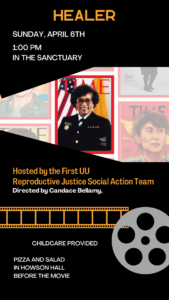
Reproductive Justice Film Festival – Healer

Dr. M. Joycelyn Elders served as the first African American and second woman to be the United States Surgeon General, from 1993 to 1994. During her 15-month tenure, Dr. Elders was known for her outspokenness and focus on controversial public health issues, including sex education and substance abuse prevention and was eventually forced out of this position because of her outspokenness. As she later concluded, change can only come about when the Surgeon General can get people to listen and talk about difficult subjects. This film looks back at the way she served our country and is a timely reminder during this time when we so badly need leaders who will speak truth to power.
Joy, Hope and Visibility
Podcast: Play in new window | Download
Listen to the sermon by clicking the play button above.
Rev. Erin Walter
March 30, 2025
First UU Church of Austin
4700 Grover Ave., Austin, TX 78756
www.austinuu.org
On the eve of Trans Day of Visibility, Rev. Erin Walter and Bis Thornton bring wisdom and beauty from diverse trans leaders, within and beyond Unitarian Universalism, as well as reflections and learnings from the recent All In For Equality Day and Texas UU Justice Ministry day at the Capitol.
Chalice Lighting
This is the flame we hold in our hearts as we strive for justice for everyone. This is the light we shine upon systems of oppression until they are no more. This is the warmth that we share with one another as our struggle becomes our salvation.
Call to Worship
THE INFINITE DIVINITY
by Rev. Jami YandleThe chalice is lit
And in the flames the memory of
Our trans and non-binary ancestors
Do a dance of freedom and liberation
Reminding us that
We are whole and holy
We are loved beyond all measure
And in our refusal to accept anything less
May we know we are rooted
In the infinite divinity
Not relegated to the outskirts
Of the web of all existence
But enshrined at its core
Enfleshed with stardust and fairy dust
An intentional creation of space where our many Gods live
Affirming Our Mission
Together we nourish souls, transform lives, and do justice to build the Beloved Community.
NOTE: This is an edited ai generated transcript.
Please forgive any omissions or errors.
Video
Hi, my name is E. Ciszek. I am a member of First Unitarian Universalist Church of Austin. I’m also a professor and a scholar.
In spring 2025, the United States remains deeply polarized with ideological conflicts shaping public discourse and policy. The second Trump administration known for its aggressive stance on social issues has exacerbated these divisions, targeting the rights and lives of trans individuals. Mainstream and alternative media outlets amplify anti-trans narratives, framing them as central to America’s cultural and moral battles. Globally similar trends are unfolding as nations grapple with their own political and cultural upheavals. the hardline rhetoric of the Trump administration has emboldened conservative movements worldwide, leading to policies that marginalize trans populations. For parents of trans youth, this means confronting an onslaught of restrictive laws and hostile media narratives that undermine their ability to support their children in an increasingly adversarial public arena.
As we know, parents serve as the first and most consistent support system for children. When a child expresses a gender identity that’s different from their assigned sex at birth, parents become crucial decision makers and advocates. They have to balance their own emotions and uncertainties while ensuring their child receives care and acceptance and protection. This journey often reshapes their relationships, sometimes leading to estrangement from relatives or faith communities unwilling to accept their child’s identity.
Educational advocacy becomes a constant battle as parents work to secure their child’s rights to recognition, their access to appropriate facilities and protection from discrimination. Yet, shifting policies of political rhetoric create confusion, allowing schools to justify inaction or exclusion. Trans Students are often denied access to bathrooms, locker rooms, sports teams, not always due to explicit bans, but because administrators fear backlash or misinterpret evolving legal guidance. As a result, parents find themselves in ungoing struggles with school officials, filing complaints and sometimes pursuing legal action, all while trying to shield their children from the emotional tool of being treated as political controversies rather than students.
Medical decision-making, though highly visible, it’s just one aspect of this fight. Parents must navigate a shrinking landscape of gender-affirming care as clinics close under legal and political pressures. Many are forced to seek care across state lines or rely on underground networks. Beyond advocating for their children’s right to life-saving treatments, they also have to contend with the alarming reality that healthcare providers themselves are under constant threat, harassed, and even forced to shut down.
The current political climate places an extraordinary pressure on these parents, pressures that are magnified for non-white families. Some states have attempted to classify gender-affirming care as child abuse, exposing families to child protective services investigations or even the threat of family separation. For black, brown, and indigenous families who are already disproportionately surveilled and criminalized by the child welfare system, these risks are amplified by a long history of racialization and racialized state violence. graphic displacement is a reality for some as families might relocate to states with stronger protections, creating medical refugees who leave behind careers, extended families, community ties in order to access care.
Yet not all families have equal access to mobility. Those most affected by intersecting racial and economic injustice often face the fewest viable options for safe relocation. The idea that families can just move to safer states or countries to protect their trans children presumes access to wealth documentation and freedom of movement. This acknowledgement demands a recognition that some individuals are fixed in place by racial capitalism settler colonialism or migration status. And so when thinking about these families and these children, we need to think also about the liberatory infrastructures where people are, not just where they might flee to through the creation of networks of solidarity, of care collectives, and local resistance that accounts for immobility as a structural condition, not as a personal failure.
Meanwhile, parents who speak publicly risk harassment and political attacks with their private medical decisions subjected to public scrutiny and debate. This surveillance is especially acute for families of non-white trans youth whose bodies are frequently rendered hyper-visible by the media as symbols of social crisis, of deviance or moral decline.
Parents choosing to stay out of the limelight, particularly black, brown and indigenous families, not because they lack care or engagement but because visibility intensifies the dangers of violence and exploitation. When anti-trans rhetoric intensifies, these families are among the first to feel its consequences. Their navigation of healthcare, education, and social systems exposes the systemic gaps and barriers that affect other marginalized groups as well.
As Reina Gossett, a queer transgender artist asserts, visibility is a trap, it creates an illusion of inclusion while intensifying vulnerability for those already marginalized. She speaks to the dangers of hyper-visibility for racialized trans people, dismantling the notion that visibility, for example, media attention or legal recognition automatically equals safety, is dismantled especially in volatile climates where black and brown trans bodies are surveilled, criminalized or politicized. Gossett really encapsulates why silence may be chosen over speech. When public attention increases surveillance and vulnerability, silence becomes a refusal to be consumed, to be co-opted or criminalized.
In a climate where schools and governments and media monitor trans kids and their families, silence can resist being co-opted, criminalized or sensationalized. Choosing not to testify, choosing not to post online, choosing not to speak publicly about a child’s identity or medical care isn’t passivity. It’s a strategy. It’s about refusing to feed systems that refuse, that reduce their lives to political battlegrounds. Silence becomes a form of care shielding trans youth from state media or public scrutiny. It’s also an act of refusal of the demand to always explain to justify or expose trans existence to satisfy cis normative curiosity or political debate.
By withholding information, parents can be carving out safer spaces for joy, transition or growth away from hostile visibility. Silence helps preserve dignity when the public sphere reduces trans-lives to spectacles. Silence is a counter surveillance tactic controlling what’s shared and with whom on whose terms for surviving in a landscape of hostile visibility. It’s not a retreat but a protective pause, a boundry around trans-joy transition and growth. Strategic silence can be a powerful tool of world-making, one that resists force visibility, embraces care and cultivates alternative ways of being and belonging in the face of trans antagonistic systems. It says we don’t owe you our child’s story. We’re busy building a better world for our child. And this is strategic invisibility as boundry-setting. It resists the assumption that transness must be made legible or palatable to audiences in order to be protected or valid.
Reading
ASKING FOR HELP
by Quinn Gormley“It is revolutionary for any trans person to choose to be seen and visible in a world that tells us we should not exist.”
-Laverne Cox
I locked myself out of my car recently. I called a garage and they sent a technician. Apparently, he tried to call me on the way over and I missed it. He left a voicemail, which meant he heard my message: “Hello, you’ve reached Quinn at the Maine Transgender Network.”
My trans status isn’t a secret. Being public about it is part of my job. But being public and being out to random men on the side of a quiet, rural road are very different things.
He arrived and we wrestled back into my Subaru. After handing over my insurance card, he got quiet for a minute. Nervously he asked, “You do the rainbow thing?”
It took me a second to put the pieces together. I froze for a moment. This question doesn’t usually end well. Tentatively I answered, “Yeah, I do the rainbow thing … Is that a problem?”
He shook his head and took a deep breath. And then he started to talk.
His kid came out a few nights ago and wants to transition. He’s very worried. He watches the news. He knows how trans kids get treated. i do too. I was a trans kid. I released the breath I’d been holding. This was a conversation I know how to have.
We talked for a while about how cruel the world is, about how his kid might very well get hurt. Lots do. He’s afraid to let them transition. But then we talked about how we can’t control the world. His kid is different and might get hurt either way. “So why not let them control what happiness they can? You can teach them how to handle the rest.” We talked about how happy kids are safer kids, because happy kids have adults they can ask for help.
A hug, a trading of numbers, and a few tissues later and he was on his way to the store to buy his son a clip-on tie and those Spider-Man shoes he didn’t give him for his birthday.
Sometimes the story does end well.
Video
ALL IN FOR EQUALITY DAY
By Joelle EspeutMy name is Joelle Espeut. My pronouns are she/her, also high girl, icy girl, city girl, material girl, and I am privileged to hail all the way from Houston, Texas.
And I just wanted to say I am a woman of many things. I am a community advocate. I am an around-the-way girl. I’m a fashionista. I’m an unapologetic black trans woman. Just a name a few. We are in Uncertainty Dark Con. Yes, yes, it’s real tricky right now. But that is not what I’m here to talk about. I’m here to speak about joy, hope and possibility-models.
Joy because even in the face of adversity and darkness and despair, we absolutely deserve to experience joy.
The hope that we lean into is the hope when we envision and imagine and think expansively about what our world can look like because we absolutely will prevail.
And possibility-models, because I, a black trans woman, will continue to stand and be a possibility-model for what can happen when you stand unapologetically and authentically in your trans-ness and in your identity.
And so because of that, and because of who we are, I want everyone here to lean into joy, hope, and possibility-models because that is where we will find liberation. Not just for trans people, but liberation for all.
Thank you.
Extinguishing the Chalice
We extinguish this flame, but not the light of truth, the warmth of community, or the fire of commitment. These we hold in our hearts until we are together again.
Benediction
The challenges that we face, the work that we face, will be like eating an elephant. But I tell people that the way to eat an elephant is one bite at a time. One bite at a time and we will win. So to recap, it will get better, stand together, unite, take care of yourself, take care of your community. It’s a marathon, not a sprint. When I say we’ve always been here, you say hell yeah, we’ve always been here, hell yeah, We’ve always been here! We’ve always been here!
– Anna Nguyen
Most sermons during the past 25 years are available online through this website. Click on the index link above to find tables of all sermons for each year listed by date (newest to oldest) with topic and speaker. Click on a topic to go to that sermon.
Podcasts of this and other sermons are also available for free on iTunes. You can find them by clicking on the podcast link above or copying and pasting this link. https://itunes.apple.com/podcast/first-unitarian-universalist/id372427776
Help Guatemalan families by shopping at First UU Sunday, April 13
UPAVIM will bring Fair Trade goods from Guatemala to sell at First UU in the Gallery Sunday, April 13 from 10 a.m. – 2 p.m. Buy with conscience in solidarity with a Community Development Foundation whose mission is to empower women.
At UPAVIM they believe when women are economically empowered, families thrive and communities are safer. Through their income generating projects, the women are able to support themselves, their families and their community, even though they live in a Red Zone of Guatemala City plagued by gangs and violence. Your support of UPAVIM offers a place of sanctuary through camaraderie, employment and security.

Holy Ground
Podcast: Play in new window | Download
Listen to the sermon by clicking the play button above.
Rev. Michelle LaGrave
March 23, 2025
First UU Church of Austin
4700 Grover Ave., Austin, TX 78756
www.austinuu.org
Join us for a restful service full of stories and music about finding Holy Ground. Rev. Michelle LaGrave weaves together a tapestry of stories accompanied by the atmospheric/symphonic stylings of music guests Thor & Friends. Take some time for rest and reflection in the midst of an increasingly chaotic world.
Chalice Lighting
This is the flame we hold in our hearts as we strive for justice for everyone. This is the light we shine upon systems of oppression until they are no more. This is the warmth that we share with one another as our struggle becomes our salvation.
Call to Worship
by Macrina Wiederkehr (adapted)
My bare feet walk the earth reverently for everything keeps crying.
Take off your shoes.
The ground you stand on is holy.
The ground of your being is holy.When the wind sings through the pines like a breath of God, awakening you to the sacred present, take off your shoes.
When the sun rises, coloring your world with dawn, put on your garment of adoration, take off your shoes.
When the red maple drops its last leaf of summer, wearing its burning bush robes no longer, read between its barren bushes and take off your shoes.
When a new person comes into your life like a mystery about to unfold, and you find yourself marveling over the frailty and splendor of every human being, take off your shoes.
When, during the wee hours of the night, You drive slowly into the new day and the morning’s fog, like angel wings, hovers mysteriously above you, take off your shoes.
Take off your shoes of distraction.
Take off your shoes of ignorance and blindness.
Take off your shoes of hurry and worry.
Take off anything that prevents you from being a child of wonder.
Take off your shoes.The ground you stand or sit or walk or roll-on is holy.
Affirming Our Mission
Together we nourish souls, transform lives, and do justice to build the Beloved Community.
NOTE: This is an edited ai generated transcript.
Please forgive any omissions or errors.
Story for all ages
“MOSES”
So, I’m going to tell you a story today that is really, really old. People have been telling this story for more than 2 ,000 years, and eventually it got written down in both the Jewish Bible, also known as the Hebrew Scriptures, or the Torah, and the Christian Bible in what is called the Old Testament. It’s a story about someone called Moses.
So Moses was living with his wife and his father-in-law in an area near Mount Horab, and he was taking care of his father-in-law’s sheep. His father-in-law was the priest of Midian, and he was taking care of the sheep, which means that he was sort of following them around and making sure that nothing bad happened to the sheep. He was acting as a shepherd. So he was wandering around in the wilderness with his father-in-law’s sheep, and Then, for whatever reason, he decided to take a little detour and head up on Mount Horab with all the sheep, and that was a mountain that was known as the mountain of God.
And while he was walking on the mountain, all of a sudden he saw a bush that looked like it was on fire. But, Even though it looked like it was on fire, the bush wasn’t burning up. All the leaves were still green. Pretty weird, huh? So Moses said to himself, “I must turn aside and go over and look at this bush that is burning but not burning up.” And you know what he saw when he looked at the bush? It wasn’t really on fire. There was an angel in the bush, and it wasn’t one of those angels that we think of today with a white gown and white wings and a golden halo. It was an angel that looked like it was on fire. It was so bright, it was hard to look at the angel.
And then, as if that weren’t enough, all of a sudden, Moses heard the voice of God. And God said, “Moses, Moses.” And Moses said, “Here I am.” And then God said, “Come no closer. Remove the sandals from your feet because the place you are standing on is holy ground.” So Moses took off his sandals.
And God said, “I am God, the God of your father, the God of Abraham and Isaac and Jacob and he had to tell him which God he was because back then they believed that different people had different gods so he had to identify himself and Moses got afraid and hid his face because back then people thought that if you looked at God you might die. So God was, so Moses was really afraid. God is talking to him. This bush is not really on fire. He’s hiding his face. He’s got his sandals off.
So, God then said, “I have seen the misery of my people who are slaves in Egypt, and I am going to send you, Moses, to free them from slavery.”
And Moses said, “What if they don’t believe me? “What if they don’t Think that I’m really coming from you. I don’t I don’t even know who you are, What do I tell them? What is your name? and God said “I am who I am.” which it sounds a little interesting in English. In Hebrew what they wrote down is the four letters, the four consonants of God’s name, which are Yodhe, Vavhe, and which looks kind of like, sounds kind of like YVHV in English.
But you know what, they didn’t write down the vowels. So nobody really knows how to say it anyway. So now we just call God “God”.
But he said, “I am who I am. Tell them, tell those people, my people down in Egypt who are in slavery, I am has sent me to you.” This is my name forever and my title for all generations.
The reason this is important today is Two things. We’re talking about holy ground through the whole rest of the service. But also, do you remember a couple of weeks ago we had a child dedication. And, in a couple of weeks, Easter and Passover are coming up. And so we’re going to have the baby parade that we always have on Easter. But before that, we’re going to have another child dedication for, I don’t know, at least three more kids. I’m not sure how many yet.
Do you remember what we did at the beginning of the child dedication, those of you who are here? before we made the promises to the children, before we told them that we would look out for them and take care of them and help them learn and grow. The first thing we did, We said the child’s name. We asked the parents what is the name of your child and they gave us the child’s full name.
So naming is very important. When Moses learned the name of God, God told him he was standing on holy ground. And when we learn your names, when you are dedicated and then we make promises to you, we are also on holy ground. It’s a really special and sacred moment in the time of your life and we’re gonna promise to take care of you all the way until you’re grown up and then you’re gonna help take care of the kids who come next.
Story
BY Stephen Huyle
A damp chill pervades the air as Amita wends her way down the dark street to the river. For warmth, she pulls her sari about her head and adjusts her light wool shawl more tightly around her shoulders. Then she reaches down with both hands to pull her two young children along with her. They stumble sleepily as she guides them through the narrow passageways. Just above the river, she stops quickly to buy a small lamp made of a curled dry leaf. In its center, a dob of clarified butter holds a wick.
The three sidle through the huddled bodies of unidentifiable figures and down the ancient stone steps that run as far as they can see along the river’s edge. Steps grooved through centuries of use, and then the black expanse of the river fills their gaze and they slip off their sandals and walk down the last steps into the icy cold water.
The children are reluctant, their teeth chattering, their mother is determined, intent on fulfilling this ritual which begins each day of her life. They wash their bodies and their clothes with soap. All the while the sky has been lightening.
Across the river, the promise of sunrise turns the water from deep purple to rich blues tinged with orange, the shivering three steps again into the water, which now seems warm compared to the biting air. Amita is immersed to her knees, Minu and Bablu to their waists. Together they sing prayers to the goddess Ganga, who is also the river.
They visualize her magnificence, her nurturing presence as the purifier and mother of all existence. With a match, Minu lights the small leaf lamp and gently floats it out before them. At that moment, the sun’s first rays peek above the sandy horizon. And they begin singing to the sun god Sarya, the source of all energy, the great provider.
Story
“EMILY”
There once was a cow named Emily, a very frightened cow, who found herself in a slaughterhouse. She was next in line when all of a sudden, the lunch whistle blew and the workers took a break.
Well, Emily saw her chance and made her own break for it, leaping in a very uncow-like manner, right over a five foot high fence and heading for the woods. When she got to the woods, she ran with a herd of deer, all the while eluding capture by both Slaughterhouse workers and the local police.
Meanwhile, and unbeknownst to Emily, Emily’s escape made headlines. People everywhere heard Emily’s story and fell in love with the cow who had rescued herself from imminent death. In the midst of all this hubbub, a group of people came together to try to rescue Emily and after some negotiation, she was purchased for a dollar. Later, when Emily’s saviors pulled up to the edge of the woods with their truck and after having wandered in the wilderness for 40 days. Emily was ready for her ordeal to end. Encouraged with some buckets of grain, Emily walked up the ramp and was brought to her new home on the grounds of the Peace Abbey in a town called Sherborn in Massachusetts.
Emily lived for several more years and was credited by many as a teacher of love and compassion and a source of inspiration for change and growth. When Emily eventually died, she was buried on the grounds of the Peace Abbey, not far from a statue of Gandhi. Her grave is now marked by a bronze life-sized statue and clippings from her hair and a sacred thread from her ear have been released in the Ganges River. People still make pilgrimages to visit her grave.
Story
“FERRY BEACH”It is summer, and I am spending the week at Ferry Beach, one of our UU camp and conference centers located on the coast of Maine. I awake to a beautiful, bright, sunny, and warm day and head to the beach as soon as I am dressed. I cross the boardwalk, slip out of my flip-flops, and quickly head down to the water’s edge.
There I stand with my feet buried in the sand and the waves lapping at my legs. This is my favorite place to meditate and pray, while standing and gazing out over the vast expanse of the ocean.
This morning, though, the sun is exceptionally bright and since it is early, low on the water. The sun and the sun’s reflection on the water are so bright that I cannot see the ocean before me. When I try, my eyes hurt and water and I am forced to lower my head so that I see only my toes and the water surrounding me. In this posture I remain for a long time, recognizing the humility inherent in the pose, sensing its foreignness to both myself and my culture.
And I wonder, here I am, standing before the sun and the ocean, feeling the immense power of both, forced into an attitude of deference and humility, which I cannot choose to overcome, sure of turning and walking way. And I wonder, is this how Moses would have felt barefoot and face hidden standing before God? And I wonder, is this how Amida feels every morning of her life as she stands in the sacred waters of the river, bending to light and release her lamp. And I feel connected to those who have gone before me and will come after me, to those who also experience awe and wonder and humility. Eventually I turn and slowly climb up the beach, replace my sandals, wash my feet, and return to my daily study of routine and learning.
I return to the beach often. For me, these visits are a reenactment of my own sacred creation story. As I take off my shoes and move lightly and quickly down to the water’s edge, I return to the primordial waters, to the murky origins of myself and my species. As I play and swim, I remember my origins, back when my kind were still fish in the sea.
When I finally emerge from the water and climb back up the beach, I wonder, at this struggle it always is to leave the water behind. And I imagine how difficult those first evolutionary transitions, those first climbs up onto the beach must have been. And I feel awe at those first changes from fish to amphibian. I think, then, that I understand the dolphin, a mammal who once on land chose to return to the sea. I understand for I too feel these urges, for I too feel the call of the deep, and I know. I know the power of this holy ground.
Message
In all of these stories, there is a common experience of standing or walking on holy ground. For Moses it is at Mount Horrib, for Amida in the River Ganges, for Emily and later her pilgrims on the grounds of the Peace Abby, for myself at the ocean’s edge.
At various times and in various ways we all visit holy ground. In doing so, some of us take off our shoes. Some of us come face-to-face with God. Some of us commune with the cosmos. Some of us come face-to-face with our own salvation.
I imagine there are many, many other stories about holy ground which I could tell. People of many faiths walk labyrinths, pagans cast circles, Hindus draw sacred diagrams called kolams near the entryways of their homes. Surgeons place special covers over their shoes before entering operating rooms. Walking, standing, rolling, or simply being on holy ground is a common human experience, one that many of us share.
When we visit holy ground, we experience awe and wonder. We ponder the great mysteries of life. We feel the force of evolution. We sense the power which emerges from our collective humanity, the power of change and growth, of inspiration and creativity and of love. We need not embark on a pilgrimage to far off lands to visit Holy Ground. Holy Ground is available to us at all times and in all places.
Holy Ground is here in this sanctuary; out there in the art gallery; around the corner at Howson Hall where we visit with each other after the service; down that hallway there where the children meet for classes and staff work to fulfill the mission of this congregation; out on the playgrounds and in the youth room; in your homes, and in so many, many places.
It is we who must set an intention to understand the ground we happen upon is holy. It is we who must pay attention. An experience of the sacred of the Holy is available to us at any time, anywhere. When I received my call to ministry, I was not at a pilgrimage to a sacred site or standing at the ocean’s edge. I was sitting at my dining room table reading a magazine. Moving to an Understanding of the ground we find ourselves upon as sacred or holy grounds can feel risky. And it’s not a journey to be undertaken lightly.
When we visit holy grounds, we confront the nature of life and death. We gain insight. We become self-aware. We come face-to-face with those parts of ourselves and others we had not previously known. We realize our human nature. We may even come to know God.
Where is your holy ground? Where do you take off your shoes? When do you bow your head?
As Unitarian Universalists, it is our religious duty to follow the paths each of us finds sacred to ourselves. These paths are incredibly diverse, take many forms and lead in many directions. They are all holy. As together we navigate the triumphs and tribulations of this great mystery we call human life. We are blessed to be able to join together in this community of faith, which honors such divergent understandings of the human, of the divine, of the holy. May we be so blessed evermore.
Amen and blessed be.
Extinguishing the Chalice
We extinguish this flame, but not the light of truth, the warmth of community, or the fire of commitment. These we hold in our hearts until we are together again.
Benediction
Open your eyes, your ears, your hearts, your minds, your spirits. The ground you sit, stand, walk, roll, dance, crawl upon is holy. As you remember, as you leave this place, remember you are blessed. The holy, the sacred, is available to you at all times and in all places. Go forth, blessing all others as you yourselves are now blessed. Amen and blessed be.
Most sermons during the past 25 years are available online through this website. Click on the index link above to find tables of all sermons for each year listed by date (newest to oldest) with topic and speaker. Click on a topic to go to that sermon.
Podcasts of this and other sermons are also available for free on iTunes. You can find them by clicking on the podcast link above or copying and pasting this link. https://itunes.apple.com/podcast/first-unitarian-universalist/id372427776
Rest
Podcast: Play in new window | Download
Listen to the sermon by clicking the play button above.
Rev. Michelle LaGrave
March 16, 2025
First UU Church of Austin
4700 Grover Ave., Austin, TX 78756
www.austinuu.org
Rest has long been a spiritual practice or even a religious mandate of many people. Yet, life can feel so busy that we imagine there is no time to rest. How might we come to a better sense of balance in our lives that honors the need to rest?
Chalice Lighting
This is the flame we hold in our hearts as we strive for justice for everyone. This is the light we shine upon systems of oppression until they are no more. This is the warmth that we share with one another as our struggle becomes our salvation.
Call to Worship
YOU ARE NEVER ALONE
by Sharon WylieIt is okay to be tired of change
It is okay to be tired of everything different
Okay to feel weary of resiliency and wholeness and learning and growth
And okay to yearn simply for rest
It’s okay to be grouchy and unsatisfied
And all the ordinary human ways of being that we are
Let this morning be a reminder that you are loved
Let our time together soothe what is restless in you
May you be comforted in knowing that whatever you are
feeling today and other days
You are not alone. You are never alone.Come, let us worship together.
Affirming Our Mission
Together we nourish souls, transform lives, and do justice to build the Beloved Community.
Reading
REST IS RESISTANCE: A MANIFESTO (Excerpted)
by Tricia HerseyTricia Hersey, also known as The Nap Bishop, is the founder of The Nap Ministry. Hersey makes a historical connection between slavery and contemporary grind culture and views rest as one form of reparations for Black people. She holds a Master of Divinity degree as well as a bachelor’s degree in Public Health.
Everything we know about rest has been tainted by the brainwashing from a white supremacist, capitalist system. As a culture, we don’t know how to rest, and our understanding of rest has been influenced by the toxicity of grind culture. We believe rest is a luxury, privilege, and an extra treat we can give to ourselves after suffering from exhaustion and sleep deprivation. Rest isn’t a luxury, but an absolute necessity if we’re going to survive and thrive. Rest isn’t an afterthought, but a basic part of being human. Rest is a divine right. Rest is a human right. We come into the world prepared to love, care, and rest. The systems kill us slowly via capitalism and white supremacy. Rest must interrupt. Like hope, rest is disruptive, it allows space for us to envision new possibilities. We must reimagine rest within a capitalist system.
Sermon
NOTE: This is an edited ai generated transcript.
Please forgive any omissions or errors.
The Torah, the Tanakh, the Hebrew Scriptures, the Christian Bible, whatever it is you call these most ancient of the Jewish and Christian texts, they all begin, as most stories do, bear a sheet and The first story that is told about the creation of the world of our world and How after six days of work? God rested on the seventh God rested. God who some theologians later came to describe as omnipotent, got tired and had to rest.
So I ask if God, Godself, can get tired and need to rest, who are we not to? Who are we to say that we don’t need to rest, that there’s too much to be done that we can rest later. After X, Y, and Z things have been done, of course. Who are we to tie our self -worth, our sense of value, into how much and how quickly we get things done?
Notice the words I’ve used here, self-worth, and value. These are also monetary terms, which is no accident. Our Western Judeo and Christian history of laboring for people other than ourselves or our own communities is long and fraught and goes back to ancient times. When God gave Moses the Ten Commandments, God took some extra time to specify exactly what God meant by saying, “On the seventh day, you should rest.” Not just you should rest, but your sons and your daughters, your male and your female slaves, your livestock and alien residents in your community. Everyone must refrain from work. Everyone must rest. No exceptions.
We know why, right? Because people are people, even ancient times, and because we know that somebody was going to try to get away with resting themselves while requiring other people to work.
In more recent history, our track record is no better and likely worse. With the rise of capitalism as it moves through its various stages, much of this nation’s wealth was created by people who were oppressed in many ways, especially blacks who were enslaved, but also indigenous people who were enslaved, white indentured servants, and white people who did not own property and could not vote, which included all women and all children for centuries.
The dominant culture of our nation has valued production, the more, the better, the faster, in terms of creating wealth. And it has done so for centuries, regardless of the cost, the cost, or the toll, the toll, more monetary terms. It has taken on human bodies and human souls. The more wealth, the better. The faster we acquire the wealth, the better.
And this has spilled over into our other aspects of our lives as well. Not just the creation of wealth, but also the arts. Think of ballet, the ballerinas with bleeding feet for our entertainment. Sports, think of any of them, but especially football, even our learning. The more difficult, the better, the higher numerical grade, the better, the faster we move ahead, the better, and our academia. The more journal articles and books published, the better, the more the better. It is all over the place.
So what do we do about all of this?
- The first thing is to acknowledge that this idea, this value, the more the better, is one aspect of the dominant culture in our country.
- Next thing is to acknowledge that this aspect, the more the better, is a problem. It exists and it’s a problem.
- And finally, the work is to dismantle this aspect of our culture. Stop putting such a high value on the more the better.
After all, look at where it’s gotten us. to right here, exactly where we are with billionaires running our country, some of them not even elected.
And for those of you who haven’t picked up on it yet or aren’t familiar with the work of Tima Okun and others, I am talking about dismantling one of the toxins of white supremacy culture. I know that phrase white supremacy culture is really hard. It’s really challenging and difficult. So I talk about dominant culture instead a lot. But it’s the same thing. To do this, it is helpful to look to the leadership of those who have been most adversely impacted by this culture, by toxins like the more, the better, the faster, the better. Enter Trisha Hersey, author of the reading you shared with us earlier today from her book, This is resistance, a manifesto.
Slowing down our grind culture, turning away from the focus on production, dismantling the constant push of the more, the better. It’s not only good for our bodies and our souls, it is also an act of resistance. A bill of reparations owed, an act of allyship, and a deeply theological imperative.
One of the places we have begun this work is right here in our church, because the more the better has been true here, right? We count the number of programs the church offers. we count the number of people who show up to a program at the church. We count the number of minutes there are in a sermon or a worship service. And we make judgments on those. The sermon’s probably the only one which the longer the better might not hold true. (audience laughing) The exception to prove the rule. And by the way, this morning will be shorter than my usual so that you have a little more time to rest on your Sunday.
I know. I know how much there is to be done in all of our lives and in this country and in this world and from so many, many perspectives, I know how easy it is to feel a sense of overwhelm. I feel it, too. I struggle with finding enough rest, too. Sometimes that’s why we preach these sermons, is because we need to preach to ourselves. This is one of those cases.
We all feel the overwhelm, and we should know that we aren’t the first to feel this way. When the Reverend Dr. Martin Luther King, Jr. felt the weight of the struggle for change and justice, and its attendant exhaustion, and the fear for his own life that he lived under. He turned to a particular hymn, his favorite, “Precious Lord, Take My Hands,” which we will sing together shortly.
And as you go forth a little bit later today, after eating some pie, I encourage you to continue to explore. We began with our kids earlier today, the many, many ways of resting. Sleep, yeah. Sure, get plenty of that, but not just sleep. Find other ways to rest, too. And as you do, remember that in your resting and in your insistence upon rest, you are doing the work of the resistance. You are not taking a break from doing the work of the resistance; by resting, you are resisting.
May it be so. Amen and Blessed be.
Extinguishing the Chalice
We extinguish this flame, but not the light of truth, the warmth of community, or the fire of commitment. These we hold in our hearts until we are together again.
Benediction
by Tricia Hersey
You are worthy of rest. We don’t have to earn rest. Rest is not a luxury, a privilege, or a bonus we must wait for once we are burned out … Rest is not a privilege because our bodies are still our own, no matter what the current systems teach us. The more we think of rest as a luxury, the more we buy into the systematic lies of grind culture. Our bodies and Spirits do not belong to capitalism, no matter how it is theorized and presented. Our divinity secures this, and it is our right to claim this boldly
Whether you are a resistor, or an ally, or a little bit of both, … Go, boldly claiming your divine right to rest and in doing so, bless all others as you yourselves are blessed.
Amen and Blessed Be.
Most sermons during the past 25 years are available online through this website. Click on the index link above to find tables of all sermons for each year listed by date (newest to oldest) with topic and speaker. Click on a topic to go to that sermon.
Podcasts of this and other sermons are also available for free on iTunes. You can find them by clicking on the podcast link above or copying and pasting this link. https://itunes.apple.com/podcast/first-unitarian-universalist/id372427776