Earth Day Events

 
Hi Earth Home Friends,
 
Here are some great Earth Day climate resources: 1. A treasure House of inspiration resources and more at  talkingclimatenewsletter@outlook.com , 2. Discover Earth Day events, 3. Austin Sustainability Office calendar and 4. Austin Commons events
 
1.  “Clean energy in Texas, wildfire and flood in Canada and Russia and how to engage your elected officials’  A powerful list of “What You Can Do”, printable coloring books and videos on “how climate change hits home” all this and more in the latest free issue of talkingclimatenewsletter@outlook.com


3. Austin Office of Sustainability Celebrate Earth Month Calendar
 
 
4. The Austin Common – Great local website and newsletter for all things green and positive.

TXUUJM April News!


Climate & Reproductive Justice, Author Talk, and more!

The Texas UU Justice Ministry’s April Newsletter is here! TXUUJM is excited to welcome several prominent guest speakers this spring — author Steve Phillips (How We Win the Civil War: Securing a Multiracial Democracy and Ending White Supremacy for Good), Elle Cross from Mano Amiga (5/2/24), and the leaders of UU Ministry for Earth and Side with Love on Moving from Environmentalism to Climate Justice (5/9/24). All events are FREE, online, and open to everyone. Register and get more info! . TXUUJM is also your source for Texas UU the Vote efforts this election year!

Sign up for TXUUJM emails to get the latest news and actions.

Interdependence Day

Listen to the sermon by clicking the play button above.

Rev. Chris Jimmerson
Rev. Michelle LaGrave
April 14, 2024
First UU Church of Austin
4700 Grover Ave., Austin, TX 78756
www.austinuu.org

We often speak of interdependence in terms of the web of all life, from earth to all the plants and animals. But what does interdependence mean in the context of human life? How does interdependence impact human relationships and human community?


Chalice Lighting

This is the flame we hold in our hearts as we strive for justice for everyone. This is the light we shine upon systems of oppression until they are no more. This is the warmth that we share with one another as our struggle becomes our salvation.

Call to Worship

RENEWAL IN THE WEARY WORLD
Rev. Shari Woodbury

Welcome, all who seek renewal in a weary world.
Welcome, all who come with love and energy to share.
Welcome, to those who worry for the future.
Welcome, each one who is grateful for today.
Know that in this place, you are not alone.
In community we share our strength with one another
and we keep the flame of love burning bright.
Know that in this place, responsibility is shared.
Here, tradition holds us; ancestors shine a light from the past.
Here, the young lift their bright faces, and beckon us onward.
Take my hand, and we can go on together.

Affirming Our Mission

Together we nourish souls, transform lives, and do justice to build the Beloved Community.

Reading

SURVIVING THROUGH RECIPROCITY
Robin Wall Kimmerer
An excerpt from Braiding Sweetgrass

Scientists are interested in how the marriage of alga and fungus occurs and so they’ve tried to identify the factors that induce two species to live as one. But when researchers put the two together in the laboratory and provide them with ideal conditions for both alga and fungus, they gave each other the cold shoulder and proceeded to live separate lives, in the same culture dish, like the most platonic of roommates. The scientists were puzzled and began to tinker with the habitat, altering one factor and then another, but still no lichen. It was only when they severely curtailed the resources, when they created harsh and stressful conditions, that the two would turn toward each other and begin to cooperate. Only with severe need did the hyphae curl around the alga; only when the alga was stressed did it welcome the advances.

When times are easy and there’s plenty to go around, individual species can go it alone. But when conditions are harsh and life is tenuous, it takes a team sworn to reciprocity to keep life going forward. In a world of scarcity, interconnection and mutual aid become critical for survival. So say the lichens.

Sermon

Text of Rev. Chris’ Homily is not available.

Rev. Michelle’s Homily

A little over 30 years ago, I headed off to Norlands Living History Center in Livermore, Maine. I had recently graduated from college with a double major in history and anthropology. I was especially interested in museum education and historical archaeology. And, after 17 years of schooling, I was especially interested in not spending most of my days reading, researching, and writing. So it was, that with great excitement and a little trepidation, I headed off to live and work on a historic farm.

While we had some hidden access to modern amenities like running water, real bathrooms, minimal heat, and electricity, we interns, of which I was one, lived as if the year was 1870 most of the time. As it was a working farm, chores needed to be done whether visitors were present, or not, and they were divided by gender. Much of the time, I was the only woman intern. I rose early, dressed in costume, walked the half mile uphill from the 1795 house in which I was living to the main area of the farm. I milked the cow, fed the chickens, collected eggs, pasteurized milk, made butter and cottage cheese, did all the cooking on a wood stove, weeded the garden, and so on. Fall was a time of harvesting, canning, making apple cider, bottling hard cider. Winter brought lots of snow and ice, horse-drawn sleigh rides and cutting 2 foot thick ice from the pond for the ice house. I taught school in the one room schoolhouse, danced in the barn on Saturday nights, made homemade ice cream, and finished off crazy quilts. I assisted with the births of piglets and a calf. And, when visitors weren’t around, I had the opportunity to try my hand at the men’s chores, too, like driving the team of oxen to pick rocks out of the fields before they were plowed and splitting wood and, yes, I learned there were some very practical reasons for the old fashioned division of labor.

Most of all, though, I was amazed at how much I had learned to do, how empowered I felt, how self-reliant I had become. I imagined that I could homestead, someday, if I wanted to. I was taken in by this feeling of independence.

And then I got sick, really sick, and I learned that feeling of independence was just a feeling; that in some ways all that selfreliance was just an illusion. I was the last of the interns to come down with whatever it was. I became feverish, weak, and beyond exhausted. The director of the museum had to take me home, down the hill to that 1795 house, get me inside, start the fire in the wood stove, and make sure I had plenty of wood right next to the stove. I fell into bed and slept, getting up only to put more wood in the fire or use that hidden bathroom.

And, at some point during that time, I began to feel better enough to think and I realized how totally and utterly dependent I was on other human beings. If I were all alone, I would not have been able to make it outside, through all the snow, over to the woodshed, and brought in all that wood. I would have frozen, become hypothermic.

Remember what I said last week? About how our lived experiences are the raw material, the scripture from which we build our theology? I was not yet a minister, had not yet been to seminary, or even graduate school and had not been raised UU. Though, as Callie Pratt, I attended an 1870 Universalist meetinghouse on Sundays, I had not yet been exposed to the Unitarian Universalism of the modern day, or its Principles, or its Values. I knew nothing of the interdependent web and was not familiar with the concept of interdependence. I was fascinated by these ideas of and feelings about independence and dependence; how both could be true at the same time. I did have a lot of survival skills and I did need other people in order to survive. I had experienced, in a very in-your-face kind of way, the concept, the reality of interdependence. Revelation was not sealed.

We humans are just like the algae and fungi of this morning’s reading; fairly independent when resources are plentiful, fairly dependent when resources are scarce, and totally interdependent – with each other, with the earth, and with all of life, all of the time.

And, we people of First UU Austin, are like the people in this morning’s story: a community in which each person has a role to play, each person is needed, and each person needs each other; it is all together that we become whole.

As Unitarian Universalists, we often place a high value on individuals hearing a call, finding a purpose, seeking fullfillment, and so on. Sometimes, we just want to be helpful, or useful. It can be easy for us to focus on these roles as something of a higher purpose. But today, and especially because it is New Member Sunday, I want to ask us, all of us, to focus on the opposite – on being helped, on allowing ourselves to be helped. (in appropriate ways, of course) I’d like us to think about how being served is of as much value as being of service. We all have different skills, different needs. We all go through times of joy and times of struggle. We all have times of service and times of being served. None of us should focus overly much on one over the other. Both are important. Balance is important. We are an interdependent community. With each other, with the earth, with all of life.

We all need one another, in all the ways, and all the time.

May it be so. Amen and Blessed Be.

Extinguishing the Chalice

We extinguish this flame, but not the light of truth, the warmth of community, or the fire of commitment. These we hold in our hearts until we are together again.

Closing Words

by the Rev. Peter Raible

We build on foundations we did not lay
We warm ourselves by fires we did not light
We sit in the shade of trees we did not plant
We drink from wells we did not dig
We profit from persons we did not know
This is as it should be.
Together we are more than anyone person could be.
Together we can build across the generations.
Together we can renew our hope and faith in the life that is yet to unfold.
Together we can heed the call to a ministry of care and justice.
We are ever bound in community.


SERMON INDEX

Most sermons during the past 24 years are available online through this website. Click on the index link above to find tables of all sermons for each year listed by date (newest to oldest) with topic and speaker. Click on a topic to go to that sermon.

PODCASTS

Podcasts of this and other sermons are also available for free on iTunes. You can find them by clicking on the podcast link above or copying and pasting this link. https://itunes.apple.com/podcast/first-unitarian-universalist/id372427776


May 4th Local Election

On the Saturday, May 4th ballot for voters in the Travis Central Appraisal District (TCAD) [coincident with Travis County] is, for the first time, the election of three members to the TCAD Board of Directors.
 
What does the appraisal district’s board do? 
Up to now, core tasks were hiring the chief appraiser and approving the district’s budget. Now they will also appoint members to the Appraisal Review Board – the group who settle property value disputes between property owners and district appraisers. 
 
If we elect the wrong folks to the board of directors, they can cause chaos in our property values and underfund public services (e.g. schools, EMS, fire departments, etc.), so we encourage everyone to to research the candidates and to vote!
 
Early voting will be April 22nd through April 30th.
 

Celebrate Earth Month

This month is Earth Month below is a wonderful calendar of Austin events celebrating our Earth Home.  Before we get there have you seen the award on the church wall by the double gallery doors? It says Our five-acre lot, has been certified as an official National Wildlife Federation (NWF) Backyard Wildlife Habitat site for its ongoing efforts to cultivate the church grounds with native plants and wildlife-friendly features. The certification is awarded to sites that use native plants to attract and sustain wildlife. The project was the brainchild of church members Pat and Dale Bulla, who have a deep interest in environmental issues. “We took the NWF Habitat training and our church members were excited to make this happen
 
We are currently blessed with our church five-acre home being cared for by our own Earth Keepers! You can pitch in with this fun verdant crew, contact  wonderful Wrangler Donna Carpenter: drdonnacarpenter@gmail.com
 
 
Hope you, your family and friends can can share our Earth Keepers and these Austin events:
 

Unwound Sound Concert: Duo Amie


First UU’s resident arts group Unwound Sound is proud to present Boston’s Duo Amie on Friday, April 19th at 8 p.m. in our Sanctuary. Duo Amie will perform “In Her Own Key: a Celebration of Cello & Piano Works by Women, and a freewill offering will benefit the organization Black Mamas.”
 
Ellyses Kuan and Julie Reimann
 
Praised for their “brilliant virtuosity and evocative musicality”, Duo Amie (Julie Reimann, cello and Ellyses Kuan, piano) is a Boston-based cello/piano duo with an active performing schedule and online presence, dedicated to inspiring and bringing diverse people together with thematic musical programs that capture the imagination through musical expression and visual elements. They will perform a program of pieces titled ‘In Her Own Key’ on Friday, April 19th as part of our Unwound Sound Series, celebrating pioneering female visionaries Fanny Mendelssohn Hensel, Clara Schumann, Amy Beach, Rebecca Clarke and Florence Price.
 
The program, which includes Beach’s beautiful ‘Romance’ and Price’s virtuosic ‘Fantasie in g minor’, will be interspersed by commentary on the pieces as well as visual art. Reimann and Kuan are world-class trained musicians who have performed nationally and internationally. They founded Duo Amie in 2015 to bring people together through the beauty and universality of music. Equally at home in classical, contemporary, and popular music forms, Duo Amie has been praised for its virtuosity, expressivity, and engaging presence. Visit www.duoamie.org to learn more or check out this event on Facebook.
 

Eclipse Sunday

Listen to the sermon by clicking the play button above.

Rev. Michelle LaGrave
April 7, 2024
First UU Church of Austin
4700 Grover Ave., Austin, TX 78756
www.austinuu.org

We live in a universe filled with awe and wonder. Join us as we celebrate the upcoming solar eclipse.


Chalice Lighting

ALL THE LIGHT IN THE HEAVENS
by Cynthia Landrum

For the wonder and inspiration we seek from sun, and stars, and all the lights of the heavens, we light this chalice.

Call to Worship

Come you who are wonder-filled,
Come you who are awe-stricken,
Come you who are filled with faith,
or riddled with doubt.
Whether you are scientist or mystic,
or both,
Whether you are one to seek answers.
or to embrace mystery,
Come.
All who are humbled by the stars, moons, and planets,
are welcome here.
Let us worship.

Affirming Our Mission

Together we nourish souls, transform lives, and do justice to build the Beloved Community.

Anthem

All of today’s music is from Pink Floyd’s 1973 album “Dark side of the Moon”

“TIME” Lyrics
Pink Floyd

Ticking away the moments that make up a dull day
You fritter and waste the hours in an offhand way
Kicking around on a piece of ground in your hometown
Waiting for someone or something to show you the way
Tired of lying in the sunshine
Staying home to watch the rain
And you are young and life is long
And there is time to kill today
And then one day you find
Ten years have got behind you
No one told you when to run
You missed the starting gun

And you run, and you run to catch up with the sun
But it’s sinking
Racing around to come up behind you again
The sun is the same in a relative way
But you’re older
Shorter of breath, and one day closer to death
Every year is getting shorter
Never seem to find the time
Plans that either come to naught
Or half a page of scribbled lines
Hanging on in quiet desperation
Is the English way
The time is gone, the song is over
Thought I’d something more to say

Reading

Excerpt from “THE MOST DAZZLING ECLIPSE IN THE UNIVERSE”
by Adam Frank

Eclipses are not particularly rare in the universe. One occurs every time a planet, its orbiting moon, and its sun line up. Nearly every planet has a sun, and astronomers have reason to believe that many of them have moons, so shadows are bound to be cast on one world or another as the years pass.

But solar eclipses like the one that millions of Americans will watch on April 8 – in which a blood-red ring and shimmering corona emerge to surround a blackened sun – are a cosmic fluke. They’re an unlikely confluence of time, space, and planetary dynamics, the result of chance events that happened billions of years ago. And, as far as we know, Earth’s magnificent eclipses are unique in their frequency, an extraordinary case of habitual stellar spectacle. On April 8, anyone who watches in wonder as the moon silently glides over the sun will be witnessing the planetary version of a lightning strike.

Centering

This is the time in our service where we center ourselves together. We breathe together.

And breathing together, we sense one another’s loving presence.

Breathing in and breathing out, we follow our breath to a deeper place inside; a place of greater wisdom; a place where we are touched by awe and filled with wonder; a place where imagination reigns and inspiration rises; a place where a spark of the divine resides.

As we enter into this space, we call to mind the vastness of the universe. We travel outward in our imaginations, from the earth, moon, planets, and sun; from the Milky Way to other galaxies, to the universe itself. And as we do so, we find ourselves gaining a new perspective; our lives, our troubles, our joys become smaller and we are filled with wonder.

Now, let us enter into a time of sacred silence.

US AND THEM Lyrics
Pink Floyd

Us and them
And after all, we’re only ordinary men
Me and you
God only knows, it’s not what we would choose to do
Forward he cried from the rear
And the front rank died
The General sat, and the lines on the map
Moved from side to side
Black and blue
And who knows which is which and who is who Up and down
And in the end, it’s only round and round and round
Haven’t you heard it’s a battle of words
The poster bearer cried
Listen son, said the man with the gun
There’s room for you inside

Sermon

Here in Austin, Texas we are expecting a grand celestial event early tomorrow afternoon. Sun, moon, and our little arc of the planet Earth will align just so. The moon will block the sun, so that only its outer atmosphere, the corona, will be visible as a brilliant ring of fire that lights up what seems to be a nighttime sky. Over the course of a relatively short period of time, the moon will appear to glide toward, over, and past the moon so that we will experience something like a miniature sunset and sunrise.

At least that’s what the scientists, and their various fields of study, tell us to expect. Without them, we would have no way to prepare ourselves or our expectations ahead of time. We would experience tomorrow’s eclipse much like the ancient humans before us would have experienced it and like all the various animals, birds, and plants will experience it tomorrow. No time to declare a state of emergency, or stock up on food, or don special eyewear ahead of time. No way to come up with advance explanations of what is happening. Only the ability to simply experience.

How many of you have experienced a total eclipse of the sun before? (Not a partial eclipse, a total one.) For most of us, this will be a once in a lifetime experience and so it is difficult to predict what exactly we should expect. First of all, the weather forecast changes day by day and we are far from certain that here in Central Texas we’ll have the best viewing conditions.

Even more importantly, we Unitarian Universalists are an experiential people. We have an embodied theology. That means that we do not begin our theological thinking with received set of creeds, doctrines, dogmas, scripture or even teachings. Instead, we begin our theological thinking with our embodied experiences, with our lived experiences. In other words, our individual lives inform the creation of our theology, at least in the beginning. Our individual lives are kind of like our primary source material. We then go on to co-create our theology from the material of our lives, each other’s’ lives, our ancestors’ lives, various fields of study, and many received teachings and scriptural sources as well as with what we might refer to as the movement of the spirit; the holy, the divine, the sacred, the eternal, maybe even G_d hirself.

In still other words, revelation is not sealed. Which means, that in relation to tomorrow’s eclipse, we have a bit of a theological hiccup. If our theology is based in lived experience (revelation) and we haven’t yet had that lived experience, how can we fully know what we might think about it, theologically? We might have some ideas. We might have some guesses. We might have listened to stories about others’ experiences. We might be fully versed in the science of it all. But (most of us) haven’t actually had the experience yet, so what are we to make of tomorrow’s eclipse? How do we celebrate it?

I’d like to propose that today is kind of like the pre-game show, for all you sports fans out there. We’re excited. We’re making plans. We’re analyzing. We’re predicting. We’re discussing. We’re getting together with family or with friends. We’re putting safety precautions in place. We’re ready. Or we think we are, as best we can tell.

Imagine this scene: Three announcers behind the desk.

    • Announcer 1 The first theologian or minister suggests the solar eclipse is all about alignment. That is getting ourselves in alignment with the universe as well as with people.
    • Announcer 2 Another one suggests the spiritual meaning is all about seeing what cannot be normally seen. Usually the sun is so brilliant we cannot see all the atmospheric gasses emanating from the center.
  • Announcer 3 Another jumps in to suggest looking from another direction. The meaning of all this is about the moon covering the sun, about the darkness, about hiding what can normally be seen. Its like those troubling times in our lives, but then, the sun eventually comes out again. Just like in our lives we go through horrendous grief and loss and then at some point we eventually move into more joyful times.

But it’s also kind of like someone telling us we’re about to have an amazing, life-changing spiritual experience before the experience actually happens. Will it live up to all the hype? How could it? What if it doesn’t happen? What if I’m the only one who doesn’t feel this great sense of awe or wonder? What if I don’t live in the path of totality or can’t even get there? What if I’m stuck inside for some reason? FOMO, or Fear of Missing Out, is a real thing, y’all. 


So, I’d like to invite you to either turn toward someone close to you, preferably someone you don’t know very well, or take some time to quietly reflect on the following:

What expectations do you hold for tomorrow’s eclipse? And what do you hope to experience during the eclipse? What expectations do you hold for tomorrow’s eclipse? And what do you hope to experience during the eclipse?

That was part 1. Here come’s part two of our spiritual preparation for tomorrow. Think of a time when you have eagerly anticipated some special event, or class, or occasion. What happened? Was the experience better than you ever could have imagined? Did the experience match your expectations or fall short in some way?

I don’t really know what to expect during tomorrow’s eclipse. I do know that I have some plans in place, that I want to try to pay special attention to the way any animals or birds may react, and that I want to enjoy and celebrate the event, as best I can, for whatever it has to offer. I also know that I can rest in reassurance from my past lived experiences that no matter how many times I have anticipated some event or other with great eagerness and high expectations, I have always found something valuable in the experience that I can keep, even when it has differed greatly from my expectations.

As we build our theologies from our lived experiences, there are gems to be found everywhere; sometimes in the darkest, most hidden locations, sometimes in the light of day, sometimes in the most obvious of places, and sometimes in the most unlikely.

All we have to do is pick them up and treasure them for what they are. May your celebration be a treasure trove.

Amen and Blessed Be.

Extinguishing the Chalice

We extinguish this flame, but not the light of truth, the warmth of community, or the fire of commitment. These we hold in our hearts until we are together again.

Benediction

“Wisdom tells me I am nothing; Love tells me I am everything; and between the two my life flows.”

– Nisargadatta Maharaj

May tomorrow, and all your tomorrows, be filled with both Wisdom and Love, in nothingness and everythingness, held in that perfect, delicate, and intricate balance that calls us into wholeness and also keeps us humble. You have been blessed. Soon, go forth blessing all others as you yourselves have been blessed.

Amen, may it be so.


SERMON INDEX

Most sermons during the past 24 years are available online through this website. Click on the index link above to find tables of all sermons for each year listed by date (newest to oldest) with topic and speaker. Click on a topic to go to that sermon.

PODCASTS

Podcasts of this and other sermons are also available for free on iTunes. You can find them by clicking on the podcast link above or copying and pasting this link. https://itunes.apple.com/podcast/first-unitarian-universalist/id372427776

Rina’s Concert Invite!

Hello, friends!

I would like to invite you to a concert that’s very special to me as it’s my Austin conducting debut. I’d love to see many familiar faces in the audience!

 
The concert is called Inversion at the Library, and it’s on Saturday, April 13 at 7:30pm at the Austin Public (Central) Library downtown. The organization I’m part of, Inversion, firmly believes in amplifying through music the voices of those who are marginalized and vulnerable, and this concert represents so much of our core philosophy.

Stories of the common lived experiences of immigrants are at the heart of this concert that heavily features my professional treble chorus Da Capo in their debut performance under my direction. These songs, most of them by BIPOC composers and poets, take us through different sound worlds that weave together a tapestry of shared joys, heartaches, hopes, and dreams. We’re performing in a couple of different languages (Arabic, Spanish, Maguindanaon, Somali, Vietnamese, etc.) aside from English, and text and translations will be projected on screen, so you can follow along and also understand what we’re singing about.

I’ll be sharing the stage with Inversion Artistic Director Trevor Shaw who conducts the rest of Inversion’s family of ensembles—our mixed-voice professional ensemble, Coda (50 and up), and Nova (youth choir)—in performing music from different cultures around the world.

One of our First UU of Austin Monthly Offering recipients, Casa Marianella, will also be present at the concert as they are our Inversion Cares partner. (Inversion matches an organization with a particular concert theme to bring awareness to the work and needs of these organizations. We invite their representatives to the concert to share and interact with our audiences.)

Tickets can be bought at inversionatthelibrary.eventbrite.com, and half price tickets are available to students. If you want to come but it’s not in your budget, please let me know so that I can help you.

I hope to see you there!

Warmly,
Rina

Rising Temperatures

Hello Life Protectors, Our Planet Champions,

Below are life changing messages from hopefull Climate Scientists Bill McKibben and Katharine Hayhoe. Links to their good work.   

“This week the World Meteorological Organization officially certified, 2023 as the hottest year in human history. Just to put on the record here what should have been the lead story in every journal and website on our home planet:

Andrea Celeste Saulo, secretary general of the WMO, said the organization was now “sounding the red alert to the world.

The report found temperatures near the surface of the earth were 1.45°C higher last year than they were in the late 1800s, when people began to destroy nature at an industrial scale and burn large amounts of coal, oil, and gas.

Last year’s spike was so scary that NASA’s Gavin Schmidt—Jim Hansen’s heir as keeper of NASA’s climate record—wrote in Nature this week that it raised the most profound possible implications. Please read his words slowly and carefully. 

Bill McKibben speaks to UU’s highlight, Bill Mckibben to UU’s: We need you to provide moral leadership.

Climate Scientist and Texas Tech Professor Katharine Hayhoe is a secure connection on hopefulness and climate actions you can choose. The latest on eco-innovations and climate risks from the Aspen Ideas Festival in Miami.

Search for Katharine Hayhoe climate solutions at The Aspen Institute’s climate summit in Miami for the my first time. It was a joy to meet so many incredible people passionate about climate solutions and reminded me once again how much stronger we can be when we work together".

For Katharine’s free very cool climate solutions oriented newsletter: talkingclimatenewsletter@outlook.com”

For climate solutions here at home put on your calendar the first Tuesday of each month Green Sanctuary hosts Bob and Victoria Hendricks presenting Sierra Club Climate Crises and Solutions; Howson Hall 6:30 p.m. potluck and 7 p.m. meeting. Free, all welcome.

** Facebook (https://www.facebook.com/katharine.hayhoe/) ( Facebook has reduced Katharine ’s visibility saying her talk about clean and renewable energy is political!?) check it out. From her Facebook page: “On Easter, we celebrate God’s gift of life. That’s why I’m convinced that tackling climate change isn’t just a responsibility—it’s a way to demonstrate our love for people, for God, and for His creation”.

Eagle Scout Project Fundraiser for Outdoor Benches

New Benches for First UU’s Memorial Park

Huntington Surrey student, Sunil Desha has chosen First UU as his Eagle Scout project recipient. Sunil is working to build 9 new benches for First UU’s Memorial Park and is asking for your assistance in funding the project for our church. This project is currently in the works and he is hoping to complete it before the end of May. 

Easter Sunday 2024

Listen to the sermon by clicking the play button above.

Rev. Chris Jimmerson
and Rev. Michelle LaGrave
March 31, 2024
First UU Church of Austin
4700 Grover Ave., Austin, TX 78756
www.austinuu.org

In the gospel stories, the people who found Jesus’ tomb empty or experienced his resurrection felt uncertain. They wondered: What is happening? What does this all mean? What should I do? Like them, we too, have much to feel uncertain about – in our lives, in our church, and in the wider world, and we ask ourselves similar questions. What might happen if we decided to embrace these feelings and experiences of uncertainty? What gifts might we discover? What joy might we find?


Chalice Lighting

This is the flame we hold in our hearts as we strive for justice for everyone. This is the light we shine upon systems of oppression until they are no more. This is the warmth that we share with one another as our struggle becomes our salvation.

Call to Worship

On this joyous day, enter into this sanctuary with an alleluia in your heart, and a hosana on your lips. For though we know not what tomorrow, or even today, will bring, we know that we have each other and that makes us rich in spirit. So let us rejoice and be glad. Our hearts beat as one community. We share a great Joy and a great Love. Hallelujah and Amen.

Affirming Our Mission

Together we nourish souls, transform lives, and do justice to build the Beloved Community.

Reading

Mark 16:1-8 NRSVUE (New Revised Standard Version, Updated Edition)

16:1 When the Sabbath was over, Mary Magdalene and Mary the mother of James and Salome bought spices, so that they might go and anoint him.

2 And very early on the first day of the week, when the sun had risen, they went to the tomb.

3 They had been saying to one another, “Who will roll away the stone for us from the entrance to the tomb?”

4 When they looked up, they saw that the stone, which was very large, had already been rolled back.

5 As they entered the tomb, they saw a young man dressed in a white robe sitting on the right side, and they were alarmed.

6 But he said to them, “Do not be alarmed; you are looking for Jesus of Nazareth, who was crucified. He has been raised; he is not here. Look, there is the place they laid him.

7 But go, tell his disciples and Peter that he is going ahead of you to Galilee; there you will see him, just as he told you.”

8 So they went out and fled from the tomb, for terror and amazement had seized them, and they said nothing to anyone, for they were afraid.

Sermon

REV CHRIS’ HOMILY

It is so good to be back with you all this Easter Sunday.

In the Christian religious tradition, a major theme during the Easter holidays is death and resurrection.

As most of you know, my spouse, Wayne, entered home hospice care about three weeks ago.

So I have been thinking about this theme a lot.

By the way, Wayne is fine with me sharing our journey with you. And what rises up for me within the story of the death and resurrection of Jesus in the Christian gospels is that we can find a larger theme about faith rooted in a love powerful enough to embrace uncertainty and unknowing.

And, of course, death may be our greatest unknowing.

Within the time between Jesus’ death and when he rises again, the Gospels tell of a great unknowing.

Those days contain so much uncertainty. Has the promised Messiah really been vanquished? What are his disciples and followers to believe now?

What will become of the movement for justice and love he had begun?

Additionally, the four gospels, Matthew, Mark, Luke, and John all tell the story of Jesus’ life, death, and resurrection differently. As far as the resurrection, among the many differences between the gospels are:

  • which folks first arrived at the tomb of Jesus,
  • whether or not they experienced a violent earthquake,
  • and how and to whom we experience Jesus reappearing after he has risen from the tomb.

These are just a very few of the differences. 


I think that these variances between the gospels also create a sense of uncertainty, require a faith in the metaphorical messages they all present about about a divine love that lasts forever and focuses especially upon the disenfranchised and the downtrodden.

But perhaps we find this theme of uncertainty the most in the gospel of Mark. As you heard in our reading earlier, the original version of Mark ended without a scene in which Jesus reappeared at all.Instead, a mysterious young man in a white robe, presumably an angel, tells the women who have come to the tomb to anoint Jesus that he has risen, and that they are to tell his disciples that he will meet them in Galilee.

But they are terrified and flee the tomb, saying nothing to anyone.

Now, apparently that original version of Mark got terrible reviews, and I understand that Jesus was extremely miffed about not getting to make his final appearance.

So, later biblical scribes added not one but two happy endings, in which Jesus does reappear – several times – to many different people – and then ascends to right hand of God, and they all live happily ever after, proclaiming the good news.

Personally, I like the original ending of Mark much better. Because it is filled with uncertainty and unknowing, just like life is.

Those of you who saw my message to the congregation earlier this week know how much uncertainty Wayne and I are living with on a day-to-day basis.

This church has shown such resilience through so much uncertainty, from surviving through the stay at home days of the pandemic; to the retirement of a much loved minister due to serious health issues; to a time of much transition and unknowing between called ministers.

Any now this, with me and mine.

And yet, I think the real message we can find in the original Mark and in the broader themes of Easter is about how love not only sustains us through uncertainty and loss, it can help us find new life and new creative possibilities out of the unknowing.

I think this is the true essence of having faith. The very word faith implies uncertainty. I believe, in fact, that faith without uncertainty becomes dogma and fundamentalism.

True faith is when, even out of our state of unknowing, we invest ourselves in trusting that love survives all, continuously giving rise to rebirth and renewal.

When we engage in a great love like Wayne and I have for almost 34 years; a great love for all humanity and all that is;

  • or a love for an art or music;
  • or a love for searching out new discoveries in physics
  • or computer sciences or the endless mysterious of consciousness and the human mind;
  • or perhaps some combination of many or all of these and more.

When we build a love as great as this, we have already created the resurrection. 


Happy Easter, my Beloveds.

Together, may love lead us to rebirth and renewal, time and time agaIn.


REV MICHELLE’S HOMILY:

Back in the day (I love that I get to say this now) which was about 17 years ago, I was in seminary, going through a process that we call ministerial formation. That means that I was growing into a minister and there were a lot of people involved in helping me to grow, especially a lot of professors and ministers and even some psychologists, as well as the other seminarians. Back then, we had to pass through 2 committees to become a UU minister, to get fellowshipped. That meant going before a group of about 8 or so people and getting questioned on a variety of things.

The first committee was called the Regional Subcommittee and that one happened early in our formation. Once we passed through the Regional Subcommittee, we became candidates for ministry. It was a big and exciting step in the process of becoming a minister. So at the end of my first year of seminary, it was with a great deal of excitement and apprehension that I went before the New England Regional Subcommittee. And guess what happened?

I didn’t pass. I didn’t pass. After my interview, they called me into the room, and picture this -I sat before a room filled with about 8 people and they told me what they thought I needed to do to become a minister. They said a lot of things that day, including that they thought my therapist wasn’t doing me any good and they thought I needed to get a new one so that I could better integrate my life experiences into my ministerial formation. I was shocked that the committee could and would be so bold to say such things to me. And I was devastated. I had felt my call to ministry to clearly and strongly that I was heartbroken to hear that I had more work to do and needed to come back to the committee next year.

I left the building and sat on a bench on Boston Common and wept. I was grief-stricken. I felt the committee had an image in mind of who I needed to grow into but I couldn’t see that image and I didn’t know how I could grow into something that I couldn’t see or even imagine. I was filled with uncertainty.

In some ways all of our lives are filled with uncertainty. We never know for sure what will happen tomorrow, later today, or even a few minutes from now. Most of the time, we don’t think about all of that uncertainty all that much. And there are other times when are lives seem filled with uncertainty. Maybe even rich with uncertainty. Or pregnant with uncertainty. Like the seeds we planted this morning and many of you will plant later today or this week, we don’t always know what it is we are growing, exactly. We might have an idea, like that we are growing some kind of plant, or growing as a human, or growing into a better minister but we don’t always know what that looks like, exactly.

These times, these potentially rich times of uncertainty, are times when we can grow as individuals, as families, as a church community – if we embrace them. If we embrace uncertainty and allow the growth, as difficult as it may be, to happen, we can find joy, even in the midst of grief.

So, back to that scene on the Boston Common. What happened? Well, I did a lot of thinking, a lot of grieving, and a lot of processing. I thought about all the ministers I knew who I respected and admired, affirmed to myself that my call was clear and true, and decided to embrace the process, even though I didn’t understand it and couldn’t see the outcome. I did all of the things that the committee asked of me: I took an extended unit of CPE, clinical pastoral education, I continued my seminary studies, I took a job working in a church as an interim ORE, Director of Religious Education, I took care of myself – and got diagnosed with and treated for an autoimmune disorder, and … I got a new therapist, who worked with me by using the enneagram as a model for personal and spiritual growth.

And guess what? The committee was right. I had needed a new therapist. I had needed all the things they prescribed. As horrible and devastating and grief-filled as the experience was, it was also a time of great growth, great joy, and great love. And I am filled with gratitude for the committee, and the person, who with great courage, spoke the truth, the hard truth, to me, in Love. So, the next year, I returned to the Regional Subcommittee and passed into candidate status, and later went to see the MFC, the Ministerial Fellowship Committee, with passed with the highest ranking. My experience with the MFC was the complete opposite of my experience with the Regional Subcommittee – instead of being devastated, I was filled with joy.

There have been, and are, and will continue to be times in my life that are rich with uncertainty, as is true of all of you, and of this church. This church has been filled with uncertainty for several years now. You went through a pandemic and began recovering, only to find that your senior minister needed to retire for devastating medical reasons. You’ve called and settled one co-lead minister, only to hear that his husband has now entered hospice. And you’re approaching the end of your second year with interim ministry. This church is rich with uncertainty and grief. It is also pregnant with great joy and new life. May you, may we, all embrace the gift of uncertainty and in the midst of grief give birth to new energy, new joy, new hope, new life, and new love. For you are held in Love, not only by me, and Rev. Chris, but also a wider community of ministers and UU congregations. Have faith, dear ones, have faith. As Julian of Norwich had said and Rev. Meg has sung many times – all will be well, all manner of things shall be well.

Amen and Blessed Be.

Extinguishing the Chalice

We extinguish this flame, but not the light of truth, the warmth of community, or the fire of commitment. These we hold in our hearts until we are together again.

Benediction

In times of uncertainty, and grief may you always be open to
New Growth
New Joy
New Love

Go in peace, knowing that you are Loved.

Amen and Blessed Be


SERMON INDEX

Most sermons during the past 24 years are available online through this website. Click on the index link above to find tables of all sermons for each year listed by date (newest to oldest) with topic and speaker. Click on a topic to go to that sermon.

PODCASTS

Podcasts of this and other sermons are also available for free on iTunes. You can find them by clicking on the podcast link above or copying and pasting this link. https://itunes.apple.com/podcast/first-unitarian-universalist/id372427776

Monthly Service Offering for April

Since 1937, Planned Parenthood has provided quality, compassionate healthcare from expert clinicians, medically accurate, inclusive sex education from professional educators, and a fierce commitment to a world in which everyone can access quality healthcare and information to live their lives fully, without judgment.

Planned Parenthood’s 4 Austin health centers offer annual exams, the full range of birth control methods (including IUDs and implants), testing and treatment for sexually transmitted infections (STIs), screenings for breast and cervical cancer, HPV (human papillomavirus) and flu vaccines, PrEP and PEP HIV prevention medication, UTI and infection treatment, gender-affirming hormone therapy, and more. Planned Parenthood is committed to providing quality sexual and reproductive healthcare to the 20% of Travis County residents ages 18-65 who do not have health insurance, including our Black and Hispanic neighbors who experience even higher uninsured rates.

To expand access to healthcare appointments for patients juggling work, school, and childcare, at least one of Planned Parenthood’s four Austin health centers are open 7 days a week, helping us to see close to 10,000 patients across the Austin-area in 2023. Over the last year Planned Parenthood of Greater Texas has seen a 21% increase in clinic visits, and as of spring 2024, PPGT now offers gender-affirming hormone therapy across our service area – from Austin to El Paso, and even online!  

Texas UU Justice Ministry NEWS: Join us in the Work of Democracy!

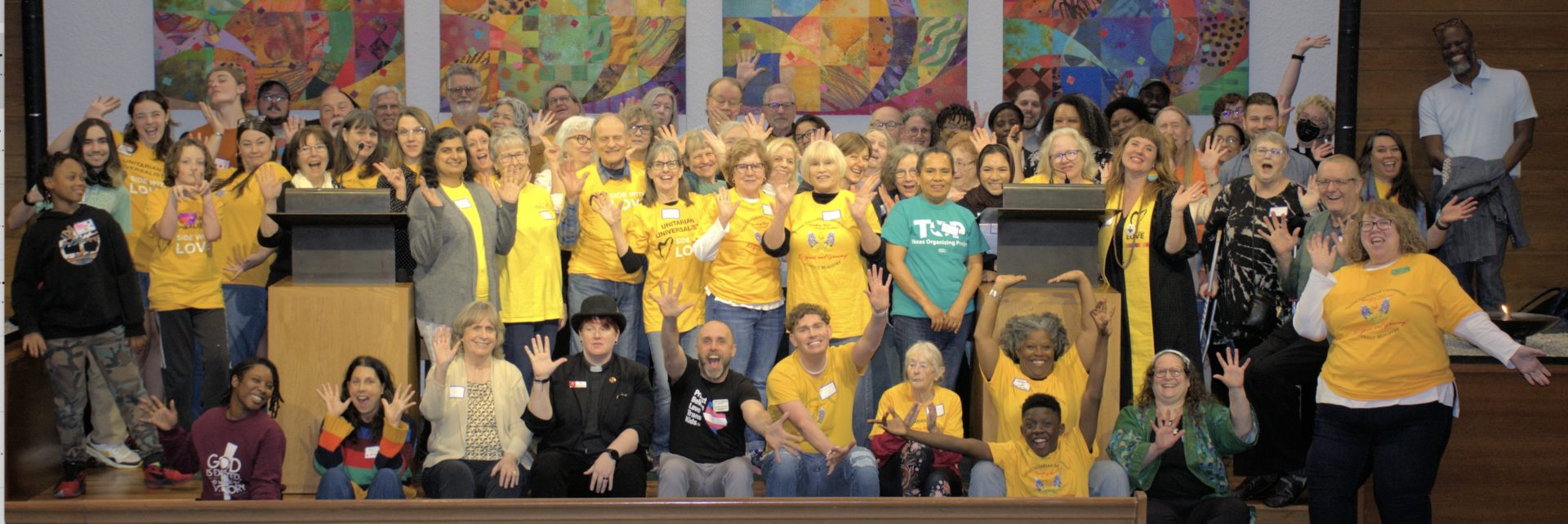
More than 100 Texas UUs and partners gathered in Dallas and online on Saturday, March 23, for the 2024 TXUUJM Annual Gathering. It was an inspiring day of learning, connecting, and renewing our spirits for justice work! If you missed it, can watch the morning program and see more photos on Facebook and Instagram. TXUUJM is your source for Texas UU the Vote efforts this election year! Sign up for TXUUJM emails to get the latest news and actions.


Public Education is Under Attack


Listen to the sermon by clicking the play button above.

Rev. Joanna Fontaine-Crawford
March 24, 2024
First UU Church of Austin
4700 Grover Ave., Austin, TX 78756
www.austinuu.org

Across the United States, people are showing up at school board meetings to protest books and knowledge they deem inappropriate, especially concerning education around diversity. Here in Texas, the governor called the legislature back into session in an attempt to divert public school funding to vouchers for private schools. But there is an underlying battle that has been waged since 1848 when Unitarian Horace Mann said, “Education then, beyond all other devices of human origin, is the great equalizer of the conditions of men, the balance-wheel of the social machinery.” What is the real outcome we are fighting over?


Chalice Lighting

This is the flame we hold in our hearts as we strive for justice for everyone. This is the light we shine upon systems of oppression until they are no more. This is the warmth that we share with one another as our struggle becomes our salvation.

Call to Worship

WE MEET TOGETHER
Ann Arthur

We meet together to celebate who we are,
to share the insights which give meaning and hope to our lives,
to learn from the wisdom of others
that their truth may contribute to our understanding.
We meet,
We share,
We learn,
We celebrate our coming together.

Affirming Our Mission

Together we nourish souls, transform lives, and do justice to build the Beloved Community.

Reading

CAN YOU SAY HERO?
Tom Junod

Mister Rogers had already won his third Daytime Emmy, and now he went onstage to accept Emmy’s Lifetime Achievement Award, and there, in front of all the soap-opera stars and talk-show sinceratrons, in front of all the jutting man-tanned jaws and jutting saltwater bosoms, he made his small bow and said into the microphone, “All of us have special ones who have loved us into being. Would you just take, along with me, ten seconds to think of the people who have helped you become who you are … Ten seconds of silence.”

And then he lifted his wrist, and looked at the audience, and looked at his watch, and said softly, “I’ll watch the time,” and there was, at first, a small whoop from the crowd, a giddy, strangled hiccup of laughter, as people realized that he wasn’t kidding, that Mister Rogers was not some convenient eunuch but rather a man, an authority figure who actually expected them to do what he asked … and so they did. One second, two seconds, three seconds … and now the jaws clenched, and the bosoms heaved, and the mascara ran, and the tears fell upon the beglittered gathering like rain leaking down a crystal chandelier, and Mister Rogers finally looked up from his watch and said, “May God be with you” to all his vanquished children.

Sermon

Do you believe in publicly funded education that is common to all? My dad was born in 1929 at the start of the Great Depression, and he grew up in East Texas in a small town called Center (because it was the center of the county, not real poetic, but there you go).

He came from a family that did not have money, but he loved school and he worked hard in school. After High School, he went to Texas A&M, which at that time was a military school and it was known as the school where all the poor kids went. And by kids, I mean white males. Texas A&M would not let in female or black students until the 1960s. So my dad was able to graduate with a degree in petroleum engineering. After that, he paid his debt to Uncle Sam, serving in the Army; this was during the Korean War, and eventually, he was able to provide a middle-class lifestyle for his family in a way that his father had never been able to-and this is what we call social mobility, and it was made possible because of that education system.

Now the system that benefited my father was working the way it was designed to. It was designed for smart, hardworking white boys.

But then in 1954, the Supreme Court had the Brown versus the Board of Education decision, and things changed. Now there was at least the possibility that this public education system that led to social mobility was now accessible to those who were not white and male. And ever since that time, there has been a concerted organized movement to damage that public education system because there are people who do not believe that it should be, in fact, common to all. If you feel like in the last few years that this movement has gone into overdrive, it is not your imagination. It absolutely has. But this is not something new – this has been a long time coming from the people who got our society to this point. They understood (and I will say it was an evil plan) … they understood that it was going to be a marathon, not a sprint, and so they set up different things so that we could be where we are now, which in my mind is a fight for our whole public education system. And for us, as Unitarian Universalists, this is not political. This is hitting at our core religious values, our beliefs about what it means to be a person: inherent worth and dignity, and the idea that every person deserves to be able to try and fulfill their potential. And this also hits at our history.

In 1796, Unitarian Horace Mann was born, and he also grew up in an extremely poor family; his father was a poor farmer, there were many kids, and Horace was never even able to go out and get a complete school year. It was usually only six weeks out of every year that he could go to school, but he made the most of it. He loved to learn; he soaked it all up. They did have in his town a library; he read everything that he could get his hands on. So eventually, he was able to go to Brown University, where he became the valedictorian. After that, he went on to law school, he became a lawyer, and then he became a Massachusetts legislator.

And you know, it’s really interesting, there seemed to be two kinds of people, as the saying goes — those people who had to go through a lot of hardship, had to really struggle to make their way in the world, and some of those people say, “I made it, so can you, you can do it the hard way too.”

And then there are the people like Mann who say, “I don’t want anyone else to ever have to go through what I went through,” and so education to him was one of the big passions of his life. In Massachusetts, while he was a legislator, the governor created a new thing, a state board of education, and he became the Secretary of it, and it was in that role that he was able to take all of these visions he had about creating a system so that everyone could reach their potential, or at least had the opportunity to do so. He created what is called the Common School movement. Now, common doesn’t refer to like commoners, common as in “for everyone.” His vision was that we would have a publicly funded system of education that was common to all. It was a radical idea.

In his vision, all American students would go to these schools, they would sit side by side. He firmly, — he was a Unitarian — he did firmly believe in the equality of all people, and his vision was one where whether you were the child of a wealthy landowner or the child of a family that was in poverty, you would all receive the exact same education. Another thing that Horace Mann really believed in — this was, you know, mid-1800s – he really believed in all of this stuff about the United States of America, and all that it could be, a place where, unlike England, it did not matter, it should not matter the circumstances of your birth. He really believed in it, and he knew that the key to that was education, and he even said,

“Education, then, beyond all other devices of human origin, is the great equalizer of the conditions of people, the balance wheel of the social machinery.”


It is a radical idea now, and it was a radical idea at that time, even many of the people who we look back at the start of this country, people who considered themselves to be the great modern Progressive thinkers. They weren’t there yet. In 1779, Thomas Jefferson also supported the idea of a public education system, but he felt that there should be two tiers to it, one for the laboring class and one for the learned class, he did say that he thought that there should be enough, you know, room in it that it could rake, his exact words, “rake a few geniuses from the rubbish.” Thomas Jefferson, boy, and that’s a sermon for another day.

Do you support publicly funded education that is common to all?

This was and is today a very radical idea, there are many people who do not want it, good publicly funded education common to all leads to social mobility and with that comes a real opportunity for a reallocation of power.

Underneath this idea of public education that is common to all is this idea of social mobility. Do you truly believe in social mobility, the vision of a society where a child is not confined to the circumstances in which they were born? We can look at other countries and we can see where there is no possibility for this kind of social mobility.

My spouse and I sponsored a student from his private school education (just wait just wait for a moment) from about Middle School through college, he was in Nepal. Do we have anyone else here who has sponsored a student from Nepal? Amazing program by the way. Education, even college, over there is more like Community College here and it is private education is way more affordable, I think it was like 5 or $600 a year. The person who runs it, Earle Canfield, is a Unitarian Universalist and he is very clear about the ultimate goal of this program. It is not so much about helping individual students, but rather, the bigger goal – one that is always kept in sight – is to overcome the caste system of Nepal, because this is the only way it can happen. You see, they do have public education, but it is so inferior that if you are in a lower caste, you will never be able to move out of that caste. The only way for you to move into a different caste is through private education.

I believe that this is the real vision for some of the people in our country.

I don’t think we often say things like this when we hear about vouchers and stuff like that. We’ll often talk about how it’s just a way for the wealthy, who are already paying for private education, to have a little more money in their pockets. Then sometimes we’ll go all the way the other way and say, “No, no, the whole goal here is to absolutely kill public education and get rid of it.”

I don’t think so. I think their vision is to have something like Nepal. A public education system that will support the existing caste system in the United States. We all know there is a caste system in the United States, right? To take that existing system and cement it in place.

And this has been a long time coming. You really can’t talk about the war on public education without talking about the Koch brothers. They’ve been part of this for a very, very long time. There was pushback to public education right after Brown versus the Board of Education, and we saw it. There were schools that literally would prefer to close their schools rather than integrate. But ultimately, that was not a long-term solution, and so there were brains that were trying to come up with, “Well, how do we make this happen?”

In 1980, David Koch ran for vice president on the libertarian platform, and that platform said, “We advocate the complete separation of education and state. Government schools lead to the indoctrination of children and interfere with the free choice of individuals. Government ownership, operation, regulation, and subsidy of schools and colleges should be ended.” That was 1980.

Charles and David Koch created a political machine that operates on the strategy of astroturfing. Do we have some people here who are familiar with this term, astroturfing? Well, I’m actually going to use the Merriam-Webster definition because it’s really good:

Astroturfing – “organized activity that is intended to create a false impression of a widespread, spontaneously arising grassroots movement in support of or in opposition to something but that is in reality initiated and controlled by a concealed group or organization, such as a corporation.”


There are so many different names, there are so many- it’s just overwhelming how many different little spontaneous grassroots organizations or think tanks are all either started by or funded by the Koch Brothers. This is just a handful: Americans for Prosperity, Koch Institute, Mercatus Center, The Federalist Society, The Institute for Humane Studies, Institute for Justice, FreedomWorks, Freedom Partners, Concerned Women for America, Young Americans for Liberty, Parents Defending Education, and of course, Moms for Liberty.

Here’s the sad thing: astroturfing often works. It worked just this past week, I think it was, in Lake Travis ISD, because of a complaint, banned another book. It’s happening in Houston now. This is where the system has -because, again, there’s not just one way to try and solve this problem of good public education-the state has taken over Houston ISD.

Here in Austin, y’all have also been fighting that. But astroturfing often works. You take anxiety and fear, and you combine it with bigotry, and it especially works in this fight on public education, because evolution has wired our poor little human brains that when we think of our kids, we often go to the amygdala and anxiety rather than the prefrontal cortex and our best thinking.

So when you combine anxiety and fear with bigotry, then that gets everyone stirred up. And then you have people, and this, again, is an organized concerted effort-they provide terms for those who are on the ground, and they tell them to repeatedly use these terms. It’s a way to bring in bigotry without having to admit that you don’t believe in treating everyone equally.

Used to, some of you will remember in the ’70s, it was busing, right? That was the code for, “Oh, I’m not against integration, I just don’t think that children should be bused to somewhere else or neighborhood schools.” Does anyone remember that one? “Oh, we just want our kids to be able to go to their neighborhood school.” It’s the fact that it was in an all-white neighborhood was just incidental.

More recently, in the last few years, it has been CRT (Critical Race Theory), DEI (Diversity, Equity, and Inclusion), and most recently, the one that I have heard the most is safety, especially safety for girls. Not safety from shooters or anything that might actually help-safety for girls is the code word for anti-trans rhetoric.

You get people revved up and give them the talking points. You can go find the talking points. None of this is hidden. You can go right now and Google it — There is a school board guide produced by the Tea Party Patriots, funded by FreedomWorks, which came out of Americans for Prosperity, aka the Koch Brothers’ political advocacy group. Forty-six pages on a how-to guide for activists combating anti-American CRT. Thirty-four pages on combating critical race theory in your community. An A-to- Z guide on “how to stop critical race theory and reclaim your local school board.”

I want to read you one line from that one: “It is important to note that whether CRT is currently in your school system is mostly irrelevant to the purpose of this document.”

Do you support public funding education that is common to all?

Now look, we never came anywhere close to realizing Horace Mann’s vision, especially in terms of a common education. I don’t believe that we ever will. People are always going to want a leg up, l(ike Felicity Huffman and Lori Loughlin) for their kids.

But the vision is more relevant than ever: public-funded education common to all, that equips children to fulfill their potential, to break the prison of generational poverty. It is not only better for them, it is better for our entire society.

In Nepal, the only way that you are able to break out of your caste is through being picked for a program that sends you to a private school. I believe that for some in the United States, that is the vision: a world with clear and rigid class boundaries that disproportionately correlate with race.

Right now, you know this thing that you’re hearing in the news-the difficulty to find unskilled laborers, right? Of course, they’re not unskilled, but if you call them that, you can pay them less. Do you really think that none of the people with the top economic privilege, those billionaires out in West Texas who have been trying to manipulate things around vouchers and around public education-do you not think that they are wondering about the question of how do you come up with an unlimited source of laborers whom you can underpay and oppress?

And this isn’t just a matter for those who have kids or grandkids in school; it’s for all of us. I ask you to support your school boards, find out what area you are in. If you don’t already know, you can go on the internet and read the agenda for school board meetings. Practically all of them are live streaming. Turn it on, see what is happening. When you start seeing hordes that are showing up there, trying to attack good teachers, attack the school board members, get books banned, show up. You don’t even have to talk; it’s great when you do during those citizen comments. But if you see that there are big crowds pouring into that room, trying to damage our public education, take one seat away from them just by sitting in it. And of course, vote at every school-related election as though it were a presidential election.

Do you support publicly funded education that is common to all? Real nice public education system you got here. It would be a real shame if something were to happen to it.

Extinguishing the Chalice

We extinguish this flame, but not the light of truth, the warmth of community, or the fire of commitment. These we hold in our hearts until we are together again.

Benediction

“Be ashamed to die until you have won some victory for humanity.”

– Horace Mann


SERMON INDEX

Most sermons during the past 24 years are available online through this website. Click on the index link above to find tables of all sermons for each year listed by date (newest to oldest) with topic and speaker. Click on a topic to go to that sermon.

PODCASTS

Podcasts of this and other sermons are also available for free on iTunes. You can find them by clicking on the podcast link above or copying and pasting this link. https://itunes.apple.com/podcast/first-unitarian-universalist/id372427776




 

Green Sanctuary Film Festival Recap and Upcoming Events

Hi Earth Champions,

We had a remarkable showing of two films for the International Uranium Film Festival 3/18. We met several church members there. Few folks know the real forever mining/land waste cost, Native people’s abuse, costly equipment, dangerous plant construction and dangerous performance and failures of nuclear energy. Here is the website if you want to know more: www.uraniumfilmfestival.org.

Disarming Toxic Empire is a free conference at U.T. Austin, March 21-22, focusing on the unjust aspects of nuclear testing, production, storage, and weaponry . (Although the Conference may be past when you read this the link is informative.)

Green Sanctuary Ministry has been part of a team to stop high-level forever Nuclear Waste being trained into Texas and dumped in the Permian Basin close to the Oglala Aquifer. Fed. Court says “NO” but they are appealing/lobbying. 

Mark your calendar for Sierra Club/Green Sanctuary Hosting First Tuesday 4/2 Climate Crises/Solutions 6:30 p.m. Potluck; 7:00 p.m. Meeting in Howson Hall. See you there.  

Check out this free newsletter: talkingclimatenewsletter@outlook.com


What You Can Do

Picture description: Three people sitting on a patio playing a card game. There’s an innovative new way to talk about climate change: the “Climate Conversations” card deck developed by Dr. Lauren Cagle at the University of Kentucky and some fellow Kentuckians worried about our shared future.

 
The card deck helps walk people through a 4-stage conversation about feelings and attitudes related to climate, and it doesn’t require a grasp of the more technical aspects of the science itself. “This game aims to create conversations, having participants work through their own relationships with climate change while envisioning a climate resilient future,” PDFs of the cards are free to download and print from the group’s website and Climate Conversations brings the game to events around Lexington, Kentucky. Check their calendar for future events, or email them to invite them to join an event you might be hosting or to ask for tips on how to host your own. The cards are available in English, Spanish, Dutch, and there’s even a K-12 English version for the classroom! 

WATCH: The trailer “A Brief History of the Future” airing on PBS