FUUCA Permanent Endowment Funds FAQs

What is the Permanent Endowment Fund (PEF)?
It is an investment account established as part of the 2014 capital campaign. It is
governed by the church bylaws.

What is an endowment fund?
It is a pool of assets, invested to provide a long-term, stable source of funding. The
principal is preserved while the income is used to support our mission.

When can it be used by the church?
Under the revised bylaws, distributions of income and appreciation may be used after
the PEF has accumulated a fair market value of $250,000.

How is the amount available for distribution determined?
Under the bylaws, the Executive or designee shall determine the maximum amount
available for distribution annually, based on the income and appreciation available on
December 31 of the year preceding the year in which distributions are to be made.

Can principal be distributed?
No. It must be preserved.

Can the principal be increased?
Yes. Gifts such as cash and property donated directly, through a will or trust, or received
as beneficiary of a retirement plan or insurance can be used to add to the principal.

What can the distributions from income be used for?
The bylaws are very specific and permit use for the maintenance of buildings, capital
improvements or renovations, debt reduction; outreach into the community such as
through grants to camps and conferences, theological schools, local social service
agencies, and certain special programs; and for the wider mission of Unitarian
Universalism such as leadership training, scholarships or grants to attend schools, etc.

Are there any limitations on distributions in addition to the purposes?
Yes. The Board of Trustees must approve distributions, and it may adopt policies and
procedures to ensure proper administration.

Can distributions be made from the PEF now (after the bylaws amendment)?
Yes. The PEF now has a balance in excess of $250,000. Bylaws changes become
effective when 2/3rds of the members approve them.

Love’s Call to Risk

Listen to the sermon by clicking the play button above.

Rev. Carrie Holley-Hurt
June 29, 2025
First UU Church of Austin
4700 Grover Ave., Austin, TX 78756
www.austinuu.org

Join Rev. Carrie as she explores how our UU history and values help us meet the moment we find ourselves in.


Chalice Lighting

This is the flame we hold in our hearts as we strive for justice for everyone. This is the light we shine upon systems of oppression until they are no more. This is the warmth that we share with one another as our struggle becomes our salvation.

Call to Worship

SISTER OUTSIDER (excerpt)
by Audre Lorde

Once you start to speak, people will yell at you. They will interrupt you, put you down, and suggest it’s personal. And the world won’t end. And the speaking will get easier and easier. And you will find you have fallen in love with your own vision, which you may never have realized you had. And you will lose some friends and lovers and realize you don’t miss them. And new ones will find you and cherish you. And you will still flirt and paint your nails, dress up and party, because I think Emma Goldman said, “If I can’t dance, I don’t want to be part of your revolution.” And at last, you’ll know with surpassing certainty that only one thing is more frightening than speaking your truth, and that is not speaking.

Affirming Our Mission

Together we nourish souls, transform lives, and do justice to build the Beloved Community.

Reading

LOVE AND ACTION (excerpt)
by Reverend Dr. Crystal Silva-McCormick.

To live out love and action, we must reject comfort and conformity. We must embrace the controversial and sacrificial way of Jesus. Love and action means refusing to rest until our neighbors, whether down the street or across the globe, have the same rights and opportunities as those with privilege. It demands that we speak hard truths about the systems that exploit and destroy. It requires us to disrupt, to step out of line, and to make people uncomfortable.

This kind of love goes beyond symbolic gestures, beyond yard signs and statements. It takes creativity, moral imagination, and the courage to challenge systems that depend on the suffering of others. We cannot truly practice love and action until we demand from others what we wish for ourselves and those we love. And that will cost us our comfort, resources, perhaps even our relationships. It may look like redirecting our money, pressuring lawmakers, or engaging in civil disobedience. These times and all times have called for this kind of love.

Sermon

NOTE: This is an edited ai generated transcript.
Please forgive any omissions or errors.

I believe that Jesus died for us.

Now before you leave or you start to write me a really nasty email, I’m gonna remind you that the sermon is about risk.

That I love you, that I am a trustworthy person, that this is not an elaborate bait or switch, the weirdest long game that there ever was.

And if none of that works for you, just hear me out first and then we’ll talk.

So yes, I believe that Jesus died for us.

And when I say that, I mean, I believe the man that historians believed walked the hills of Galilee 2,000 years ago, teaching to people of all genders died for us.

Not in a metaphysical way, not because you were born evil and needed to be freed by cosmic sacrifice.

NOPE, we’re not going to do that original sin trauma. OK, we’re good. No, that’s not for us. Thank you very much.

The reason I say it is because of what he modeled for us. His message was one of solidarity and compassion and love.

He said, “Blessed are the poor and the meek.”

He taught that the most important thing is to love our neighbor, and then he did this really cool thing by radically challenging us to expand who our neighbor is by the story of The Good Samaritan, a profound message of life affirming solidarity if ever there was one.

His message was an indictment of the empire and the systems of supremacy of his time because he had to speak against their cruelty and repression and violence. He spoke even though it was dangerous to speak. And I don’t believe that he did it because death was the goal, but rather that because there was no other option for him.

What he was experiencing, what he was witnessing compelled him to do it. His faith in his study of the Hebrew scriptures compelled him to speak. And in doing so, he demonstrated what it means to live for one another.
What it looks like to live into the fullness of our values.
What it looks like when we bow not to power, but live for one another.
What it looks like when we show up in love.

This is what I mean when I say he died for us.

And while Jesus is the original for both Unitarians and Universalists, he isn’t our only model.

We have Norbert Chapek, the Unitarian minister who gave us the Flower Communion, who was murdered in Dachau because his message of the beauty of diversity was so terrifying to the Nazis.

We have Reverend James Reeb and Viola Liuzzo, whose commitment to a more just world was seen as a threat by white supremacists who were so threatened that they had to kill them in Selma.

To center love in our actions, in our words, and in our choices, especially when there are powerful forces set against us, that’s inherent to our religion. That is the natural conclusion of our principles and our values because they don’t just live on paper, or at least they shouldn’t.

I know for me, when I am aligned with my values, When I am in solidarity with others, I am in awe of the purpose that I feel in my life. I’m in awe of the life that I’ve been given.

And to be in alignment with our values, it doesn’t always result in death. I just feel like I have to say that, OK? In fact, I would say most of the time it doesn’t, right? Which, you know, being killed by supremacy is a little heavy. So I’m going to give you some other examples of people who didn’t die.

We have Unitarian minister Theodore Parker, who spoke for women’s rights, who funded John Brown, who was seen as a heretic by fellow Unitarians. He risked so much, but he still spoke up.

We have Frances Ellen Watkins Harper, a free black woman, who was a household name for abolition in the very dangerous time leading up to the Civil War.

We have Unitarian Minister Waitstill Sharp and Martha Sharp, who physically helped many people escape Nazi-occupied Europe.

These are just a few people in our religion who have put their values into action. And there are so, so many UUs that we will never know that showed up for abolition and suffrage and civil rights and gay rights and women’s rights and voting rights and disability rights that have and do and will continue to speak up for immigration and immigrants for bodily autonomy for everyone, for voting rights and all of the other things that we need to work for true liberation.

Many many people in this room right now I know have shown up and spoken up, centered love and fought for one another.

That’s our history.
That’s our theology.
And that’s what we do as a religious people.

And today, when we find ourselves in the middle of fascism, our call remains the same.

Yes, things are scary.

Some of us, mostly those of us who identify as white and straight and able-bodied, are experiencing a level of fear that is new and different.

Things are scary. And voices of resistance are needed just as much as they always have been under soul-crushing supremacy. Whether it was the Roman Empire of Jesus’ times or the fascism of our own. Actions of love are needed just as much as they ever have.

Unitarian Universalist theologian James Luther Adams, after having a really terrifying run with Nazis in Germany in the 1930s, left that experience with a core question. Does our liberal theology, our liberal church, have enough substance to defeat fascism? It is a pertinent question for us I think. Are our values enough? And are we willilng to live in them in a way that can stand up to Fascism? For me, that answer is yes.

The values that we hold as a religious people, justice, and equity, and interdependence, and pluralism, and generosity, and democracy are the solutions to authoritarianism, to manufactured wars, the dehumanization that is happening at all levels of government. Values and action bred out of love for ourselves and for one another are terrifying to systems of supremacy because they undermine their powers.

In bell hook’s book, All About Love, she writes,

“Fear is the primary force of holding structures of domination. It promotes the desire for separation, the desire not to be known. When we are taught that safety lies always with sameness, then difference of any kind will appeaar as a threat. When we choose love we choose to move against fear – against alienation and searation. The choice to love is a choice to connect – to find ourselves in the other.”

So when we hold these values, our values, and more importantly when we live them out in our actions like continuously calling out injustice and oppression. By refusing to participate in unjust laws – By finding fun little opportunities to resist wherever we can. When we do those things. And whatever else might come in the months and years ahead, We are living into our liberal religion with substance.


But it’s gonna take some work because, let’s be fair, centering love when times are relatively easy or good is easy. It’s much harder to do this when the stakes are so high and so we must speak as Audre Lorde instructs us. We also have to fall in love with our own vision of what we are creating, of this beloved community that we are creating.

But I think we’re also going to need some tools to do that. First, I think we have to attune ourselves to what is uncomfortable versus what is dangerous. For example, we, this church, have slowly started having more formal conversations and learning opportunities around what’s been happening in Gaza. The ongoing attack through bombing and snipers and starvation of Gazans over the last 629 days.

While I have personally been somewhat vocal, I have been hesitant to take this on because it seems scary. In fact, the rhetoric around what has been happening has been shaped in a way that scares people away from engaging with it in a meaningful way, especially when being against genocide and condemning the actions of a nation-state have been labeled (incorrectly) as anti-semitic.

But that’s just discomfort. I am uncomfortable with the idea that I will falsely be accused of being anti-semitic, that I will offend someone, that someone will say something mean or hurtful to me. That’s really uncomfortable, But it is not danger. I am not in any real danger.

An uncomfortable conversation, or an unfavorable opinion of me, that doesn’t harm me. The two million people living in the 141 square miles of Gaza, those people aren’t danger. That’s real danger. And so I must speak even when I’m afraid and even when my voice shakes and I have to remember that this discomfort is not the same as danger.

I have to put my hands on my heart and remind my body, this body that is so attuned to look for the proverbial tiger – that there is no tiger. This just feels like living into your values. This is what centering love can feel like when the stakes are high.

And then I speak Imperfectly but I do it. And when we do that the hope is that we raise the consciousness of those around us. And with great hope bring about real change. And then we must remember that we cannot isolate ourselves, that we cannot forget that we have one another, and never forget bell hooks told us that domination requires us to be in isolation.

And I feel pretty good about our chances because I believe that the most beautiful part of our religion is our ability to be with and for one another. Because we accomplish beautiful things together. None of us are alone unless we allow fear to keep us isolated. Staying together is one of our strengths. We show up for each other again and again.

As Reverend Julian Soto tells us, “All of us need all of us to make it.” Like the way that our social action team shows up for us and our values again and again.

I just want to take a brief moment to acknowledge the work that they have done. Thank you David Overton. Thank you Peggy Morton. Thank you Elizabeth Gray and Bob and Victoria Hendricks and Leo Collas and Jenny Fredericks and Melanie Cofield and Wendy Erisman and anyone I must have met and must have missed. And of course thank you all of you that have shown up and participated in social action.

I bet if we took time to identify ourselves, most of us would find ourselves raising our hand. And if that’s not you, that’s okay, ’cause there’s gonna be a lot of opportunities ahead. Don’t you worry about that.

And what a life-affirming way to live this one precious life we’ve been given, to be with and to be for one another, to live and to speak up and risk for one another. Isn’t that what we mean when we say “Our Struggle Becomes Our Salvation”.

The struggle we see in the life of Jesus, and in all of those that came before us, who have been guided by their values. All of those who have rejected personal comfort for the life-affirming work of solidarity. To center love in our actions and in our words and in our choices is inherent to our religion, especially when powerful forces are set against us. Being brave and answering love’s call to risk is the natural conclusion of our principles and values. Because they just don’t live on paper, they live in us. They live in our words and in our actions.

May it always be so.

Extinguishing the Chalice

We extinguish this flame, but not the light of truth, the warmth of community, or the fire of commitment. These we hold in our hearts until we are together again.

Benediction

As we leave this sacred time together, as our lives go back to their normal rhythm with all the distractions that that entails. May you feel connected. May you feel connected to your faith and to one another. And may you be held as equally as you are motivated. May you feel brave in answering love’s call to risk.

Go in love.


SERMON INDEX

Most sermons during the past 25 years are available online through this website. Click on the index link above to find tables of all sermons for each year listed by date (newest to oldest) with topic and speaker. Click on a topic to go to that sermon.

PODCASTS

Podcasts of this and other sermons are also available for free on iTunes. You can find them by clicking on the podcast link above or copying and pasting this link. https://itunes.apple.com/podcast/first-unitarian-universalist/id372427776


Climate Committee

The Climate Committee of First UU will join with the Austin Sierra Club Climate Committee on Tuesday, July 1st in Howson Hall. We will discuss ideas for a new Earth Day-like event, Sun Day 2025. Sun Day will be an event that includes hundreds of events and millions of people throughout the country to celebrate and educate people on the fact that solar energy is cheaper than dirty energy and will inevitably replace fossil fuels for almost all energy needs. We will make signs to take to the Sun Day event as well as to other rallies to protect democracy and to advocate for social justice. Bring some cardboard if you’d like to reuse it as a sign, bring extra markers if you have any, and bring creative ideas. You can take home with you signs you make or we can make some extra to hand out at the rallies.

We will have a short presentation on Sun Day 2025, present a few ideas for Sun Day events being planned in other cities, and brainstorm additional activities for Sun Day.

Since most of the meeting will be hands on, we won’t do Zoom this meeting.

6:30 pm    – Start potluck

7:00 pm    – Short presentation on Sun Day

7:20 pm    – Brainstorm ideas and activities for Sun Day

7:30 pm    – Make signs

July for Justice

Our Social Action Committee will sponsor another July for Justice month, this year with a focus on Immigration, starting after we get through the 4th of July weekend.

Look for the posters already hung around First UU with specific info about our Kickoff Immigration 101, lively, interactive training at the monthly Senior Luncheon that’s open to people of all ages, Wednesday, July 9

The month will culminate with a Ten Year Celebration of Sulma’s Freedom and Austin Sanctuary Network’s existence working in solidarity with immigrants. In addition to a potluck dinner both Sulma Franco, who won her freedom taking sanctuary here at First UU in 2015, and the Rev. Chris Jimmerson will share their memories and updates about the struggle for immigrant rights.

For more info or to volunteer email Peggy at  insideamigos@austinuu.org

Love at the Center

Listen to the sermon by clicking the play button above.

Nancy Mohn Bernard
June 22, 2025
First UU Church of Austin
4700 Grover Ave., Austin, TX 78756
www.austinuu.org

How centering love can help us build bridges during polarizing times.


Chalice Lighting

This is the flame we hold in our hearts as we strive for justice for everyone. This is the light we shine upon systems of oppression until they are no more. This is the warmth that we share with one another as our struggle becomes our salvation.

Call to Worship

He drew a circle that shut me out,
heretic, a rebel,
a thing to flout.
But love and I had the wit to win.
We drew a circle that took him in.

– Edwin Markham

Affirming Our Mission

Together we nourish souls, transform lives, and do justice to build the Beloved Community.

Reading

From SACRED NATURE
By Karen Armstrong

The Golden Rule “Do not do to others what you would not have done to you.” was developed independently by all the great religious traditions. It seems deeply rooted in human morality. It requires us to look into our hearts, identify what causes us pain, and then refuse to inflict that on anybody else. What’s more, this benevolence cannot be confined to your own congenial group. It has to be applied to everybody without exception. Compassion is the essence of religion and morality, and it is essential to the survival of humanity. That we constantly fail to put it effectively into practice is perhaps not surprising in that as it runs counter to our engrained selfishness, insisting that we dethrone ourselves from the center of the world. It requires us to regard others as equal to ourselves, refuse to put ourselves into a privileged category, and deem the needs, desires, and ambitions of our fellow human beings to be as valuable as our own.

Sermon

NOTE: This is an edited ai generated transcript.
Please forgive any omissions or errors.

A couple of weeks ago I finished my UU internship whereas my fellow seminarians chose to complete internships within the congregation or in social justice contexts like Texas UUJM. I chose to do my internship within the context of pastoral care.

And so for the past nine months I have been a chaplain resident with Seton Ascension. This experience can only be described as intense and I suspect it’s going to take me quite a while to process all the things that I have experienced during this time. In the role of chaplain I’ve been with people at their lowest and at their most vulnerable. I’ve been with the psychotic, the incarcerated, the dying, and the sick. I’ve looked suffering in the face and wrestled with the injustices of the world. I’ve been humbled again and again, humbled by the courage of others, humbled by my own ineptitude, and humbled by the mystery of life, in which there are no easy answers. Needless to say, I am not the same person that I was when I first started this position in August of 2024. My experience has been one of transformation.

Being a hospital and it’s one of the most challenging things I’ve ever done. I’ve sat with family members after suicides. I’ve comforted parents who have lost young children. And I’ve seen firsthand the damage caused by gunshot wounds, which, by the way, often take multiple surgeries before they can heal. There were times when I felt like quitting and times that I dreaded going to work. But what helped me get through these times and these low points, believe it or not, was our Unitarian Universalist theology. When I felt stretched to my limits, when I felt so burned out that I wanted to quit, I leaned into love.

Indeed, over this past year, I’ve spent a considerable amount of time reflecting on our article two revisions and I must say the changes have been a touchstone for me throughout my residency. Specifically I often found myself asking what it means to put love at the center both in terms of self-care and in terms of care for others for there were many times throughout the residency in which my ability to love was challenged by patients who are radically different from me and my beliefs. In other words, I’ve had many opportunities to put our theology to the test. And I’ve truly come to believe that centering love is the antidote that we need in today’s challenging world.

For the world in which we live is one of chaos. It’s a world that’s full of rapid changes. In the past five years alone, we have witnessed the advance of technology and AI, extreme geopolitical shifts, a fractured news media, and furthering climate change. And let’s not forget the recent pandemic. Ten years ago, it seemed as if we were moving towards a society that was progressive, open, and tolerant, and now we are seeing these reforms be upended. And those who are not cis-gendered, straight white men in general are being threatened. I’m not overstating things when I say that we live in a world that’s more polarized than ever.

It’s easy to get down about the state of the world, and yet my residency actually gave me hope. Gave me hope that there is power in the centering of love. When we center love, we are actually being subversive. Centering love is exactly what this administration does not want us to do. For when we put love at the center, we are able to build bridges, and building bridges is the only way that polarization will come to an end.

I’d like to begin with a story in which I was able to build such a bridge and put politics aside. During my first unit as CPE, Trump was elected president, and as a super lefty individual, I was angered by the outcome of that election. I was scared for all that his election implied, and I was scared for my friends and my family and my community. Almost immediately, I began to encounter patients with radically different political perspectives. One patient must have clocked me as being liberal the instant I walked through the door. I guess I looked very liberal. After introducing myself, the patient immediately returned his attention to Fox News, which was blaring loudly from his wall-mounted TV. He soon launched into a tirade about the messed-up state of America, explaining how Trump was going to fix all that was wrong. And as he spoke, he kept side-eyeing me as if daring me to challenge him.

And though I’m loath to admit it, I immediately felt the anger spark within. I knew he was trying to give a reaction out of me and to my chagrin it was working. Now I have no poker face at all and my face was actively growing warm and I’m sure turning super red in the moment. How could I possibly be expected to provide spiritual care to someone like this, especially when my emotions were written all over my face. I wanted to turn around and just march right out of the room. But instead I hit pause and I forced myself to take a deep breath or two. And then the many trainings that I had spent training took over the many hours I spent training. Instead of listening to his words, I tried a different tactic. I tried listening for his emotions and for his needs, a technique that I learned from the book Nonviolent Communication.

And suddenly I heard something very different from this man. I heard someone who was angry and I heard someone who felt forgotten, unheard, and unseen. In the instant I identified these emotions, a funny thing happened. My anger began to dissipate, and my heart began to feel with empathy. For I too have often felt unseen and unheard. I too know what it’s like to feel invisible, and how that can lead to anger.

When he finally took a pause from talking, I decided to do a perception check with him and asked about the feelings of anger and abandonment that I was hearing. Naming those emotions had this strange effect of silencing him, and to my surprise he suddenly grew tearful. Next thing I know, the conversation shifted, and he began to tell me about his loneliness and lack of support. He felt abandoned in the hospital, and he was scared for the outcomes of his health. We went on to have a deep and meaningful conversation. Our differences had disappeared. We were no longer conservative or liberal, but rather two human beings moving through life with all of its pain and beauty.

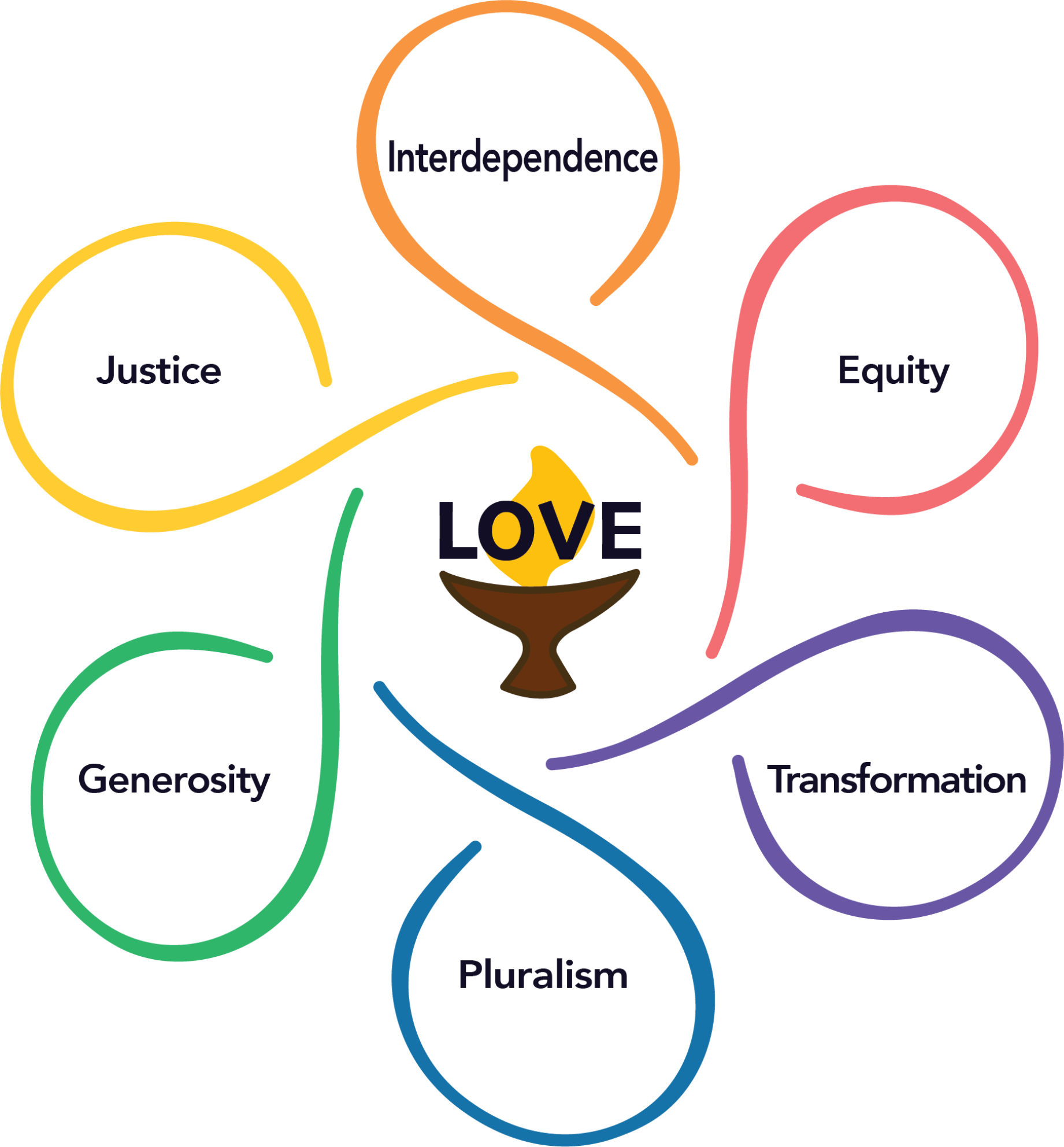
In this moment, I suddenly understood what it meant to put love at the center, at least in my specific pastoral care context. To center love is to look for the commonality, the humanity, and the vulnerabilities that we share with others. It means acknowledging that we are more alike than not, that we are interdependent, and it asks that we lead with this assumption. When we center love at the heart of our experiences and interactions, the other seven values, justice, equity, transformation, pluralism, interdependence, and generosity, they are the natural offshoots.

 Love Flower Graphic

Indeed, I most often thought of archaeology during the first six months of residency, which I spent at Shoal Creek, the now closed psychiatric hospital for Seaton Ascension. It was there that I began to understand the Article Two revisions on a deeper level. It was at Shoal Creek that I learned how the aforementioned values are twined with the centering of love. It was at Shoal Creek that I witnessed firsthand the power of our theology in building bridges.

From the first day I walked through the doors, I fell in love with Shoal Creek. As a teaching hospital, it was staffed by doctors, residents, nurses, and social workers, all of whom were passionate about their jobs and strove to provide equitable and just care to a radically diverse group of people.

As mentioned, Shoal Creek was part of the Ascension Seed and System, which is Catholic and non-profit. And as such, Shoal Creek was charitable and did not turn away the uninsured. The resulting patient population was diverse from an array of backgrounds.

While many of the patients were experiencing homelessness, there were also wealthy private pay patients who didn’t want the stigma of a psychiatric hospitalization on their medical record. At a quick glance, it may seem unreasonable to expect these two populations to form a loving and supportive community. But being hospitalized, particularly in a psych ward, is the great equalizer, especially when half the people are wearing disposable blue paper pajamas.

Such hospitalizations strip away the trappings of society that mark our differences. With such trappings stripped away, the patients were able to see the humanity and the suffering in each other. And when one is able to share in the suffering of another, empathy occurs and a beautiful thing happens. Time and time again, despite their socioeconomic differences, I witnessed patients becoming friends and forming communities of care and support. The dispossessed and the wealthy, the young and the old, all found solace in each other’s company and wisdom. Despite the restrictions, despite the lockdowns, these patients somehow managed to discover something that eludes so many of us. At their lowest point, these patients saw themselves in the faces of their peers, a realization that led to empathy in the centering of love. They discovered that despite appearances, we are more alike than not. Everyone suffers. Everyone despairs. And everyone is in need of human connection.

Indeed, I heard again and again from patients there that there was something just magical about Shoal Creek. Now many of them had experienced multiple hospitalizations, and many of them had been to facilities much nicer than Shoal Creek. Shoal Creek indeed, some said, were the worst facilities by far. But nonetheless, it was still their favorite place. It was their favorite place because of the love and the care that they received from the staff. Such love and care allowed them to kind of relax a little bit and to connect and share done with each other.

The closing of Shoal Creek is arguably a social justice issue. They’re about to demolish the building itself sometime this summer, I believe. The psych population is one that is both marginalized and othered. Many psych patients are unemployed and therefore uninsured, and Shoal Creek is the only psychiatric hospital that would accept an unlimited number of uninsured patients. Unfortunately, this meant that the hospital operated at a significant and unsustainable budget and it has been forced to close its doors. Now much of this population will fall through the cracks. And while most hospitals do have a few available beds for the uninsured, most of those available beds can be counted on one hand.

The situation frustrates me. I know it’s unreasonable and unsustainable for systems to operate at such a deficit, and I’m grateful to see it in Ascension for allowing Shoal Creek to do so for so many years. But the truth is that the system is broken. We live in a capitalistic society that centers money and not love. We value the individual, and not the interdependent web of existence, of which we are all apart.

As many of our greatest minds have pointed out, we can judge a society by how its weakest members are treated. In this country, we choose to ignore our humanity when we choose to ignore the dispossessed. But when we center love, we become generous individuals. We are generous with our tolerance, generous with our judgments, and generous with our ability to see the commonality in humanity and others, even those who differ from us politically. It is generosity that truly fuels my care, and it is generosity that we need now more than ever in this world, for we must be generous with love and how we define it.

To truly put love at the center, we must find a way to build bridges, to focus not on our differences, but on our shared experiences of humanity. I saw suffering psychiatric patients do what many of us cannot, put politics aside, center love, and come together.

Now I won’t lie, placing love at the center is incredibly hard to do and I haven’t always been successful at this. When someone makes threatening or disparaging remarks towards the oppressed, my friends and family or my community, I get angry and not so nice words have been known to leave my mouth. And I wonder how are we supposed to love those who have no interest in trying to love us. How do we hear past the hateful rhetoric? Bridge-building sounds all well and nice, but how do we love those who are so determined to hate?

I admittedly don’t have all the answers to these questions, but I believe that a good starting point is Marshall B. Rosenberg’s book on Nonviolent Communication, which I mentioned at the beginning of this sermon. When we are faced with a vitriol of others, it can be helpful to try to listen to the emotions behind the words. So often people just want their emotions to be validated. So often they just want to be seen and to be heard.

To truly center love means approaching people with openness and curiosity, which admittedly is hard, especially when those very same people are doing their best to make us feel angry and defensive. But again, to do so is an act of subversion. It is choosing to not give in to the hate, for that is exactly what they want. When we give in to the hate and anger, we are feeding into a polarized culture, giving it sustenance. When we give in to the hate and anger, we allow the extreme rhetoric and hate to win.

Now, centering love and trying to find our shared humanity doesn’t mean that we agree with the haters. Indeed, once upon a time in this country, we knew how to have differences of opinion and still respect one another. We knew how to engage in discourse, to listen to one another even when we don’t share the same opinions. I am asking us to lean into our theology of centering love, because it’s the only way that we will be able to engage in such discourse again. I’m asking us to try and find the commonality to find a way to bridge this gap of polarization. For we must try, because digging into our differences is not working. It is only making the divisions wider and As these divisions grow finding a solution becomes an increasingly impossible task.

So as we leave here today I ask you to consider what putting love at the center looks like in your own lives. How can we hear past the anger, to build bridges and not walls. How do we lead by example and model the change that we hope to see?

Extinguishing the Chalice

We extinguish this flame, but not the light of truth, the warmth of community, or the fire of commitment. These we hold in our hearts until we are together again.

Benediction

BLESSINGS SHALL FOLLOW US
by Rev Dr. Rebecca A. Savage

As we end our time together today in spiritual community, may we depart this sacred space, knowing that blessings shall follow us all the days of our lives, if we live in and return to right relationships, if we extend grace and forgiveness to ourselves and others, if We behold mercy as a spiritual superpower, if we emanate the greater love that holds us close. May our lives radiate the blessings that we have been given, may kindness and compassion fall gently from us, and may there be peace in the world, and may it begin again with us.

Blessed be.


SERMON INDEX

Most sermons during the past 25 years are available online through this website. Click on the index link above to find tables of all sermons for each year listed by date (newest to oldest) with topic and speaker. Click on a topic to go to that sermon.

PODCASTS

Podcasts of this and other sermons are also available for free on iTunes. You can find them by clicking on the podcast link above or copying and pasting this link. https://itunes.apple.com/podcast/first-unitarian-universalist/id372427776

Something Larger than Ourselves

Listen to the sermon by clicking the play button above.

Rev. Chris Jimmerson
June 15, 2025
First UU Church of Austin
4700 Grover Ave., Austin, TX 78756
www.austinuu.org

For individuals, feeling a part of something larger than oneself can increase happiness, enhance well-being, create a greater sense of purpose and meaning in life, give us a sense of belonging, and improve mental health in a variety of areas. First Unitarian Universalist Church of Austin is a part of our larger UU faith and an even larger effort to build Beloved Community. Might fully engaging this larger belonging confer these same benefits to us a religious community?


Chalice Lighting

This is the flame we hold in our hearts as we strive for justice for everyone. This is the light we shine upon systems of oppression until they are no more. This is the warmth that we share with one another as our struggle becomes our salvation.

Call to Worship

SOMETHING A BIT LARGER

Scientists estimate that there are at least a septillion stars out there. That’s a one, followed by 24 zeros. Imagine then, how much star dust there may be. I am but one tiny configuration of star dust. That’s so infinitesimal. Any yet, I am an integral part of something much greater than a septillion! And that’s immeasurable! What a difference I might make.

Affirming Our Mission

Together we nourish souls, transform lives, and do justice to build the Beloved Community.

Reading

BELONGING
by Rosemerry Wahtola Trommer

And if it’s true we are alone,
we are alone together,
the way blades of grass
are alone, but exist as a field.
Sometimes I feel it,
the green fuse that ignites us,
the wild thrum that unites us,
an inner hum that reminds us
of our shared humanity.

Just as thirty-five trillion
red blood cells join in one body
to become one blood.
Just as one hundred thirty-six thousand
notes make up one symphony.
Alone as we are, our small voices
weave into the one big conversation.
Our actions are essential
to the one infinite story of what it is
to be alive.

When we feel alone,
we belong to the grand communion
of those who sometimes feel alone –
we are the dust, the dust that hopes,
a rising of dust, a thrill of dust,
the dust that dances in the light
with all other dust, the dust
that makes the world.

Sermon

At the turn of the 19th century, 23 year old Joseph Tuckerman was asked to be the minister of what would become the Unitarian church in the town of Chelsea Massachusetts.

He had recently graduated from from Harvard (you know, that place that is under attack by the taco tyrant all of these years later), where one of his classmates was another aspiring minister, William Ellery Channing, who would go on to give a famous sermon he titled, “Unitarian Christianity” that would catalyze the formalization of Unitarian religion in the United States and lead to Channing and others forming the American Unitarian Association six years later.

Tuckerman, though, struggled at Harvard. It’s said Channing had even told him, “You should study harder.”

But Tuckerman felt something was missing from his studies. He didn’t want to just read books all the time. He felt like he could also learn from talking with other people.

Something was incomplete. He need more to be feel whole.

He did graduate though and went on to serve that church in Chelsea for 25 years, preaching twice on Sundays and serving the spiritual needs of the people in his congregation.

Still, he continued to feel something was missing – a dissatisfaction. That his ministry and calling were not entirely complete.

And so he began to also serve the greater community in Chelsea, where many sailors and their families lived.

The sailors were often away for months and years, so their families often faced periods where they had little money.

Tuckerman would help them with food, clothing or whatever else they might need.

In 1826, still feeling a need to connect with something larger and facing ill health, Tuckerman resigned from his church.

He went to Boston, where he immersed himself among the sailors and others who lived with financial challenges, as well as difficulties like alcoholism.

Tuckerman listened to their stories about how they had come to face these challenges and what their needs were. He studied his bible and concluded that Jesus had called us to love everyone and to assist the poor, the hungry, the sick, including the illness of addiction. And there he found his greater calling.

He worked with his college classmate’s American Unitarian Association to create an organization that coordinated with each of the Unitarian churches throughout the Boston area to provide support and assistance to help meet the needs of folks in their neighborhoods and communities.

Joseph Tuckerman had found his purpose and now felt complete, and in doing so, he founded what we have come to know as “community ministry” – ministers who primarily serve the needs of communities beyond our church walls.

Tuckerman found his purpose in life by connecting with something much larger than himself and what had traditionally been the role of a minister.

Author and scholar of mythology and religion, Joseph Campbell said, “A hero is someone who has given their life to something bigger than oneself.”

And I suppose by that definition he means we all have the capacity to be heroes in on our own way.

He believed we all have a purpose – a calling from and toward something larger than ourselves that when followed will bring us bliss.

He said, “Follow your bliss.”

Our religious education manager, Sol, spoke eloquently of this last Sunday when they talked about the sense of calling they have found through Sol’s wonderful work with our children.

And, there is evidence that, like our Unitarian ancestor Joseph Tuckerman, we all need that sense of being a part of something greater to feel complete and fulfilled.

Studies have found that having a sense of being a part of something larger benefits us in a variety of ways, especially when that sense is that though we may be a tiny part of that something larger, we are also an integral part it.

So, embrace humility and hero potential all at the same time! Now, some of those potential benefits of doing so seem to be:

  • positive psychological effects, such as reduced stress and anxiety, less depression, and a greater sense of wholeness, happiness and life-fulfillment.
  • a bigger sense of connection and belonging, moving us toward greater compassion, empathy and prosocial behavior.
  • it can make us more resilient in the face of life challenges.
  • provide us with greater meaning and purpose in our lives, and when shared with other folks can deepen our emotional bonds.

And that’s just to name a few! 


Now, it’s important to note that feeling we are a part of something larger can take many different forms.

That “something larger” could be a belief in a deity or a sense of transcendent or divine forces at play in our universe.

But, it can also take so many other forms:


  • Joining a church can feel like connecting with something larger.
  • Playing a piano duet such that the combined talent produces something of even greater beauty!
  • Prayer, meditation, and other forms of religious or spiritual experiences whether or not they involve a supernatural belief system.
  • It can be dedication to a cause or working for justice
  • It could be a vocation that fulfills us, but it could also be the volunteer work we do during our time off.
  • It could be an art, music, a sport or athletic endeavor, connecting with nature, a science, learning, reading, gardening, our family and loved ones, a community or some combination of all of these and more!

Whatever gives us this profound sense of vast interconnectedness and belonging, can be the something larger through which we find that sense of purpose in life. 


It is this feeling of interconnectedness and belonging so immense it is beyond words, regardless of the specific sources that drive it within us, that has the potential to transform us.

There is currently a lot of research showing the potential benefits of psychedelics such as ketamine, psilocybin (the active agent in magic mushrooms), LSD and the like as treatments for conditions such as depression, addiction, grief and trauma.

A theory behind why these compounds may have such benefits is that they almost universally bring about this sense of vast interconnectedness.

Well, I was amused recently to read that a study in London found that people treated with psilocybin tended to switch from a highly individualistic, materialistic, every person for themself personal and political philosophy, to a more altruistic, communal, we’re all in this together mindset.

I thought, “Maybe we should create magic mushrooms for MAGA spiritual retreats.

Speaking of spiritual gatherings, this coming week, several us from First Unitarian Universalist (UU) Church of Austin will be attending our annual UU General Assembly.

General Assembly or GA is where UUs from across the country and indeed the world gather to learn together, do the business of our association of UU Congregations and organizations, and to build communal power for doing justice.

Interestingly enough, this year GA will be in Baltimore, the city where William Ellery Channing preached the sermon I mentioned earlier that launched American Unitarianism and is often referred to as the “Baltimore sermon”.

And so we return to the birthplace of something greater than us as individual congregations but of which we are still an integral part to immerse ourselves in our larger faith movement.

I can still remember the first GA I ever attended. It was at the Salt Lake City convention center right next to the Mormon Tabernacle and complex, so you had UUs and Mormons intermingling on those Salt lake city sidewalks, which made for some interesting juxtapositions.

We UUs tended to sport many more tattoos, body piercings, slogan buttons, and practical if not very attractive footwear.

We were, though, almost as white.

I remember feeling awestruck when I first joined with those thousands of other UU s at that GA, somewhat humbled by the realization that our church and we are not nearly as unique as we may sometimes think, but also feeling so empowered to discover that we are not alone.

We are not isolated, but instead a part of a much larger religious movement that is in turn interconnected in solidarity with many other faith traditions and social movements dedicated to building the Beloved Community on a national and even global level.

And my beloveds, we, as a religious community need this connection with something larger than ourselves now more than ever.

With what had been happening in Los Angeles and across our country:

  • the use of the military against our own citizens,
  • the threats and even violence against government officials with whom the Trump administration disagrees, and now even assassinations,
  • the demonization of LTBTQ+ folks,
  • spending millions on a military parade for the taco tyrant while he pushes through policies to make the wealthy and powerful even more powerful at the. expense of everyone else – dismantling things like medicaid, medicare, social security, health research and care, FEMA, and so much more.
  • the use of Immigration and Customs Enforcement, not to protect anyone or anything, but to intimidate – instill terror into anyone who would resist this racist, misogynistic, white Christian Nationalist, authoritarian agenda.

With these and so many other threats to justice and equity, with the absolute disregard and disdain for checks and balances and the fundamental structures and norms required for functional democracy, both nationally and here in our state, we, as one church, no matter how wonderful and engaged we may be, cannot be a lone hero. 


We need our connection with our fellow UU churches, locally, throughout the state through our Texas UU Justice Ministry, and more broadly through our UU Southern region offices and our national Unitarian Universalist Association.

We need the solidarity they bring with other faiths and secular organizations that share our values and our commitment to building the Beloved Community even up against these threats to it we are currently witnessing.

Just like with individuals, as a religious community, we can benefit from being a part of something larger than ourselves: greater social and political power; increased resiliency in this time of such great difficulty in our state and our country.

And who here when witnessing the news these days can easily fall prey to anxiety, or even despair and depression?

Me!

Connecting to our greater faith movement as a religious community can help alleviate these stressors for us, as both the community as a whole and as individuals.

It can further increase our sense of belonging, give us support and encouragement and remind us of our shared mission to nourish souls, transform lives and do justice to build the Beloved Community.

Something larger.

Hope. Meaning. Purpose.

In the months to come, your ministers, along with your board of trustees, your church staff and volunteers, and with each of you who want to participate will be exploring ways of becoming even more a part of our larger UU faith and the larger movement for justice that is rising up across our country and our world.

I encourage each of you individually to explore how you can connect with our greater faith also. You can find several ways to get started by going to austinuu.org, and I would be happy to set up a time to talk with you about it also if you would like.

And, allow me to bear witness and give testimony.

I am so lucky, so blessed to get serve as your minister within this greater UU faith of ours.

Along with a fierce love, it is such a source of what gives me that sense of being a part of something greater.

Hope. Meaning. Purpose.

I wish the very same for each of you and for this religious community as a whole.

Joseph Campbell was right. I have no doubt there is a hero within each of you – a calling from something immense and powerful from both within and beyond. Keep answering that call. As Campbell said, “follow your bliss.”

Amen.

Extinguishing the Chalice

We extinguish this flame, but not the light of truth, the warmth of community, or the fire of commitment. These we hold in our hearts until we are together again.

Benediction

“We are the dust,
the dust that hopes,
a rising of dust, a thrill of dust,
the dust that dances in the light
with all other dust, the dust
that makes the world.”

Let us go out now and make and remake our world.
May the congregation say, “Amen”, and “Blessed be”.
Go in peace.


SERMON INDEX

Most sermons during the past 25 years are available online through this website. Click on the index link above to find tables of all sermons for each year listed by date (newest to oldest) with topic and speaker. Click on a topic to go to that sermon.

PODCASTS

Podcasts of this and other sermons are also available for free on iTunes. You can find them by clicking on the podcast link above or copying and pasting this link. https://itunes.apple.com/podcast/first-unitarian-universalist/id372427776
Justice Across Generations

Join youth and elders for an event hosted by Nonviolent Austin called Justice Across Generations. Wildflower UU youth leader Max Rodriguez will be the keynote speaker, alongside a youth leader from East Austin in the First UU Sanctuary, Sunday, June 22, from 1:30 – 3 p.m.

It will be a time for the broader community to hear from Austin youth about what they are feeling as young people coming of age at a very difficult time for democracy, what gives them hope, and how to build intergenerational and multiracial community. All ages will learn and practice nonviolent community-
building together.

These youth have attended a social justice program called the Encampment for Citizenship (EFC –referring to global citizenship) with Program Director Jesus Salcido. He facilitates this space for youth from all over the country to build authentic relationships as they share their own stories and learn from local organizers about land, immigration, housing, environmental and racial justice. Historically EFC was founded in the 1940’s as a response to the Hilter youth, to organize anti-facist youth in the United States. They were the first non- segregated youth program. Over the decades they introduced youth to Rev. Dr. Martin Luther King Jr., Malcolm X, the UFW, etc. Please RSVP at bit.ly/austinyouth ~ to practice nonviolent community-building together.

While they ask for donations, please know it’s ok not to donate too.

Light snacks will be provided starting at 1 p.m. Youth speakers begin at 1:30PM.


WHEN: Sunday, June 22nd from 1:30 – 3 p.m.

WHERE: First Unitarian Universalist Church of Austin, 4700 Grover Ave.


RSVP at bit.ly/austinyouth! Share this invitation with your community, all are welcome ~ young & old.

Soul Freedom

Listen to the sermon by clicking the play button above.

Rev. Chris Jimmerson & Chalice Camp Youth
June 8 2025
First UU Church of Austin
4700 Grover Ave., Austin, TX 78756
www.austinuu.org

We often think of freedom as an individualistic act of escaping that which limits us. And that may be a part of the whole. What if a more complete understanding of freedom involves a communal embrace of our interdependence and the choices we make in order to live love?


Chalice Lighting

This is the flame we hold in our hearts as we strive for justice for everyone. This is the light we shine upon systems of oppression until they are no more. This is the warmth that we share with one another as our struggle becomes our salvation.

Call to Worship

There is something in the very nature of my freedom that inclines me to love, to do good, to dedicate myself to others. I have an instinct that tells me I am less free when I am living for myself alone. The reason for this is that I cannot be completely independent. Since I am not self-sufficient, I depend on someone else for my fulfillment. My freedom is not fully free when left to itself. It becomes so when it is brought into the right relation with freedom of another.

– Thomas Merton

Affirming Our Mission

Together we nourish souls, transform lives, and do justice to build the Beloved Community.

Reading

I am learning that getting well in community is liberation. We are interdependent. When one of us attains freedom, it elicits/rekindles that longing in each of us. When we learn to feel, when we learn to stand with each other in feeling, when we learn to tune into the wisdom of our bodies, to love ourselves, to love each other, we are doing the unthinkable, we are creating new worlds of possibility… We must love each other and protect each other. We have nothing to lose but our chains.

– adrienne marie brown

Sermon

NOTE: This is an edited ai generated transcript.
Please forgive any omissions or errors.

Rosie:

In Chalice Camp this week, we learned our camp creed and learned about a different line of it each day. It goes,

“It’s a Blessing we were born.
It matters what we do.
It matters what we do together.
What we know about God as a piece of the truth.
We don’t have to do it alone.”

I think maybe adults should be learning this creed too. A lot of people forget these things or never learn them in the first place. We all deserve the freedom to search for our truth, to know we are born worthy and to connect with the people around us. I hope maybe we can remind you.


Sol Cornell:

Thank you Rosie.

Hello. My names are Sol and Shanti. I am a small white human with short blue hair and I’m also the manager of religious education here at First UU Austin.

Over The past week, I got to plan, direct, and run our chalice camp, a week-long summer day camp for kids in kindergarten through sixth with counselors from seventh through twelfth. It focuses on introducing the beginnings of spiritual development, practicing presence and grounding, and asking some really big questions in between crafts, games, and various levels of joyful chaos.

Let me tell you, this has possibly been the most intensive, demanding and exhausting project I have ever taken on, and I am so, so glad that I did. I’ve wanted to work with kids for a long time, but I hadn’t considered working with them in this particular capacity, helping them explore spirit and meaning and self until pretty recently. And I’m finding it to be a calling that fills my soul beyond any work that I’ve done before.

There’s something sacred about the way that kids move through the world. They’re honest. They’ll tell you exactly what they think and feel. Sometimes while sitting quietly in communal reverence and sometimes while running in circles, demolishing a bag of cheez-its.

Kids ask fantastic questions, Some big and some small. I heard a broad array over the past week from, “How old is that Eye of the tiger song?” All the way up to “How is God real, but also not real?” I learned some of the most interesting facts from Googling a curiosity that someone had, and I sat with some of the deepest questions that Google simply can’t answer.

At one point, a camper asked me, “Why do you like working with kids? They’re really loud.” She’s not wrong, but I answered honestly and I said, “I think it’s the coolest thing in the world to watch you all become who you are.” Working with kids gifts me a sense of joy, curiosity, and peace.

Children are unburdened by the spiritual baggage that many of us carry and they invite us to put some of it down just for a little bit. It’s an honor to teach our newest humans about something so big and personal as spirituality. And in doing so, they teach me too.

In the midst of all the chaos, the paint and the pipe cleaners and the occasional bout of tears, I found something quietly blooming in my soul, a deep sense of freedom, the freedom that comes from having a passion instead of just a job, the freedom that comes from doing something that feels right, that fits, that brings me home to myself. I get to wake up every day and do something that truly fills my heart and soul. I never knew I could have this life.

And I want to be clear. That kind of freedom, that kind of joy, isn’t just for me. We all deserve it. You deserve it. And sure, maybe it won’t come in the form of directing a children’s camp but there’s something out there that will make your heart sing. I promise you. Seek it, find it, grab it with both hands, and pull it from the ether if you have to. Because when we do that, when we find and bring the whole of ourselves into community, we create something powerful. Not just a group or a congregation, but a living, breathing, deeply human kind of togetherness.

So thank you for being part of that. Thank you for letting me be a part of it too and for trusting me with something so important. Let’s keep chasing the things that fill us up. Let’s keep asking the big questions. And let’s remember that we’re all still growing as long as we live and that that’s a beautiful thing. As the Camp Creed tells us, “We don’t have to do it alone.”

Blessed be and amen.

Chris Jimmerson:

I think I’ll grant myself the freedom this morning to not sermonize a lot about the taco tyrant in the White House and his enablers, nor the Texas tyrants in control of our state government.

French philosopher and author Albert Camus said that,

“The only way to deal with an unfree world is to become so absolutely free that your very existence is an act of rebellion.”

I think Camus is expressing there what I call “soul freedom,” a sense of deep internal freedom that can’t be taken from us and that we need to sustain ourselves to persevere when we must rebel against tyrants who would rob us of our societal freedom. 


Indeed, this soul freedom is what allows us to flourish, to live our lives most fully and fearlessly. It is what has empowered people throughout the ages to thrive, even when forced to endure the harshest of repressive conditions, concentration camps, slavery, colonization, racism, ongoing systemic oppression.

Our children at Camp UU this past week, as you’ve heard, have been learning about our Unitarian Universalist Theological Heritage and Identity, an identity that is deeply rooted in this soul freedom from the early Unitarians that claim the freedom to reject religious dogma and to form their own personal relationship with the God of their understanding to our universalist forebearers that freed us from fearing a judgmental and punishing God centered us instead in liberatory universal and communal love now.

One of the things that we you use have discovered along the way is that there is a potential paradox in developing soul freedom a tension between individualism and communalism. Communities can sometimes stifle our personal freedom, the expression of our true selves, can’t they?

And yet, as both of our readings highlighted this morning, we are interdependent. We need one another. We need love and support to fully become who we are meant to be, to find the sense of fierce love and belonging that sets our hearts and souls free.

So we have to form communities that accept and support each of our individual whole and fully creative selves, while at the same time each of us as individuals must choose to accept constraints, obligations that actually free us to contribute toward the love relationships and communal belonging we so desire.

Here’s another seeming paradox. Soul freedom requires surrendering. Surrendering to the fact that we are only the co-authors of our life stories, that much of the plot involves events that are well beyond our control. Our freedom lies in creating the narrative about how we interpret and respond to these events, Surrendering all that isn’t really important to us so that we are left with only the needs and boundaries that really matter to us, and this again frees us to then fiercely and fearlessly immerse ourselves in love and belonging.

So what we surrender is really only that which we have been telling ourselves mattered to us that really didn’t. And so often these things are things we absorbed and internalized from misguided, repressive societal norms that subjected our true selves in the first place.

Author Virginia Woof once put it:

“The eyes of others are prisons, their thoughts, our cages.”

Here’s a part of my own personal narrative that I think might illustrate much of all of this.


When I was seven, my dad developed severe depression that required repeated hospitalizations. By the time I was 12, he had divorced my mom. And because of all this, I became a sort of child parent to my younger siblings, a sort of child co-head of household with my struggling single mom. I had to learn to give love, to help, support, nurture, parent, protect. And some of that has become a valuable part of who I am. It’s a big part of what led me to become an activist for justice, to work in social support organizations, eventually to become a minister.

What it didn’t allow me to see as a part of my story nearly as much, though, is that I also need to be nurtured, helped, supported, protected to let myself want, accept, and ask for these things to enjoy and recognize being loved. Add to that a small-town culture in which I grew up that derided males for admitting a need for things like help and protection, and the eyes of others became a prison of sorts.

Flash forward to last year when my spouse of 33 years died. I grieved the loss of me loving him. I even felt gratitude for having loved him all those years.

But somehow I was still stuck. I was having trouble moving forward. I was just going through the motions of life without the joy that it used to bring me, unable to even entertain the idea of romantic love again.

It was only after several months of reexamining that self-story I had learned as that seven-year-old with lots of counseling and lots of support from loved ones, that I realized I was stuck because I hadn’t been able to let myself grieve the love, support, nurturing, and protection he had given me.

It was only then after I began to surrender that nearly lifelong self-narrative to allow for a more full, whole self-image that accepts being loved and nurtured, that I found the freedom To open myself to new love and to life again.

My beloveds, we will all sometimes fall into the traps that life can put in front of us.

Our soul freedom comes from allowing ourselves love and belonging accepting our interdependence because that, that is what helps us to rewrite our narrative and steer our story in a new direction more of our own choosing.

And sometimes we have to allow ourselves some time, some freedom to learn, And to unlearn some of those cages, the thoughts of others and/or our own, have trapped us within. The learned habits that can be so very hard to surrender.

I leave you with a poem by singer, songwriter, actress and author, Portia Nelson that I think illustrates this last idea in a kind of fun way. It’s called:

AUTOBIOGRAPHY IN FIVE SHORT CHAPTERS.

Chapter 1
I walk down the street. There is a deep hole in the sidewalk. I fall in. I am lost. I am hopeless. It isn’t my fault. It takes forever to find a way out.

Chapter 2
I walk down the same street. There is a deep hole in the sidewalk. I pretend I don’t see it. I fall in again. I can’t believe I’m in the same place, but it isn’t my fault. It still takes a long time to get out.

Chapter 3
I walk down the same street. There is a deep hole in the sidewalk. I see it there. I still fall in. It’s a habit, but my eyes are open. I know where I am. It is my responsibility. I get out immediately.

Chapter 4
I walk down the same street. There is a deep hole in the sidewalk. I walk around it.

Chapter 5
I walk down a different street.
The end.

Amen.

Extinguishing the Chalice

We extinguish this flame, but not the light of truth, the warmth of community, or the fire of commitment. These we hold in our hearts until we are together again.

Benediction

Go now into daily life free, not only of that which holds you back, but also free to choose that which ignites your mind, body, and soul.

Choose to revel in our interdependence.

Choose community. Choose to love fiercely, fearlessly.

This is our revolution. This is our journey toward freedom.

May the congregation say amen and blessed be.

Go in peace.

SERMON INDEX

Most sermons during the past 25 years are available online through this website. Click on the index link above to find tables of all sermons for each year listed by date (newest to oldest) with topic and speaker. Click on a topic to go to that sermon.

PODCASTS

Podcasts of this and other sermons are also available for free on iTunes. You can find them by clicking on the podcast link above or copying and pasting this link. https://itunes.apple.com/podcast/first-unitarian-universalist/id372427776
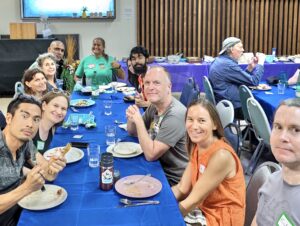
Vegan Potluck Dinner

 
Saturday, June 14th, 6:30 PM – 8:30 PM, food check-in begins at 6:00 PM in Howson Hall.
Joint potluck with the Veganistas, a First UU group, and the Austin Vegan Association.
email info@veganistas.org to RSVP or for more information.
 
What to Bring:
  • A VEGAN* dish that can serve 8. Couples can choose to bring two dishes or one extra-large dish.
  • Be prepared to mark whether your food contains any allergens like nuts or gluten.
  • Bring your recipe if you want to share it.
  • Serving utensil for your dish.** 
  • A plate for yourself and utensils for eating.
  • Your own beverage.


Whether you’re vegan, vegetarian, or just veg-curious, you’re welcome to join us.
This event is free and open to all. Children are welcome.
Thank you for helping us create an inclusive meal for everyone to enjoy!
 
*We ask that food be free of all animal products, including meat, fish, eggs, dairy (milk, cheese, yogurt, butter), animal broth, gelatin, and honey.
** Pro tip: a small serving utensil encourages smaller servings and allows more people to enjoy your dish.
 

Social Justice Resilience Support Group

The Social Justice Resilience Support Group, a new First UU Austin offering, will help build the Beloved Community by providing an opportunity for participants to connect, grow and heal alongside others committed to the hard work of social justice. We will base our work on the Revolutionary Love Compass developed by Valarie Kaur’s Revolutionary Love Project: https://revolutionarylove.org/learn/

This will be a skill-building and support group for those who advocate for the vulnerable, including our vulnerable Mother Earth. It will also be a group for those who feel othered and exhausted from continuously having to advocate for themselves or their loved ones.

We will meet monthly for 10 months on Zoom at 7:30 pm on the first Thursday of each month, starting in September. We will use videos and readings from the Revolutionary Love Compass Education Guide to stimulate discussion. Materials will include a variety of Social Justice voices that amplify fierce love and resilience in these dark political times. Group participants will be invited to share their stories of struggle and resilience. We will apply these learnings to current challenges.

At each meeting, we will also activate the Compass umbrella theme of Joy, using techniques such as iRest Yoga Nidra, breath-work, music, and movement. For more information, contact resiliencesupport@austinuu.org.

Goodbye, So Long, Farewell

Listen to the sermon by clicking the play button above.

Rev. Michelle LaGrave and Rev. Chris Jimmerson
June 1, 2025
First UU Church of Austin
4700 Grover Ave., Austin, TX 78756
www.austinuu.org

Today’s service will be our last with Rev. Michelle. Join us as we celebrate the good work we have done together and wish each other well with blessings for the journey.


Chalice Lighting

This is the flame we hold in our hearts as we strive for justice for everyone. This is the light we shine upon systems of oppression until they are no more. This is the warmth that we share with one another as our struggle becomes our salvation.

Call to Worship

WE COME TO LOVE A CHURCH
by Andrew C. Kennedy

We come to love a church,
the traditions,
the history,
and especially the people associated with it.
And through these people,
young and old,
known and unknown,
we reach out,
both backward into history
and forward into the future.
To link together the generations
in this imperfect but
blessed community
of memory and hope.

Affirming Our Mission

Together we nourish souls, transform lives, and do justice to build the Beloved Community.

Sermon

NOTE: This is an edited ai generated transcript.
Please forgive any omissions or errors.

To everything there is a season and a time for every matter under heaven. Whether it is the Bible you read or Simon and Garfunkel you listen to, it is time. It is time to come together, to be together one last time. To laugh, to cry, to mourn, to reflect, to celebrate, to express our gratitude, and to say goodbye and God be with you.

These past two years, has it really only been two years, have been purpose filled and busy and comfortable and a trial and so many many things. You have listened to each other and explored and experimented and made decisions and grown into an even stronger congregation than you were just a short time ago. You have worked hard and you have much to be proud of and you each deserve a gold star which you can collect on your way out of worship today. Surprise, this is a long service.

It is feeling fairly impossible to recap everything we have done together in one short little time together today so I’m just going to share a few highlights And then if you want to shout out a few more as we go along, feel free,

Co-ministry. You experimented with the idea of co-ministry with the special purpose underlying it of trying to dismantle some of that dominant culture of hierarchy and move in a new direction that is more collaborative, more partnership-based, more cooperative. You had listening circles, you experimented with Jonalu as an interim co-lead minister, and then with me for two years.

Your board decided after listening to you that this was definitely the direction you wanted to go, and that is what you chose. That was a lot of work just in that one piece of figuring out that whole process of how to decide on co-ministry or not and how to conduct search.

We’ve only been together two years and yet you had two search committees. Usually congregations have one in two years and they’re exhausted at the end, and y’all still seem to have energy. So you went through one search process, you called and settled one co-lead minister, you had a formal installation, that in itself is a huge accomplishment.

And then you made the courageous decision with the second search committee to wait for the right match for your next co-lead minister when a good match didn’t show up during that search process. And then you made the wise decision to take next year off from settled search because you deserve a break.

Last summer you ordained the Reverend Carrie Holly-Hurt and this year you decided to hire her for the next two years as an assistant minister. Still keeping, still keeping the idea of co-ministry in the forefront and still hoping for that in the future, but in the meantime, finding a wonderful minister who knows you and knows you well and can help you through the next couple of years. And I have to tell you, I feel so much better leaving you all knowing that it’s Reverend Chris and Reverend Carrie that I’m leaving with you leaving you with. That’s all. That is that is so much.

And then you also ran a successful capital campaign to fully pay off your construction loan. And in the same year, the same budget year, you also raised 100% of your stewardship goal.

You survived multiple RE transitions, Religious Education transitions, and you did so with grace. So sadly, there were more transitions than you all wanted or I wanted, but they were done with grace and without the conflict and the drama of some of the things that have happened in the past. And so that is a huge change and a huge cause for celebration.

And now you’re here with Sol, and I have every hope and every faith that this is going to be a long-term ministry between Sol and all of you.

Oh my gosh, is there more? Yes, yes, there is more still. You survived all of that, you did all of that, and then you also made four months of long overdue sabbatical we’ve happened for your newly settled co-minister.

You created brand new programs like the Caring Companions and the Online Caregivers Support Group.

You reincarnated or reinvigorated the Outreach Program with a twist, it is now not only for seniors, it’s for anyone who is disabled or otherwise unable to get out of the house for long periods of time or very often.

You continued the arduous work of dismantling white supremacy culture, no more parliamentarian, no more Roberts rules, you have your own simplified versions of rules for congregational meetings, you no longer focus on quantity over quality in your board reporting. You have greatly reduced expectations of perfection from each other, from staff and from your ministers.

You’ve supported your BIPOC group and joining DRUM, which is Diverse Revolutionary Unitarian Universalist Multicultural Ministries, the National BIPOC group.

You’ve made more room for younger generations in congregational life, not just in worship, but in all aspects of congregational life. You’ve made more room for diverse needs in worship styles, clapping at sometimes, not clapping at other times, having some kinds of music at sometimes, other kinds at other times, trying to find that balance so that everybody’s needs can be met some of the time. Enough of the time.

You’ve made worship more accessible. You’ve made congregational life more accessible than it had been before in lots of small different ways that have added up. That is just incredible. I don’t even have words for it.

And that’s what you did on top of all of the usual things you do to sustain a vital and thriving church. The worship services, the memorial services, the religious education for adults and children, the social justice in an even heavier than usual political climate, both here in Texas and in the nation.

All the things you had to do for good governance, updating bylaws and policies, this place doesn’t run itself after all.

All the things that you do to love and care for each other, to learn together, to grieve together, to celebrate together, the work you have done is not final, it’s not a hundred percent finished or a hundred percent perfect or complete, but you know what? It’s not supposed to be. It’s never done. And what you have done is absolutely incredible, absolutely amazing. I am so proud of you.

I hope that what you’re hearing is that this church is in a really good place right now. You have all done really good work, and you have lots to celebrate, and not only am I proud of all of you, I have faith in all of you for the future, for the years after I’ve left you and the good work, the good ministry that you will continue to do with Reverend Chris and for a little while with Reverend Carrie and with whatever ministers you call after that.

Which also means it’s a good time to say goodbye Which we will do with some good boundaries in place You’ve done this before most of you are probably familiar. I will need to leave and take a pretty complete departure when I leave. That means we won’t be in contact for quite a while. So I am on Facebook. If you are friends with me or want to friend me before I leave, I will not unfriend you.

You will still be able to read all my posts and see what I’m up to. And honestly, I’m not a big poster anyway, so don’t get overly excited about this. But I will unfollow you so that I am not tempted to respond to you pastorally or to try to be your minister when I am no longer your minister. But you can feel like you still have some connection and you still know what’s going on in my life.

And with Reverend Chris’s blessing, once I am matched with my new service dog, I’m going to send you a video of me with my dog.

Holding these lines I think will be easier because I am leaving you in such good hands with Reverend Carrie and Reverend Chris with a very capable and cooperative staff. They’re in really really good shape right now. a strong and well-trained board, and all of the work that you have done. It will all serve you well.

It’s also perhaps a little bit easier to leave you because I have so much to be grateful for from our time together. For the ways you’ve supported the transformational aspects of my interim ministry, the ways you supported me personally and perhaps most impactful, of all, the way you shared your can-do spirits with me. The feeling of coming here on Sunday morning and that energy and vitality that courses through this congregation is something that I will carry with me always.

I appreciate you and I am grateful for you. I am glad this church exists and I have faith in you. May God go with you. Goodbye. So long. Farewell.

Release from Covenant

Minister: When I came to serve this congregation, we marked the beginning of this interim by making promises to one another about how we would be together. Thus, we created the essence of a covenant. It is right to mark the ending of such a relationship, and today we do that.

Congregation: We welcomed you. We promised to use our hands and hearts, our vision and voices, to help and not to harm this community through this time of transition. We promised to share our portions of truth with you and promised to listen deeply to what you would say. We let you know that we would dare to disagree agreeably with you, to dream what we might become and to venture down some untried paths as we set out to make ready for new called ministry.

Minister: I, too, promise to share my portions of truth with you and promise to listen deeply to what you would say. I let you know that I would dare to speak hard truth to you as best I could discern them, to hold up a mirror so that you could see your past and present clearly and to make it some empty space here for the new to enter in.

Congregation: You have made our concerns your concerns and led us as you were able in the paths of understanding and right relations. We have looked to you for leadership, insight, and guidance.

Minister: You have entrusted to me the deep concerns of your lives. You have worked side-by-side with me and we have sought together to live lives of integrity and worth.

Congregation: We recognize that the professional ministry of this congregation is fulfilled not by one minister but by ministers who have come before and ministers who are still to come. Knowing this, we hereby release you from your covenant with us. We send you on your way and wish you well. We will honor your gifts to us by sharing them with others.

Minister: When I came, you pledged to support me and work with me as together we would carry forward the ministry of this congregation. I now release you from your covenant with me and return to you for safekeeping the free pulpit of this congregation. May you be blessed by the spirit of love and life. Know that I will always keep you in my heart.

Extinguishing the Chalice

We extinguish this flame, but not the light of truth, the warmth of community, or the fire of commitment. These we hold in our hearts until we are together again.

Benediction

Go in peace with love in your hearts, kindness on your lips, and compassion at your fingertips. Blessing all others as you yourselves are now blessed.

Goodbye, God be with you. Amen and blessed be.


SERMON INDEX

Most sermons during the past 25 years are available online through this website. Click on the index link above to find tables of all sermons for each year listed by date (newest to oldest) with topic and speaker. Click on a topic to go to that sermon.

PODCASTS

Podcasts of this and other sermons are also available for free on iTunes. You can find them by clicking on the podcast link above or copying and pasting this link. https://itunes.apple.com/podcast/first-unitarian-universalist/id372427776

Monthly Service Offering for June

PFLAG Austin, Monthly Service Offering recipient June 2025

Article by Leo Collas

All of the organizations that First UU supports deserve accolades for the work that they do despite the opposition they face, but none more than PFLAG.  PFLAG Austin has been supporting central Texas families for over 30 years.  Besides offering friendly and supportive meetings all across the greater Austin area,  the national PFLAG organization has its fingers on the pulse of state and national legislation that might harm LGBTQIA folks or their families. They have a legal team set to oppose hateful laws and call supporters to action.

I came to know PFLAG when I was living in another state at the height of the AIDS epidemic.  Lovely and helpful people welcomed individuals and distraught family members to meetings that brought comfort to so many who were struggling alone.  Parents whose children were not getting the care or attention they deserved from elected officials, whose job it was to keep them informed, found comfort there.  Although the issues have shifted and we’re now in another century, the need for a compassionate voice speaking to and for LGBTQIA people remains important.

While the PFLAG meetings are outside the public eye, its outreach mission could never be accomplished without a resilient commitment to visibility.  PFLAG Austin answers requests to speak at various organizations, and is present at Pride festivals and related events doing outreach and education.

The monthly PFLAG meeting at First UU is held on the first Thursday of each month at 7:00 PM.  There are usually 15 – 20 people present, representing allies and all flavors of LGBTQIA.  It’s especially touching to see parents in the group, parents of Trans kids in particular.  They seek a place to get their questions answered and to feel like they are part of a community.  Feeling less alone and more understood is sometimes all that’s needed to nourish a soul and light the path to transformation. 

Come to a PFLAG meeting!  90% of life is about showing up.  Let your smile brighten someone’s day and warm your heart.

2025 Question Box Service

Listen to the sermon by clicking the play button above.

Rev. Michelle LaGrave and Rev. Chris Jimmerson
May 25, 2025
First UU Church of Austin
4700 Grover Ave., Austin, TX 78756
www.austinuu.org

Rev. Michelle and Rev. Chris will answer your questions about the church, life, the universe, and everything (though neither will pretend to have the answers to all that).


Chalice Lighting

This is the flame we hold in our hearts as we strive for justice for everyone. This is the light we shine upon systems of oppression until they are no more. This is the warmth that we share with one another as our struggle becomes our salvation.

Call to Worship

Understand that the task is to shift the demand from the right answer to the search for the right question. Let us worship.

– Peter Block

Affirming Our Mission

Together we nourish souls, transform lives, and do justice to build the Beloved Community.

Reading

LETTERS TO A YOUNG POET
by Rilke

Have patience with everything that remains unsolved in your heart. Try to love the questions themselves, like locked rooms and like books written in a foreign language. Do not now look for the answers. They cannot now be given to you because you could not live them. It is a question of experiencing everything, at present you need to live the questions. Perhaps you will gradually, without even noticing it, find yourself experiencing the answer some distant day.

Sermon

NOTE: This is an edited ai generated transcript.
Please forgive any omissions or errors.

– Here we go. Okay. You ready?

– I am ready as I’m gonna get.

WHAT IS YOUR FAVORITE AQUATIC ANIMAL AND WHY?

– That is such a Unitarian question. Wow, I would say the whale because it’s so documented how Intelligent they are and how much they bond with one another that whales actually mourn the loss of their mates and companions and that they actually Help each other out and rescue each other and not only that they they help out other species including humans sometimes and that’s been well documented so perhaps we can learn something about interconnectedness from their sense of interconnectedness.

– I would say similarly the dolphin.

IS FIRST UU FULLY STAFFED AT THE MOMENT?

– No.

– We did not plant that – I’m just saying.

– No, that was a legitimate question and no you are not and we are struggling to staff people at appropriate salary levels as well as appropriate numbers of staff.

WHAT WOULD YOU SAY IS UNITARIAN UNIVERSALISM’S GREATEST CALLING IN THIS MOMENT IN HISTORY?

– That one is pretty easy. We are – we have passed all the markers according to academic scholars who study political movements and we are currently living in an authoritarian government. We meet all of those characteristics and we are well on the way to fascism. So I would say our greatest calling right now is speaking up against fascism and keeping on, keeping on with all the good work we do.

– So in a similar way, I would say that as many of you know, we have centered our faith in the value of love. We have centered our faith in love. I call that a fierce love. And I think right now that fierce love is calling us more than ever to our anti-racism, anti-oppression and multicultural work, because I think that racism, and oppression, and anti-multiculturalism are the tools of fascism right now.

And I think theologically, as Dr. Martin Luther King said, injustice to one is injustice to all. And as collective liberation says, we’re all part of that interwoven tapestry. None of us can reach our most creative spiritual fulfillment until all of us can reach their most creative spiritual fulfillment.

And so right now I would say that that is our calling and that fierce love calls us to not allow ourselves to get discouraged and fall into despair. My beau sent me some information from Pew Research recently about how discouraged so many of us really are becoming because of what’s happening in our country, specifically related, especially to racism and oppression.

And I would say right now I want to talk to my fellow cis white people, so If you don’t identify as those, feel free to look at your smartphone or take a potty break. I won’t be offended. I think that other folks have been doing the heavy lifting for a long time and I think it is now time for us to step up and I think it’s especially easy for us to fall into despair because we’re not the ones that are going to get sent to a concentration camp in El Salvador or Sudan or somewhere even worse.

So I think that we are the ones that are now called to rip up racism and all of those related oppressions from the roots because all of those oppressions are rooted together. We have to rip up racism and all of the other oppressions because again none of us can thrive until all of us can thrive and I don’t know what gets more theological than that, and I don’t know what expresses love more than that.

DOES SIN EXIST IN UNITARIAN UNIVERSALISM?

– Yes, not recycling. Not including vegan and other options during meals, I actually want to talk about this a little bit I think later possibly but I do think that we as Unitarian Universalists do have to develop a theology of evil because we have to recognize that evil is happening in our world in order to combat that evil.

– So, those of you who were here last week will remember that I talked about seeing sin as injustice or sin as cruelty out there in the world instead of internalized and shameful within ourselves. I still hold to that and I would say that within Unitarian Universalism, injustice certainly exists because as long as we’ve been working on anti-racism, anti-oppression related things from abolition all the way through history, Selma, everything else, we’re still not there and we’re still working on it and we still have a lot more to do.

– Is it my turn to ask a question?

– Yes, yes, it is.

WHAT IS A VERY INSPIRING MOMENT IN UU HISTORY?

– This one’s really hard to choose, only one. I think I’ll say, because we’re already kind of on the topic anyway, I’ll say the teachings that happened about eight-ish years ago, getting close to a decade. Those of you who are newer to Unitarian Universalism may not be familiar with this history, but we had a program where all of the congregations throughout the country were invited to have teachings on white supremacy pretty much at the same time. And a lot of what we did was look at the work of Tima Okun and Kenny Jones and start talking about dismantling a culture of white supremacy. And I feel like that was a major shift for myself, but also for all of us as a faith tradition.

I think for a long time we had looked at racism as something out there to combat and fight against. And then with these teachings, we started to understand better the work that we have to do internal to ourselves as individuals, as well as internal to our congregations. So it’s not just about society, it’s about how we embody things in our congregation and embody in ourselves.

And I’m going to expand that a little bit. While it was really focused on racism, I’m speaking to everybody because there are so many other oppressions that we are also working on, whether they are related to LGBTQ or gender identity, which is the T and the Q, But especially right now, gender identity, and also we’ve only really started talking about disability the last couple years.

– I would agree with all that, and I would add just more personally and more involving Unitarian Universalism within this church. For me, a really inspiring moment was when I was a new minister and I was in the airport in Boston actually coming home from a meeting at the Unitarian Universalist Association and our senior minister at the time, Meg Barnhouse, called me and asked me if I would be okay if we took a young woman into immigration sanctuary here at the church and I burst into tears right there in the Boston airport because I was so, so proud of this church And that was such a meaningful moment. And then the way this church responded to that and really set up a place for her to live within the church and took part in eventually gaining freedom for that person was just so inspiring for me.

DO DOGS AND CATS GO TO HEAVEN?

– Yes.

– Agreed, especially my dogs.

– Yes, that was a simple answer. Yes, that’s all you’re getting.

WHAT IS ONE OF YOUR CURRENT PET PEEVES?

– Right now, it is when people look at our current political situation and say something like, “This is not who we are as a country.” And I’ll admit it’s a peeve because I want to think that too.

And then I have to go really, because this is a country that was built on slavery. This is a country that was built on indentured servitude. And then after that, a continuation of working conditions that looked a lot like indentured servitude. It’s a country that continued Jim Crow laws, had broken promises after the Civil War – Segregation – I could go on and on – lynching.

White people used to pack a picnic basket and take their children to lynchings and hold them on their shoulders so they could see better. This is a country that didn’t give women the vote for years and years and years that even more recently didn’t let women own credit cards or property.

It’s a country that engaged in imperialism throughout the world in order to build up and make profits for our corporations. It is a country that did not respond as a government and a society when my friends were dying of AIDS and in fact laughed and said they deserved it. So this is the country who we are and have been. It is.

And we have to recognize that because it’s not the country we want to be and we want to become and what we have to do is demand that this country live up to the values that this country has always proclaimed but has not yet lived out.

And in order to do that, I want to challenge a couple of almost theologies of progressive religion. One is that people are inherently good. I think we have to challenge that. It goes back to the question about sin. I think people have inherent worthiness, but whether we behave in ways that are helpful and good as regards others or harmful and sinful as regards others depends on the work that we do within ourselves to answer that call of love and depends on the education and in cultural environment we create for everyone.

So we cannot assume that we will automatically do good because that’s not true. We have to answer the call of love so that we engage in the good and we don’t answer the call of our lesser angels and do harm.

The other thing I would say is we have to get rid of this idea that the arc of the universe inevitably bends towards justice, ’cause it doesn’t. Left alone, the universe is random. We have to bend that arc toward justice and that is up to us. And we have to realize that we have to do that not knowing what the outcome of that is going to be because we have to know it’s worth doing that work regardless because that is the way that we know God and that is the way that we know love. And that arc is going to be a jagged line and we have to know that – so that is my pet peeve.

So there, Theodore Parker.

– Yeah. I’ve got a gun – I’m kidding.

– Theodore Parker used to keep a gun. Yeah – in order to defend the fugitive slaves who lived in his congregations from those militias that were coming after them in Massachusetts.

– And what’s your pet peeve?

– So bringing it down to the specifics of actual day-to-day life for me, when people park their vehicles over the edge of the curb and block the sidewalk, so that people who use scooters and Rolators and walkers and service dogs and guide sticks and everything else can’t walk on the walk stop or roll on the sidewalks. I’m reminded of this because yesterday I was coming home to my apartment and there was a moving van blocking the two disabled spots, and I was not able to park. I could go on and on about disability pet peeves.

– So blocking the sidewalk is a sin within Unitarian Universalism?

– Yes, it is. Don’t do it.

And I would add on to what Chris said, that, you know, this is a big vision talking about the country and the difference between the ideals we believe in and how our country actually behaves or actually is. The same is true for our UU congregations people. We have wonderful ideas and ideals and values about welcoming people of diverse genders and diverse races and ethnicities and diverse orientations and diverse abilities. But we don’t always actually do it.

We have work to do. And I think it’s okay to have work to do. What’s not okay with me, the peeve part is thinking that because we believe it makes it true

– Yeah, thank you.

WHAT IS THE RATIONALE BEHIND THE UN-GENDERING OF THE RESTROOMS WITH THE NEW SIGNS?

– Oh, okay. We are going to stop focusing on people’s personal equipment, also known as genitalia. We’re not going to figure out which reproductive organs people have or do not have and which bathrooms they belong in. Instead, we are going to focus on the equipment which is present in the bathroom, whether they are stalls or urinals. If urinals freak you out, I know it’s true for a lot of people. Don’t go in the one that has urinals. And if, to be a little, I’m being a little flippant, my spouse is transgender. If that gives some perspective to my going on and on about this.

But I also want to say, pastorally, I think this can activate some people who have a trauma history in terms of safety in bathrooms – and I get that – and we need to be pastoral in addressing that. We have a single-stall bathroom – so anyone who doesn’t feel safe, doesn’t feel comfortable, just use the single-stall. Everybody else who’s good mixing up the genders, use all the rest of them.

– I don’t have anything to add to that.

– Okay.

– DO YOU HAVE A FAVORITE HYMN?

– Oh, my gosh, “Morning is Broken.” I just love that one for some reason.

– I have so many favorite hymns. I know, it’s so hard to pick one. I would say number six. That is the one I want sung at my memorial service. that is how I want to live my life.

– It’s probably easier to answer the one that I don’t like, but I’m not going to tell you that.

– Okay.

WHY DON’T WE HAVE MORE EVENING ACTIVITIES FOR ADULTS WITHOUT CHILDREN?

-Okay. Two answers for that. One is we have a plethora of Chalice Circles and Wellspring groups that really are adults only. Yes, it’s important to have some adults only type things. And we are building a beloved community. And children are part of our beloved community. And children and youth of all ages belong in all of our worship services and in all of our Vesper services and in all of our social potluck and auction, everything else we do. So we need to really think about are we separating ourselves out as adults because there’s some kind of like intellectual discourse we’re having that would be above their heads and they’d be bored to tears and or might not be quite appropriate to their little ears or are we kind of going in that direction of children are a bother they should be seen but not heard. So we need to really think about that before we we talk about whether and when we should have adults only spacing.

And we are understaffed. We are understaffed and one of the areas that we need more help with is adult RE. So what we have been doing is putting a lot, a lot, lot of stuff out in our newsletters that has to do with getting involved with adult RE, adult faith development, either through DRUM, which is the people of color BIPOC group or Southern Region or UUA activities where you can join in online and meet UUs from other congregations who are adults.

– So we are running short on time, so we’re gonna make this the last question and I’ll just add very quickly. I talked earlier about collective liberation theology and a part of that theology that says, I can only thrive unless all of you and everyone thrives is that one of the ways we thrive is appreciating difference. And that’s true whether it’s across culture or race or gender or gender identity or whatever it might be. As Valerie Kaur says, you each of you and everyone else is just a part of me that I haven’t gotten to know yet. And so for me to thrive I have to get to know you and I have to enjoy and respect that difference and learn from it. The same is true for multi-generational differences and believe me, we can enhance our spirituality as adults by listening to what our children have to say and that’s why I would invite you, even if you’re an adult without children, to come to the events that include adults with children and interact with the children because it will help you to thrive to do that. (audience applauding)

– Absolutely.

– And I have, oh, there we go.

– And speaking of Valerie Kaur, is Beth here by any chance? Can you stand up? This is Beth. She is going to be leading a Year-long adult faith program on Valerie Kaur’s work next year based on Revolutionary Love and it is gonna be amazing and I’m so sad that I’m going to miss it. So if you have questions or wanna start getting information, Beth is your person to talk to.

Extinguishing the Chalice

We extinguish this flame, but not the light of truth, the warmth of community, or the fire of commitment. These we hold in our hearts until we are together again.

Benediction

As we go out into our world now, may we continue to explore questions more profound than answers. And may we also find some really good answers every now and then.

May the congregation say Amen.

Amen. And blessed be. Go in peace.


SERMON INDEX

Most sermons during the past 25 years are available online through this website. Click on the index link above to find tables of all sermons for each year listed by date (newest to oldest) with topic and speaker. Click on a topic to go to that sermon.

PODCASTS

Podcasts of this and other sermons are also available for free on iTunes. You can find them by clicking on the podcast link above or copying and pasting this link. https://itunes.apple.com/podcast/first-unitarian-universalist/id372427776

A Thea/ological Re-imagining

Listen to the sermon by clicking the play button above.

Rev. Michelle LaGrave
May 18, 2025
First UU Church of Austin
4700 Grover Ave., Austin, TX 78756
www.austinuu.org

Theology, as well as its scriptural sources, tends to come with a lot of baggage, both personal and cultural. How might we unpack, or set aside, this baggage to reclaim lost sources of spiritual wisdom? What new insights might we gain? Let’s bring our sense of imagination out to play in the spiritual realm.


Chalice Lighting

This is the flame we hold in our hearts as we strive for justice for everyone. This is the light we shine upon systems of oppression until they are no more. This is the warmth that we share with one another as our struggle becomes our salvation.

Call to Worship

GOD RUNS LATE FOR CHURCH
by the Rev. Gretchen Haley, adapted

Today God is running late, trying to find their seat
Scanning the room for someone they know
Or someone they don’t
God’s feeling evangelical, but not in a judgy way
Mysterious, but not manipulative
God can’t stop thinking about the James Webb telescope
And the possibility that time is not linear
Which God might have guessed
From the never-ending urgency of some upcoming legislation
And the likelihood that sometime next week Halloween candy
Will show up in the grocery store.

God is tired.
Tired of grief and white supremacy,
And the warming of the oceans
Not to mention they usually come to the evening Vespers service
And it’s hot. Why haven’t
the public swimming pools been opened yet? God wonders.
And of course we’re all like – No kidding
God, can’t you do something about that?
But God’s hearing aid batteries ran out and
They haven’t had time to order more
Or, that’s what they say when asked
And can hear the question, but really
That last emergency room visit maxed
Their credit cards, and their partner’s been
Working Door Dash for some extra cash,
But it’s just not enough, and really
God just wants to BE PRESENT
STOP WORRYING ABOUT EVERYTHING
SING. BREATHE. LAUGH –

We got you, God, we say.
We’ll settle in, and we’ll be present, and we’ll sing.
We’ll tell stories, and breathe deep
We’ll remember ourselves, and offer whole
Galaxies of gratitude for all this beauty
For still-blooming roses, and newly-hatched owlets
Zucchini bread and the US women’s soccer team,
For protest letters and
Entire villages of people saying
You are safe here

God,
Your creation is not yet done
Creating you.

Come, let us worship, together.

Affirming Our Mission

Together we nourish souls, transform lives, and do justice to build the Beloved Community.

Reading

PRAYERS FOR THE COSMOS
by Neil Douglas-Klotz

The reading today comes from Neil Douglas Klotz, a scholar in ancient languages. This is going to be a reading about the Aramaic language. The Bible, in the Bible, in the Christian Old Testament and the Christian New Testament and the Hebrew Scriptures, there is a mix of languages, primarily Hebrew and Aramaic. Aramaic is the language that Jesus and all the disciples spoke. The Bible was originally spoken.

The stories were not initially told in either Greek or Latin. It was all Hebrew and Aramaic. So we’re going to be talking about translation a little bit later. So this is what he has to say about the Aramaic language.


The Aramaic language is close to the earth, rich in images of planting and harvesting, full of views of the natural wonder of the cosmos. Heaven, in Aramaic, ceases to be a metaphysical concept and presents the image of light and sound shining through all creation. Like its native Middle Eastern predecessors and like other ancient native languages around the planet, Aramaic is rich in sound meaning. That is, one can feel direction, color, movement, and other sensations as certain sacred words resonate in the body. This body resonance was another layer of meaning for the hearers of Jesus’ words and for the native Middle Eastern mystic. In fact, this writer finds similarities between some of the most important words used by Jesus and words used in Native Middle Eastern chants for thousands of years before Jesus’ own time.


Sermon

NOTE: This is an edited ai generated transcript.
Please forgive any omissions or errors.

I begin with a disclaimer. This sermon was not paid for or sponsored in any way by Beacon Press, the Association of UU Musicians, also known as AUUM. This congregation’s music department or Brent Baldwin.

I found myself in a time of reflection recently, both with the upcoming ends to this interim period which will happen in just two short weeks from now, as well as my having recently celebrated the 15th anniversary of my ordination. So, I’m going to share a story that goes way back to the beginning of when I first became a Unitarian Universalist. I found myself in far northern Maine living on the Canadian border in a very small UU congregation, which might have 12 or 13 people present on a snow day. And I struggled.

Now keep in mind I had made a simple theological shift to the left by showing up at a UU congregation in the beginning. I did not have any kind of history of religious trauma or harm, I was just getting even more liberal than I already was. But I struggled. I struggled to grasp what this Unitarian Universalist theology was, what it was all about. I read the pocket guide and all the introductory books, and it still just wasn’t jelling in my head,

But the music did, so I asked for and was given a UU hymnal for Christmas one year. This was way back in the beginning of the hymnal. It was only maybe four years old or so at the time, and it felt pretty radical to me. I loved it. I sat in my recliner and spent hours just flipping through the pages, reading the lyrics to the hymns and songs, playing the melody I could read music, playing the melodies in my head, focusing on hymns that we had recently sung in church, thinking about new ways to conceptualize God, sin, salvation, evil, heaven, all the big theological words and concepts.

The hymnal, this very hymnal, became my own personal UU scripture. It is filled with bookmarks and notes and scribblings all over the place. And I also used it, not just for growing spiritually and theologically, but also for comfort.

Some of my favorite songs that helped me to re-imagine theology, re-imagine God, included number two, “Down the Ages We Have Trod, Many Pass in Search of God, Seeking Ever to define the eternal and the divine. That’s what we UUs are all about, isn’t it?

In this hymn, I found God described in multiple ways as parenthood, nature, humanity, love. I loved number 23, bring many names. Many names for God, beautiful and good, celebrating in parable and story, God as mother, not just father, not just old, but also young, a young, growing God.

All these things began to break open my mind’s and my heart’s and my spirit’s. And I began to not just reinterpret, not just to grow theologically and spiritually, but to reimagine my faith. Now, I had my own personal UU hymnal and study that I did solo at home. You all have, you’ve all had an amazing experience this past year, and I think there’s still a couple more to go this year of Evening Vespers with Reverend Carrie and Biss. They have been leading Vespers all year and using the hymnal as a source for lectio devina practice. If you haven’t joined in a vesper service yet, I highly encourage you to do so. It is a great way to sort of break open some of those old concepts and come to new understandings.

And I may as well, I mentioned now that yes, it’s not 1997 anymore, and our hymnal is already getting old and already in need of some updates in terms of language, especially around gender, which is still pretty binary in here. But it’s also still pretty radical in a lot of circles.

We as Unitarian Universalists are a tradition of come-outers. Many of us who are raised Unitarian Universalists do remain as UU adults. Some do not. But many, many more come out of other faith traditions and join us as UUs as an adult. What this means for us is that along with our children and youth, our adults are also in many, many different places of spiritual, theological, faith development. We’re all in different stages all at the same time, which can be challenging. It also provides an amazing opportunity where we can support each other as we learn and grow.

Now, I do want to say that unlike my simple theological shift to the left, there are many people, especially queer people, who come out of traditions which have caused significant harm, even trauma, even PTSD or PTSR. That’s important to remember as we go forward, not just in this sermon, but in our shared life together, that there are some sensitivities around that.

That said, we are going to try to have some fun with the Bible and theology today. Someone once said that our UU musicians are some of our best students. I absolutely believe this truth. It makes sense to me, not just because of my own personal history, but also because much of the Bible, in its day, when it was still an oral tradition, was sung, not spoken. We don’t think about that we’re reading lyrics to songs. We think we’re reading a book, right, but much of it was actually shared in song.

So if we are to begin to reimagine theologically and spiritually, we need to begin with some very basic understandings of the Bible. Many of us were not raised in churches or in churches that used a Bible very much. And so we may have vague ideas of some biblical references and some biblical stories, but may not feel quite all there. Others of us are possibly pretty expert in it, depending on what church you came out of.

And yes, by the way, our hymnal is chock-full of biblical references and biblical stories. So if you think you’re going to our very liberal, fun, fun, radical UU gray hymnal to get away from the Bible, you’re not. Sorry. The references might be a little more subtle. They might have been re-imagined somewhat, but they are all there.

So why look at the Bible? Why is the Bible important to us as modern scientific based Unitarian Universalists in the 21st century. Well, for one reason, because both Unitarianism and Universalism were originally Christian. One of the radical aspects, especially of early Unitarianism, was the use of biblical criticism. William Ellery Channing, who some call, rightly or wrongly, the father of Unitarianism, studied the Bible in its original Hebrew. He did not rely on the King’s James or any other version, but went back to Hebrew himself and did his own form of biblical criticism and applied the use of reason to the Bible, which was radical in its time. And unfortunately, it’s radical again. But that was sort of the origin of our Unitarian faith.

And the other reason that I think is important is because of our national culture. We are currently fighting things like keeping church and state separate, keeping the Ten Commandments out of the public schools. We kind of need to know what we’re talking about when we show up and protest this.

Also, it’s filled, the Bible is just saturated throughout our contemporary culture. There are biblical references everywhere all the time, things that we very easily miss if we have not ever had any exposure to the Bible ourselves. So it’s just good for general sort of understanding our own culture.

So why make the effort? I mean figuring out the Bible is a heck of a lot of work. I could dedicate all my time to studying the Bible and still not get all the way there. And yet, it is important so that we can, so that I can grow spiritually as we come into, as I come into, new understandings of old theological language.

We often talk about a certain aspect of Christianity having a very literal interpretation of the Bible. So I want to take a moment to point out that while we, UUs tend to think that we’re very metaphorical when we look at and read the Bible. Lots of times we’re not. And here’s the sign. Here’s how you can tell if you are taking it literally. When we get upset at reading the Bible, we’re taking it literally. That’s our clue. When you start feeling it in your body and in your heart and in your spirit, it’s time to try, if you can, keep it in your mind. There’s possibly some aspect of trauma that’s a little more challenging to work with, to shift into a more metaphorical, more story-based version of the Bible. We can look at it, hopefully, without getting any more upset than when we read Winnie the Pooh getting stuck in that hole in the tree because he ate too much honey.

Ancient people, this is also helpful to know as we try to reclaim and re-imagine some of these old stories, ancient people did not understand history as something factual, objective, unbiased. That’s a 20th century understanding of history. Notice I didn’t say 21st century. They were telling stories and re-telling stories, sharing them around the campfire and passing them down to their children. These stories grew and changed over time, and they probably all had or still have elements of truth, elements of reality, but not 100%.

My favorite example is the story of Jericho. You might have heard of it probably through song about the walls of Jericho tumbling down. If you read the biblical story it’s actually kind of funny because they like circle the city so many times and they blow trumpets and like there’s this whole ritual thing before the newly freed tribes of Israel, fairly recently, newly freed tribes of Israel, come in and take over this magnificent city of Jericho. They blow their horns and those walls just come crumbling down. Well, luckily we also have biblical archeology and from that we know that, Yes, the walls of Jericho did actually crumble down. They crumbled down a couple of millennia before the people arrived to conquer the empty city. Elements of truth. Maybe they even did it all the magical circles, I don’t know. But the walls were already crumbled before they moved in, and apparently had to rebuild, I would imagine.

So to begin to understand the Bible, it’s also important to keep in mind that the oldest stories are between 3,000 and 4,000 years old. Let that soak in for a moment.

We, in 2025, are still telling and talking about stories that are almost 4,000 years old. And in some cultures, that age is even older, but for the Christian and Jewish traditions and Muslim traditions, up to 4,000 years ago. That’s sort of awe-inspiring when I think about it.

When we study the Bible, it’s important to use multiple lenses as we look at it. Now this is just going to be a rocking sort of, we’re going to rock and roll and highlight some biblical things, any one of which we could do an hour-long class on.

So this is more of a teaser. We need to use multiple lenses when studying the Bible. We need to understand the culture of the times, as well as our own culture, because that shifts how we understand the language and the stories. I have a favorite social media meme that helps us keep things in perspective. You ready for this? 2,000 years from now, people will not be able to tell the difference between a butt dial and a booty call.

Let’s not think we don’t have the same problem looking backwards 2,000 years. Now, admittedly, LGBTQ+ issues might be one of the hardest aspects of the Bible for us to wrap our minds around. I know you’ve done some work on that in a couple of classes recently, this year and last year, with AJ Juraska. So some of you may already know this.

But one of my favorite examples is from Leviticus. We are told not to lie with a man as a woman because it is too bah. That’s the Hebrew. In English they translated this into an abomination. In English, abomination sounds pretty horrible, right? To more accurately translate from the Hebrew, it’s probably better to say, it is ritually unclean due to a crossing of boundaries or a mixing of categories. So this isn’t about morality or ethics. This is a priestly term about not mixing categories. It is about ritual.

So, one trick scholars use to better understand ancient words is to look at multiple uses of the same words. So in this case, we can ask, “What else, besides lying with a man as with a woman, is too Ebah? What else is abomination?” And then we can get sort of an idea of the degree of what we’re talking about in terms of ritual uncleanness.

  • You can also improperly use incense,
  • use a blemished animal in a sacrifice,
  • eat unclean animals like shellfish or pigs,
  • remarry your former wife,
  • or have sex with your own wife during certain times of the month.

Those are all abominations as translated into English in some versions of the Bible. So that can help get us a little bit of perspective about what’s going on. In addition to this idea of ritual purity, part of what was going on during this time was laying out some rules for the Israelites who are moving in maybe or maybe not conquering the empty villages of Canaan to have their own culture, to keep their own culture, to have their own ethnic identity, to be separate in some way or undefinable in some way from the Canaanites.


So one way to do that, to not lie with a man as a woman, really probably had a lot more to do with a prohibition on not visiting or using the sacred male prostitutes that were hanging out in the temples of the Canaanites. So we’re not going to go use sacred prostitutes in the temples that the Canaanites use and go to. We have our own separate faith that tells us not to eat pigs and to use incense in a certain way and to not use male prostitutes.

Furthermore, ideas about sexuality and reproduction and orientation and gender were all vastly different from what we have today. So I’m going to talk a little bit here about, this is the sex-ed part of the sermon.

At the time, ancient Israel’s thought of semen as seed, remember, were very agrarian, very related to the earth. The semen was the seed and the woman’s uterus was the fertile earth. You plant the seed in the earth, stuff grows. You waste seed, if you spill it, it needs to go into fertile earth.

Also later Greco-Roman context had their very different, And we’re talking about a span of thousands of years, so there is not one biblical culture. There was the ancient Israelites who had many cultures evolving over the thousands of years, and then the Greeks, and then the Romans, and that was after the Persians and a whole bunch of other people, all having very different ideas of sexuality and gender.

So this is my favorite New Testament Example, on which I did a paper that really irritated my very conservative professor. Someone wrote a scholarly paper on this.

In the New Testament, you may have heard of or read about women being required to cover their hair, because it’s unseemly to have your hair uncovered. Well, part of this had to do with some, to me, very bizarre idea about how sex works. That there was some kind of like suction pump action that happened between the man and the woman and that the place the semen resided was in the hair. So men kept their hair short so that they wouldn’t hold on to their semen and the suction pump thing would work and it would go into the women in their hair. And they had long hair, nice long hair to hold all that semen. And then if there’s a whole bunch of hair with a whole bunch of semen, you’ve got to cover it up because that is not okay to show in public, okay?

We are not talking about our modern ideas of sexuality when we try to go back to the Bible for our rules about it. Never mind that we have all sorts of translation issues with Hebrew and Aramaic. The Bible was not written in English. And despite my experience in a bookstore a couple of decades ago, in which I visited the religion section as I was very tickled to find a plastic-wrapped Bible with a sticker on it that said, “Autographed copy.”

We don’t actually have any English version autographed copies of the Bible. We’ve had to translate everything from Hebrew and Aramaic, and much of the time, not directly from Hebrew to English or Aramaic to English, but Hebrew or Aramaic through either Greek or Latin and then to English, sometimes through Greek and Latin before English. So, and as we talked about with that soundscape, the ideas of direction and color and sound meaning, It’s very, very different languages. We’re not comparing Italian and Spanish when we compare Hebrew and Aramaic with English.

And by the way, keep in mind how many of you understand Shakespearean English easily? Never mind Beowulf. We have to work at it, right? and that’s like a lot lot lot less time than we’re talking about with Hebrew to English.

So as we begin to re-imagine, as we begin to re-imagine, remember “God is running late”, the future is unwritten, the end is the beginning, Loosen, loosen, loosen. You do not have to carry the weight of the world in your muscles and bones. Let go, let go, let go.

Aramaic is rich in sound meaning. As we Imagine we can look at one word or one phrase at a time, whatever it is that you’re ready for, interested in, whatever tugs at your heart or your spirit.

I love thinking about “Balm of Gilead,” which is one of the songs in our teal hymn, though. And it talks about our sin-sick soul. So many of us have been conditioned to turn that inward that our own souls are sick with and full of sin. What if we simply turn that outward? What if the song is really talking about being sick of all the sin that is out there in the world? What if sin actually means something more like injustice or cruelty. Can we all agree that we might have sin-sick souls if we were to think in those terms? And I’m not telling you to do that. I’m giving you some examples of what I have done.

What about the love of Jesus? What did it mean for Jesus to love people? He was essentially the first liberation theologian. He was on the side of everyone who was marginalized or oppressed in some way, including women and children. What does that kind of love mean? He died to save us all. What does it mean to be saved? What is salvation? Can salvation happen here on earth? Maybe it’s not about the afterlife. How do we as a people save ourselves here on earth as we fight all that injustice and cruelty?

I also love the 23rd song that Bobby McFerrin wrote for his mother in which he changed some of the words in a very poetic way and also changed the gender of God and God all of a sudden feels like a nurturing comforting mother figure. So I encourage you as you hopefully go forward engaging this process of re-imagining on your own with those words and phrases that stick with you, that you want to work on or think differently about. I’ll leave you with a translation of, actually my own translation, of the 23rd Psalm, in which I refer to God as love. And you’ll get some sense of it not being quite poetic but having a little bit like the way that grass is talked about. It’s not just grass or not just meadow there’s a lot there’s a particular kind of grass

Love is my guide, I shall not lack.
Love makes me lie down in beautiful new fresh grass after rain.
Love leads me beside still waters with great care.
Love restores my soul.
Love leads me in well-worn paths of what is right and just for the sake of love’s name.
Even though I walk through the darkest valley, I fear no misery, for love is with me.
The symbols of Love, they comfort me.
Love sets a table before me, across from those with whom I am in conflict.
Love revives my head with oil, My cup overflows.
Surely, goodness, sweetness, and constant, unconditional, never-ending, steadfast love shall follow me all the days of my life,
and I shall dwell in the house of Love for the length of days.

May it be so for each and every one of you.
Amen and blessed be.

Extinguishing the Chalice

We extinguish this flame, but not the light of truth, the warmth of community, or the fire of commitment. These we hold in our hearts until we are together again.

Benediction

God blesses you and keeps you
God’s face shines upon you and encompasses you with compassion
God’s face lifts up your burdens from upon you and gives to you peace
Go forth blessing all others as you yourselves have now been blessed.
Amen and Blessed Be.


SERMON INDEX

Most sermons during the past 25 years are available online through this website. Click on the index link above to find tables of all sermons for each year listed by date (newest to oldest) with topic and speaker. Click on a topic to go to that sermon.

PODCASTS

Podcasts of this and other sermons are also available for free on iTunes. You can find them by clicking on the podcast link above or copying and pasting this link. https://itunes.apple.com/podcast/first-unitarian-universalist/id372427776

2025 Flower Communion

Listen to the sermon by clicking the play button above.

Rev. Chris Jimmerson
and Michelle LaGrange
May 11, 2025
First UU Church of Austin
4700 Grover Ave., Austin, TX 78756
www.austinuu.org

Join with us in this much-loved Unitarian Universalist ritual where we bring flowers to add to the large bouquet we create and take a different flower with you, symbolizing both the unique, sacred beauty of each of us and the even greater beauty we create when we share that sacred uniqueness with one another.


Chalice Lighting

This is the flame we hold in our hearts as we strive for justice for everyone. This is the light we shine upon systems of oppression until they are no more. This is the warmth that we share with one another as our struggle becomes our salvation.

Call to Worship

FOR ALL THE MOTHERS
Lindasusan Ulrich

For all the mothers and mother figures
The grandmothers, aunts, and extended family members who mother
The soon-to-be mothers,
the wish-they-were mothers,
the never-wanted-to-be mothers,
the “it’s complicated” mothers
The birth mothers, foster mothers, adoptive mothers, stepmother
The “used to be Dad” mothers and “more than one Mom” mothers
The single mothers, separated mothers, stay-at-home mothers, unhoused mothers
The grieving mothers, those who grieve their mothers, and those whose grief is complex
For all the communities that mother
And for all who depend on the Great Mother
You are held – and beloved.

Affirming Our Mission

Together we nourish souls, transform lives, and do justice to build the Beloved Community.

Special Offering for May

ONLINE ABORTION RESOURCE SQUAD (OARS)
Elizabeth Gray

Good morning. I’m Elizabeth Gray, co-lead of the reproductive justice team. I’m here to talk about our monthly service offering.

Many of us recently have had our focus on big picture, state, and national issues. And as we struggle with the big stuff, it’s easy to overlook, the personal daily challenges that people face just to keep going. One of those challenges is the reality of unintended pregnancy. With many desperately seeking solutions every day, let us not normalize the heartbreaking truth that women and girls are being forced to carry and bear children they do not want with little or no access to accurate, compassionate and timely information to guide them.

But there is hope. There is trustworthy, non-stigmatized, peer-based information available for people seeking information and guidance on abortion. It’s found on the internet. There’s a social media site called Reddit with a collection of communities or online forums called sub-Reddit. And one of those sub-Reddit is our abortion.

AbortionSquad.org
r/abortion

People gather here by the millions, I kid you not, and from across the entire globe to ask questions, share their experiences, and support one another as they navigate abortion.

Here are some conversations at the top of the list from a few days ago. This is not highly curated. Each of these subject lines is followed by a personal, passionate, compelling stories with pleas for help or information.

  • Pregnant and not sure if I want to keep it.
  • Pregnant at 15 can’t pay for the pills in Texas.
  • My experience using the pill.
  • How long does bleeding last after a medical abortion?
  • My current experience five weeks,
  • abortion tomorrow and I’m scared.
  • He left me after I decided to abort. Please help.
  • How to have an abortion.
And these just this random sample that I grabbed are posted from Asia, Africa, Canada, Europe, and the Middle East as well as the United States.


But what ensures that this space remains safe and supportive? especially when so much online content about abortion is steeped in shame, stigma, or intentionally misleading information.

The Online Abortion Resource Squad (OARS) is what keeps the space safe and supportive for the people who need and share their information. The OARS moderators manage the site. They maintain the order and the quality of the content. This is a huge task given the extremely high volume of posts and comments, and they are volunteers. So they need our help to keep doing what they do.

Imagine you need a medical procedure, but you don’t have any access to information, support, or guidance. Imagine you’ve heard a lot of things about the procedure that are wrong or inaccurate or intentionally misleading. Imagine that without that procedure, your whole life will be turned upside down. Your future will not be the one you planned and hoped for. And add to that a procedure that has been stigmatized, even made illegal in many parts of the country. What an incredibly stressful, sad situation, but OARS has your back. No matter who you are, where you live, or what you need regarding your abortion, you can write a post on the Our Abortion sub-Reddit any day, at any time, and you’ll receive a quick, thorough, accurate and compassionate personal response.

When people have trouble getting the abortion information and support they need, they head to the internet or meets them there. We have agency here in this church or online and we can help support OARS to ensure that the our abortion sub-Reddit is there for the women girls and pregnant people when there literally is nowhere else for them to go.

Thank you very much for your support.

Reading

WELCOMING SPIRIT HOME
by Sobonfu Somé

Sobonfu Somé was one of the foremost voices in African spirituality to come to the West. Destined from birth to teach the ancient wisdom, ritual, and practices of her ancestors to those in the West, Sobonfu, whose name means “keeper of the rituals” traveled the world on a healing mission, sharing the rich spiritual life and culture of her people, the Dagara Tribe of Burkina Faso, which ranks as one of the world’s richest countries in spiritual life and custom.

“A ritual is a ceremony in which we call in spirit to be the driving force, the overseer of our activities. It is a way for us to find our way to wholeness, peace, self-acceptance, and acceptance of others. Ritual allows us to connect with the self, the community, and the natural forces around us. Ritual helps us remove blocks between us and our true spirit.

“The purpose of rituals is to take us to a place of self-discovery and mastery. In this sense ritual is to the soul what food is to the physical body … Rituals are participatory activities that involve the whole being: body, spirit, mind, and soul. In our rituals we call in spirits, ancestors … to guide us each step of the way. Rituals are a form of continuous prayer. They help us to consciously incorporate healthy, genuine spiritual evolution and to dwell in the sacred in a way that truly heals us.”

Sermon

NOTE: This is an edited ai generated transcript.
Please forgive any omissions or errors.

Flower Communion is one of the many shared rituals that we live out together each year. Other examples include Water Communion, the Christmas Pageant, and our Christmas Eve service, Burning Bowl, the Pet Blessing, the Baby Parade, and several others.

We also have weekly rituals such as lighting our chalice together, praying or meditating together, lighting candles together, and singing hymns together. Notice there’s a lot of “togethers” there. As well as periodic rituals such as signing the membership book and our new member welcoming ceremonies and child dedications, as well as one-time rituals that we create specific to a spiritual topic that has risen in importance at that time.

– So today, Reverend Michelle and I thought it might be good to pause and remind ourselves why we do these rituals, to discuss the role they play in our lives. – So Chris, what role do you think rituals play in our religious community, as well as more broadly? Well, Michelle, I never expected that question, so I’ll have to think for a minute.

I think rituals, as you’re reading earlier pointed out, are a way to involve our bodies, our senses, our emotions, all of ourselves, so that we can form a deeper understanding of life’s mysteries. They are a way to mark the passing of time and ground ourselves in history like Sol did for us with the Flower Communion story earlier. Rituals as a community help bind us together. They promote emotional bonding, that together word again. They transmit culture and values and they provide ways to express the sacred, the spiritual, higher metaphorical understandings. And sometimes those understandings are beyond our ability to express them in regular words. And so we need the rituals as a way to understand those things.

Also, though, we repeat these rituals like the Flower Communion every year, I’m wondering, Michelle, if you think their meaning changes over time, and if so, how they might affect us given the context in which we find ourselves in any given year.

– Yeah, all of that is true. And I think that over time, as we repeat our rituals, whether the rituals are rituals of words or actions, the meaning of the ritual deepens. For me, one repetitious phrase that we do hear frequently that has deep meaning for me, it comes with a chalice lighting with, “Our struggle becomes our salvation.” Salvation is not easy. We do struggle on our way to it, on our path to it. I think those are words that you actually wrote, and I asked Chris if I could bring them with me when I leave, because I love them so much.

Also I think that as times change and different things happen in our larger community life, in the nation, in the world, then that can impact how we experience our rituals as well. So for example, right now we’re living in a time of rising fascism. Things can be pretty scary out there. And it makes me think so much of Norbert Chopek’s story in addition to creating and sharing the flower celebration, flower communion ritual with us. Norbert, Reverend Norbert also sheltered people who were Jewish within his congregation. It was a good fit because they were Unitarian and believed in only one God.

And in that way was able to help people hide from the Nazis. But Chopec himself was actually arrested and taken to a concentration camp in Dachau actually and he Brought that ritual with him So not only are we recreating all these many almost 80 years later Ritual a flower communion in this really scary time, we’re remembering someone who lived in a similarly scary time. And to me, that just feels so much more powerful and more beautiful and the meaning is so much deeper this year than it has been in previous years.

So I think we’ve pretty much, pretty well covered a lot of the general ways in which our rituals might be of benefit to us and our spiritual lives. But do you think of any specific ways, can you think of any specific ways that the rituals can benefit us as individuals?

– Sure, again, that sense of bonding that I talked about as a community, I think benefits us as individuals. When we participate in a ritual like this with our religious community, it gives us a sense of belonging to be a part of that. Studies have also shown that participating in rituals can help us reduce anxiety. Rituals are one of the ways that help us process loss and grief, and they help us make meaning and find purpose.

And finally, rituals also, according to the research, can bring on other psychological benefits. They give us a sense of calmness. Sometimes rituals can even bring us a sense of euphoria, bliss, and joy. They give us a sense of personal empowerment by participating that we have our own agency, and studies have even shown that participating in a ritual can boost our confidence afterwards and just in general improve our mood.

So Michelle, we’ve been talking a lot about how rituals function here at First UU. What are your thoughts about how they might connect us to other Unitarian Universalists?

Well, I think they do connect us on a very deep level. We tend to be very siloed in our experience of individual UU congregations, but then we do sometimes have opportunities to come together. One of them is General Assembly, which happens every year. We send delegates to go and vote and do the business of the association, but we also have worship services and workshops and we conduct rituals, including a bridging ceremony for our youth who are moving into young adulthood.

And when we arrive, we arrive as strangers, and yet not really strangers, not completely strangers. We arrive with this shared, common understanding of the role of ritual in our lives and that means that we begin our relationships with each other in a different place. We already have something deep and important in common that we already know about each other and we start in a place of shared values and greater trust and a better ability to relate with each other.

I don’t know how many of you have ever been to General Assembly. I highly recommend it if you either have the chance to go in person when it’s in Texas or the ability to travel, walking into a place, any place, even something that seems as unsacred as a convention center with thousands of other UUs is absolutely a spiritual experience to just simply be in that space with each other before we even start doing anything. So if you have the chance, Please do so.

With that, we’re going to begin our own annual ritual of flower communion this year For those of you who have not already brought a flower forward you can do that when you come up and the only hard and fast rule here is You take a different flower from the one that you brought. Don’t bring your own flower home, even if you really, really like it.

So once you come up and exchange your flower for a new flower, I invite you to take some time to quietly reflect and meditate on the meaning of that flower, on its beauty, on the life of the person who brought it and shared it with you today. Let us begin.

For those of you joining us online we hope that you will go outdoors on this beautiful day and find some flowers to enjoy also. May not only these flowers but also the spirit of communion and the love of this religious community go with you.

Extinguishing the Chalice

We extinguish this flame, but not the light of truth, the warmth of community, or the fire of commitment. These we hold in our hearts until we are together again.

Benediction

As we go out into our world today,
Just as we carry with us the flowers we have shared,
The spiritual nourishment found only in communion.
May we also carry with us the shared meanings of our shared ritual,
Holding our history in our hearts,
We embody a new and ever more just and loving future together,

So may it be.
Go in peace.


SERMON INDEX

Most sermons during the past 25 years are available online through this website. Click on the index link above to find tables of all sermons for each year listed by date (newest to oldest) with topic and speaker. Click on a topic to go to that sermon.

PODCASTS

Podcasts of this and other sermons are also available for free on iTunes. You can find them by clicking on the podcast link above or copying and pasting this link. https://itunes.apple.com/podcast/first-unitarian-universalist/id372427776